Spotify raised prices and subscribers stayed: ARPU up 9.3%, with December churn as the real test
Spotify's Q3 letter prices the price-hike thesis: ARPU up 9.3% while net adds beat guidance, and margin at a third-quarter record. The December quarter, the first full one under the household QR check and the AI-track purge, is the real test.
 Richard Tangthree-minute read
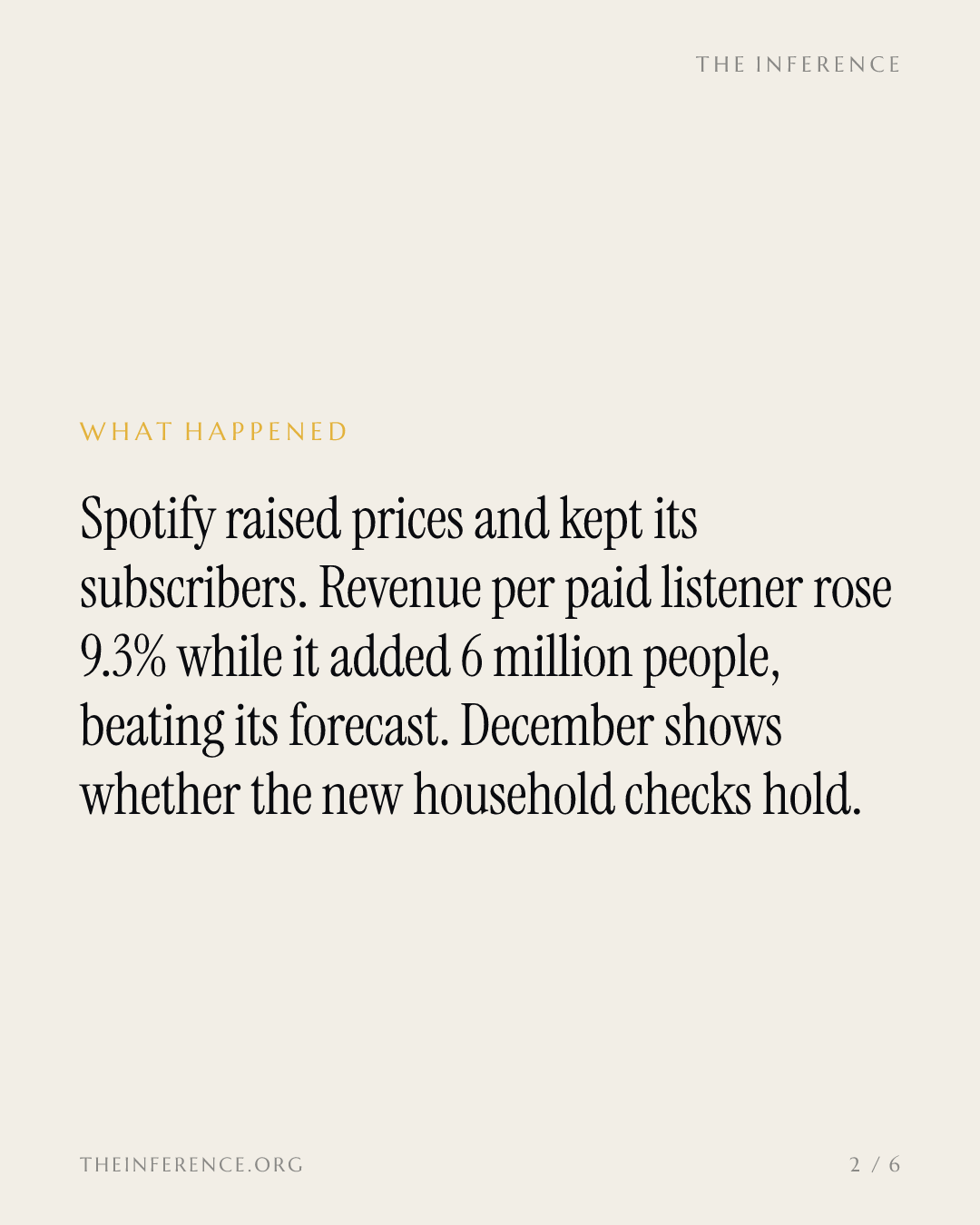
Spotify−2.80% — Spotify, down 2.80 percent today settled one argument with this morning's third-quarter letter: the audio streaming company can raise prices and keep its subscribers. Premium ARPU, the average revenue it collects per subscriber each month, reached €4.95, up 9.3% year over year, which the letter attributes to price increases 1. The Premium base still added 6 million people to 306 million, a million above Spotify's own guidance 1. The price-hike camp said subscriptions could absorb increases without churn; the September quarter is the cleanest evidence yet that they did.
The growth is in the price ladder, not the user count
Premium revenue grew 17% on a subscriber base that grew 9%, and the distance between those two numbers is the price ladder 1. That ladder carried total revenue to €4.97 billion, up 16% 1. Gross margin finished at 33.0%, a third-quarter record that beat guidance, and operating income of €672 million came in above forecast 1.
Free cash flow has compounded to €3.2 billion over the past year on a workforce of 7,284 1. Co-CEO Alex Norström's summary was flat: "This was a quarter where we did what we said" 2. The people funding that compounding are subscribers; the margin collecting it belongs to Spotify.
Quarterly revenue is up 54% since late 2023, and free cash flow now runs near $1 billion
- Revenue
- Free cash flow
Data
| Revenue | Free cash flow | |
|---|---|---|
| Q3 '23 | $3.55B | $0.22B |
| Q4 '23 | $4.07B | $0.44B |
| Q1 '24 | $3.92B | $0.22B |
| Q2 '24 | $4.09B | $0.53B |
| Q3 '24 | $4.43B | $0.79B |
| Q4 '24 | $4.41B | $0.91B |
| Q1 '25 | $4.54B | $0.58B |
| Q2 '25 | $4.93B | $0.82B |
| Q3 '25 | $5.01B | $0.95B |
| Q4 '25 | $5.32B | $0.98B |
| Q1 '26 | $5.25B | $0.96B |
| Q2 '26 | $5.45B | $0.91B |
Three years of tightening lifted Spotify's gross margin from 26% to 33%
Data
| Gross margin | |
|---|---|
| Q3 '23 | 26.4% |
| Q4 '23 | 26.7% |
| Q1 '24 | 27.6% |
| Q2 '24 | 29.2% |
| Q3 '24 | 31.1% |
| Q4 '24 | 32.2% |
| Q1 '25 | 31.6% |
| Q2 '25 | 31.5% |
| Q3 '25 | 31.6% |
| Q4 '25 | 33.1% |
| Q1 '26 | 33% |
| Q2 '26 | 33.4% |
| Q3 '26 | 33% |
The December quarter is the first honest test of enforcement
None of these numbers yet carry the two crackdowns. The household check, a QR code that refreshes every few seconds and gives Premium Family members seven days to scan it, was reported rolling out this month; failing it locks a member out of Family and Duo plans for a year 3. The AI purge, more than 50 million machine-made tracks pulled from recommendations this year, was announced on October 20 5.
Both landed after the quarter closed, so the clean print carries none of their churn risk. As we reported on Monday, the check's economics turn a $3.67 family seat into a $12.99 subscription when a sharer converts 4. Whether sharers convert or simply leave is exactly what December's net additions will show, and no document published today answers it.
Spotify is not rejecting AI; it is curating it
The purge targets filler, not the technology. Spotify found that songs listeners repeatedly skip overlap heavily with machine-made audio, and pulling them protects the recommendation surface that keeps people paying 6.
Meanwhile its own operating expenses rose on marketing and cloud and AI spend, it shipped an integration that lets an AI agent play music and build playlists, and it is building an AI remix tool with Universal Music Group and the distributor Believe 15. Cleaner recommendations hold attention; held attention makes a price rise easier to defend. That middle hop is Spotify's own work, and it is where the margin comes from.
Two blemishes, one real question
The print is not spotless. Net income fell to €518 million from €899 million a year earlier, a comparison distorted by one-off finance income and a tax benefit in 2025, and it ended a four-quarter streak of earnings beats 17. Music-ad pricing softened even as ad revenue grew 10%, and social charges ran €13 million over forecast purely because Spotify's own share price rose 1. The fourth-quarter guide, 10 million more subscribers at a 33.8% gross margin, quietly assumes enforcement costs nothing 1.
The question was never whether Spotify could raise prices. It is whether it can police who pays them, and the December churn number answers it.
Get Applications by email, free
How AI is changing the software people and companies use. In our daily email, every weekday.