TD Cowen, Cerebras' own underwriter, now marks the stock below its IPO price
TD Cowen, a May bookrunner, cut Cerebras 36 percent to $175, ten dollars under the price it helped sell, and the stock closed at a 52-week low. With OpenAI's newest fast tier reportedly running on Nvidia, the November 12 print becomes the first reading on whether the bookings convert.
 Vincent Jiang · 3 min read

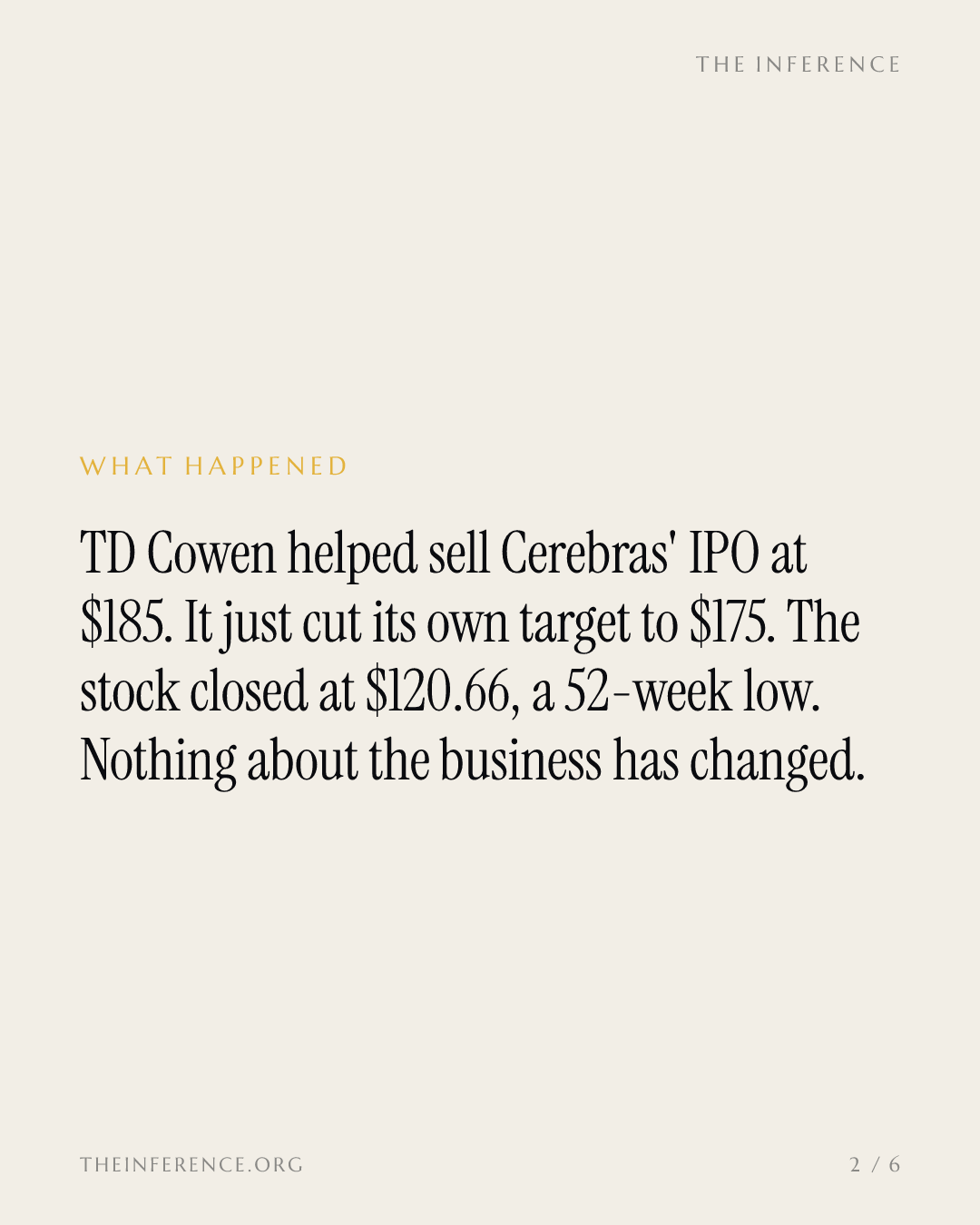
On October 19, TD Cowen, one of the underwriters that sold Cerebras Systems'−0.19% — Cerebras Systems, down 0.19 percent today May IPO at $185 a share, cut its 12-month price target 36.4 percent to $175, ten dollars below the price it helped set 1. The stock closed the same day at $120.66, down 5.15 percent after a 10.52 percent drop on October 16, a 52-week low and 34.8 percent below the offering price 1.
Five months ago this was the hottest listing in US tech: priced at $185 on May 14, opened at $350, raised $5.55 billion, near a $95 billion market cap on day one 2. Nothing about the business turned in the meantime. Q2 revenue rose 103 percent year over year to $209.9 million, and 2025 swung to $87.9 million of net income on $510 million of revenue 2. UBS kept Buy and raised its target to $330 2.
The order book is real, the customer is the question
The bull case rests on $25.4 billion of remaining performance obligations at June 30, a large share of it tied to OpenAI's$1.18T — OpenAI, private, latest valuation $1.18T commitment to buy 750 megawatts of Cerebras inference capacity through 2028 1. That concentration cuts both ways: the agreement is the largest single driver of the backlog, so the stock trades on one customer's intentions as much as on its own results.
The demand question sharpened on September 29, when the research firm SemiAnalysis reported that OpenAI's newest fast tier, GPT-6.1 Sol Ultrafast, runs on Nvidia+2.34% — Nvidia, up 2.34 percent today GPUs rather than Cerebras' wafer-scale chip 1. Cerebras had confirmed its processors powered the earlier GPT-5.6 tier; neither company has named the supplier of the 6.1 tier, and Sam Altman called Cerebras a "close partner" on October 2 without settling it 1.
Pressure comes from OpenAI's plans and Groq's redesign
The question of whether OpenAI is now building silicon of its own has its own thread in The Inference's October 20 coverage, and it hangs over every line of this order book 5. A parallel pressure is visible at Groq$3.5B — Groq, private, latest valuation $3.5B, which now plans 3D-stacked DRAM for its next inference chip, a concession that capacity, not just speed, decides who serves the largest models 5.
November 12 is the reading that matters
One of Cerebras' own underwriters now marks the stock below its $185 offer price
Data
| Value | |
|---|---|
| Oct 19 close | 120.66 |
| TD Cowen target | 175 |
| IPO price | 185 |
| UBS target | 330 |
Supply has not cleared either. The October 1 lockup freed about 13 percent of IPO shares, Form 144 filings cover roughly $84 million of planned insider sales, and CEO Andrew Feldman sold $5.92 million, trimming his stake about 28.5 percent 2.
The date to circle is November 12, when Cerebras reports its first full quarter as a listed company 3. A backlog concentrated in one customer, marked below its own offering price by one of its own bookrunners, is a stock priced for that customer walking. The November print shows whether the customer stays.

More about NVIDIA
NVDA · Fiscal Q2 2027Revenue rose 106% to $96.2B, 92.5% of it from Data Center, “driven by the ramp of our Blackwell Ultra infrastructure”. Gains on equity stakes of $7.8B lifted net income to $59.7B.
Show as a table
| Line | Value |
|---|---|
| Revenue | $96.2B |
| Gross margin | 75.0% |
| Operating margin | 66.2% |
| Net income | $59.7B |
| Hyperscale | $48.7B |
| AI clouds & enterprise | $40.3B |
| Data Center | $89.0B |
| Edge Computing | $7.2B |
| Gross profit | $72.1B |
| Cost of revenue | $24.1B |
| Other income | $7.8B |
| Operating income | $63.7B |
| Operating expenses | $8.4B |
| Tax | $11.8B |
| R&D | $7.1B |
| SG&A | $1.4B |
The daily newsletter