Tesla Must Build 1,000 Robots a Week, and the Hands Keep Failing
Tesla lifted 2026 capex past $25 billion while keeping 1.4 cents of every sales dollar last quarter. The robot meant to justify that spend is ramping tenfold, but its hands are still assembled by hand, and rivals just raised billions on the same thesis.
 Vincent Jiang · 3 min read
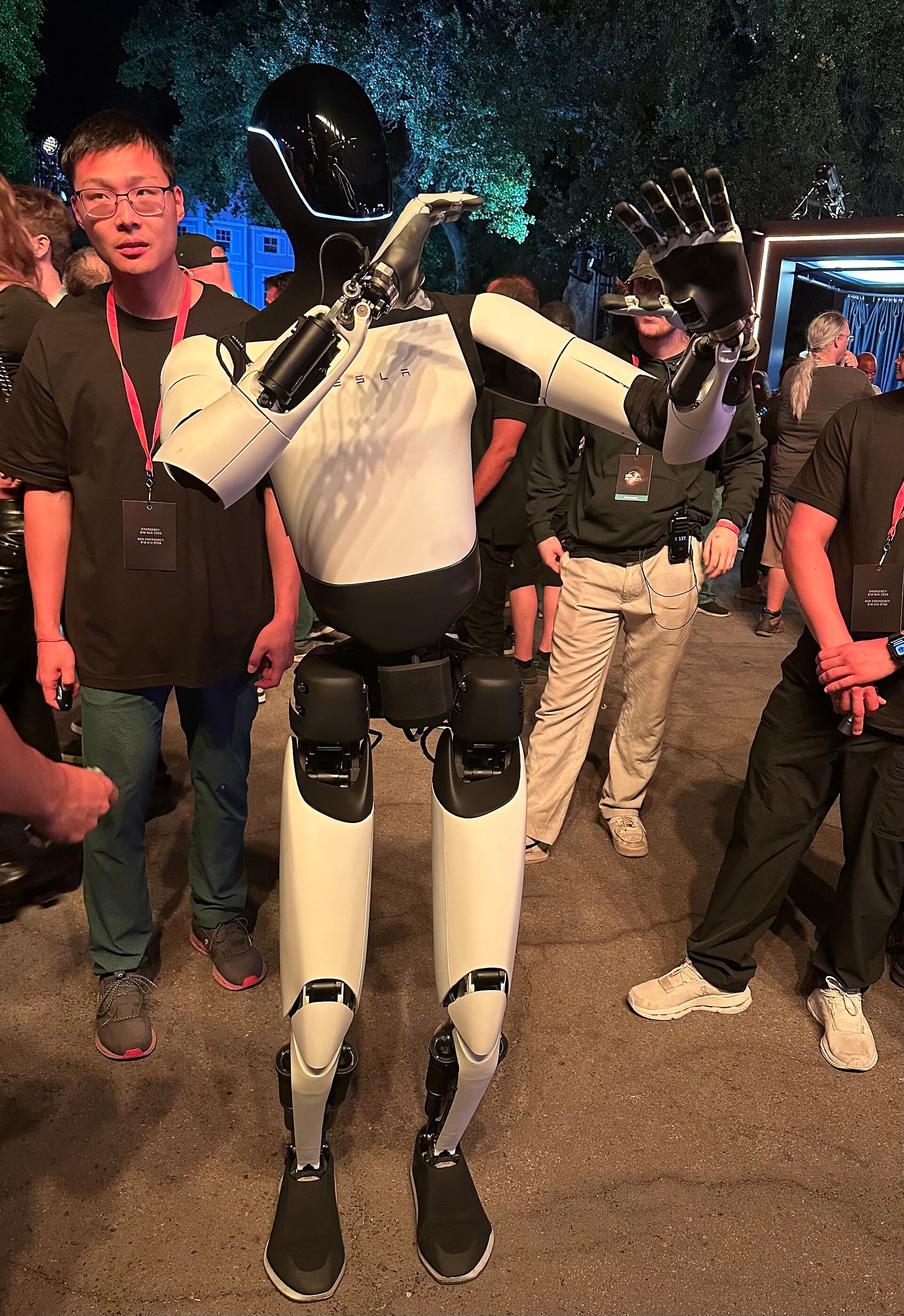
The number that decides Tesla's year is a weekly count at Fremont: Optimus humanoids built per week. Managers want more than 1,000 a week by 31 December, on a line that until May built the Model S 123. Output reached several hundred a week in August, up from a few dozen in the spring 23.
The car business kept 1.4 cents of every dollar
Second-quarter revenue set a record at $28.2 billion, up 26%, yet operating income fell 57% to $398 million: a 1.4% margin against 4.1% a year earlier 45. Capex guidance went above $25 billion in April, roughly triple the $8.5 billion spent in 2025, and second-quarter free cash flow ran at minus $1.09 billion 46. CFO Vaibhav Taneja already books "preproduction ramp costs" for the Semi, Optimus, Cybercab and other AI initiatives inside operating expenses, and expects negative free cash flow through year-end 67.
Capex more than doubled to $5.8 billion in Q2 2026, the largest quarter in three years of filings
Data
| Capex | |
|---|---|
| Q3 '23 | $2.46B |
| Q4 '23 | $2.31B |
| Q1 '24 | $2.78B |
| Q2 '24 | $2.27B |
| Q3 '24 | $3.51B |
| Q4 '24 | $2.78B |
| Q1 '25 | $1.49B |
| Q2 '25 | $2.39B |
| Q3 '25 | $2.25B |
| Q4 '25 | $2.39B |
| Q1 '26 | $2.49B |
| Q2 '26 | $5.79B |
Tesla kept 1.4 cents of every sales dollar in Q2 2026, its weakest margin in three years of filings
Data
| Operating margin | |
|---|---|
| Q3 '23 | 7.6% |
| Q4 '23 | 8.2% |
| Q1 '24 | 5.5% |
| Q2 '24 | 6.3% |
| Q3 '24 | 10.8% |
| Q4 '24 | 6.2% |
| Q1 '25 | 2.1% |
| Q2 '25 | 4.1% |
| Q3 '25 | 5.8% |
| Q4 '25 | 5.7% |
| Q1 '26 | 4.2% |
| Q2 '26 | 1.4% |
A 155-times multiple rests on the robot
Tesla trades at roughly 155 times forward earnings against about 15 for Nvidia on one tally, near 195 on another 14. Morningstar's Seth Goldstein states the condition plainly: the capex case depends on Optimus becoming Tesla's most value-creating platform, and skeptical investors may find the spending difficult to support 4.
The hands are the hard part
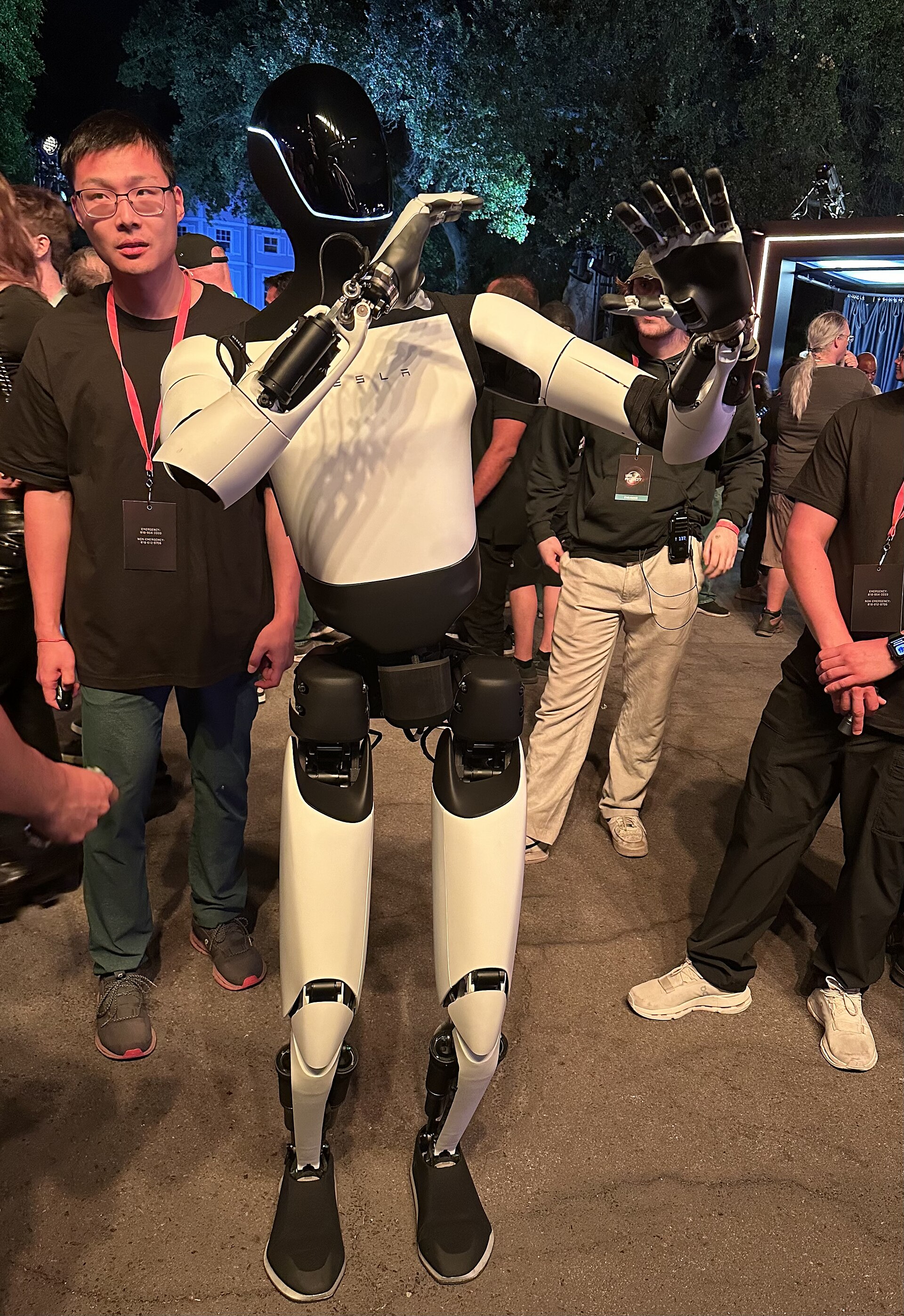
Each hand and forearm holds more than 100 screws and small parts, still fitted by workers; touch sensors fail often enough that a replaceable "sensing glove" is planned for next year; and suppliers, many in China, struggle to hold quality at volume 23. Most robots built so far stay inside Tesla for testing and data collection, and the software needs days to learn a basic task 2. Tesla's next platform is being screwed together by hand. No public figure establishes the weekly rate beyond "several hundred," and no robot revenue is broken out 4.
Musk's own forecast is the flat part
"Optimus will follow the sort of normal S-curve of a manufacturing ramp, but the initial portion of the S-curve will be quite flat and long," Musk said on the Q2 call 1. He calls the spending "well justified for a substantially increased future revenue stream," with useful work outside Tesla "probably" a 2027 event 6. Output did rise about tenfold in a quarter 3.
Rivals raise billions on the same thesis
FieldAI has signed a term sheet for $700 million at a $10 billion valuation, five times its worth a year ago, on more than $135 million of revenue and customer contracts, with Jeff Bezos's family office, Nvidia's NVentures and Intel Capital among its backers 89. Skild AI stands above $14 billion and Physical Intelligence near $11 billion 8. The private market pays for the robot brain without a car business financing it.
Three robotics startups now carry private valuations of $10 billion or more
- Estimate
Data
| Value | |
|---|---|
| Skild AI | $14B |
| Physical Intelligence | $11B |
| FieldAI (estimate) | $10B |
The verdict watch: 21 October
Third-quarter earnings arrive around 21 October 1. The tell is disclosure: a build rate compounding toward 1,000 a week, or the same multiple resting on a program with no separable revenue.
Deepdive
AI-generated from this story and its cited sources. Not investment advice.