Snowflake's agents dodge the spending caps that made them safe to buy
Snowflake sold agent spending caps as the feature that makes runaway AI bills safe to run; its consumption billing means a cap that binds gives back revenue and a cap that does not leaves the churn with Snowflake. Three weeks before the December 2 print, with the stock 20% off its high, which design the company actually ships prices the stock.
 Richard Tangtwo-minute read

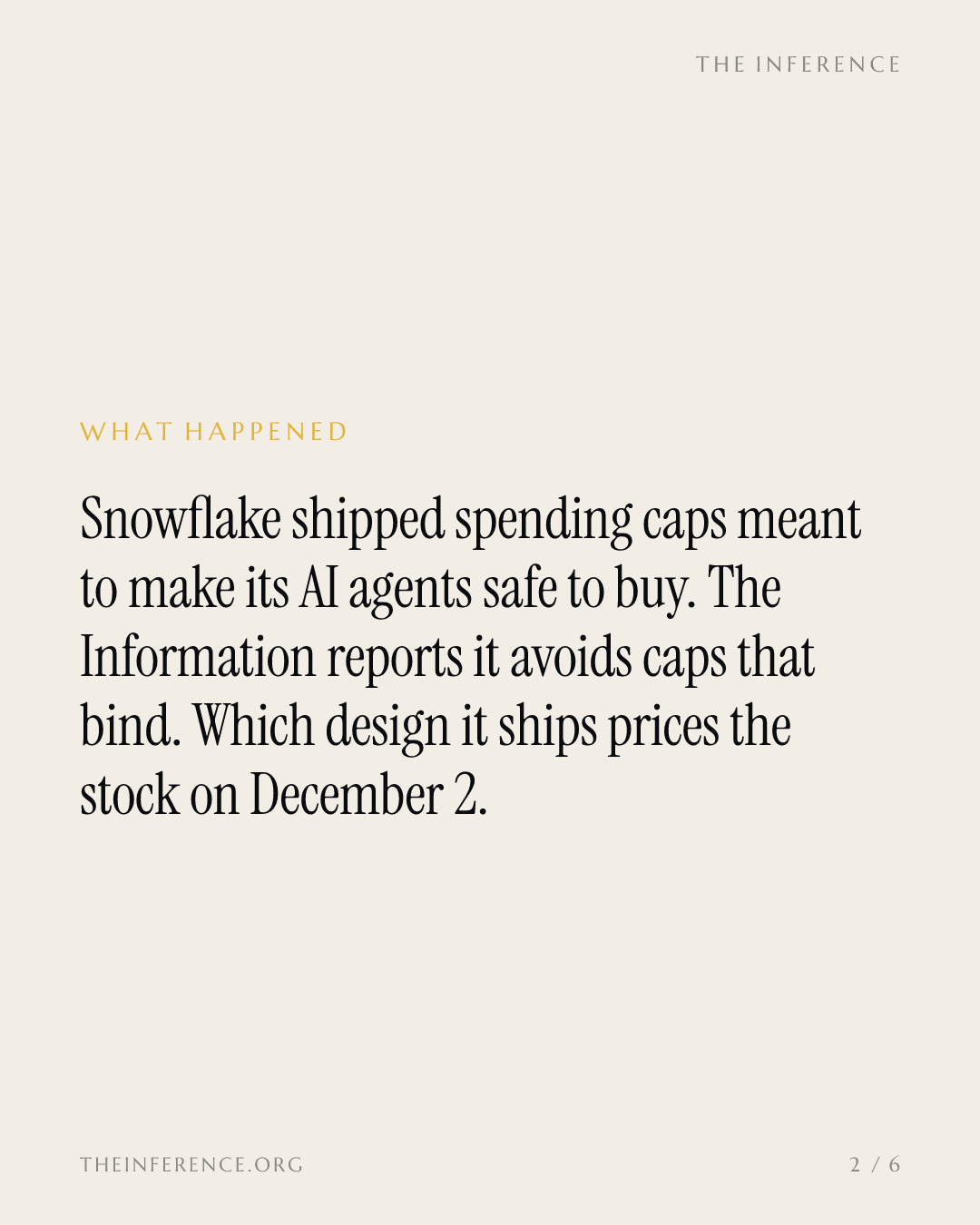
The Information reports that Snowflake+2.03% — Snowflake, up 2.03 percent today, HubSpot+1.05% — HubSpot, up 1.05 percent today and other software vendors are avoiding AI spending caps that bind 2. That cuts at the feature Snowflake shipped on November 10 to make its CoCo and CoWork agents safe to buy 1. Snowflake bills by consumption, so the two cap designs pay out in opposite ways: a hard cap is revenue the company gives back, and a soft one leaves the runaway bill with the customer and the churn with Snowflake. The December 2 report is where the market prices which design Snowflake actually ships 1.
The caps sit on the wrong side of Snowflake's incentive
The mechanism runs in three steps. Every query from Snowflake's agents runs on Snowflake compute, so agent adoption arrives as paid usage 1. Customers know that, which is why caps work as a trust feature. But if the caps are advisory, agent usage grows without limit on Snowflake compute, which is exactly the growth management wants; the customer holds the runaway bill, and Snowflake holds the renewal risk. Management credits AI products with about half of its growth acceleration, so the constraint the cap design puts on that growth is the load-bearing question in the print.
The margin math leaves no room for a stumble
Agent queries that run unbound also cost more to serve. Gross margin slipped to 67.0% from 67.5% a year earlier, stock compensation ran $456 million or 29.5% of revenue, and the GAAP operating loss was $263 million against $1.49 billion of product revenue, up 37% 1. With that much of the cost line paid in stock, agent growth has to arrive as cash, not just usage, for the premium over the broader software group to hold 1.
Agent-serving costs have taken Snowflake's gross margin back to two years ago
Data
| Gross margin, % of revenue | |
|---|---|
| Q3 '24 | 65.9 |
| Q4 '24 | 66.2 |
| Q1 '25 | 66.5 |
| Q2 '25 | 67.5 |
| Q3 '25 | 67.8 |
| Q4 '25 | 66.8 |
| Q1 '26 | 66.6 |
| Q2 '26 | 67 |
The one filing in the window is neutral
The only filing in the window says nothing about any of this: Snowflake director Michael Speiser sold about 50,700 shares for roughly $14.2 million on November 6, under a 10b5-1 trading plan adopted in December 2024 34. A scheduled sale is not a signal, and this one matters only because it is all there is between the cap reports and the print.
What the December 2 print must show
The stock sits more than 20% below its September 3 high 1, so the bar is already set. The print needs three things: cap language in the agent contracts, churn that says customers were not burned by an unbounded bill, and a gross margin that holds near 67% as agent usage scales 1. One clause decides which branch of the story is true.
Get Platforms by email, free
The cloud, data and developer software AI is built on. In our daily email, every weekday.