Trump told Jensen Huang AI safety is a "hoax" while his family sells the Chinese AI he says it helps
The president put Nvidia's CEO on speakerphone to declare a "SICK conspiracy" against AI. Back at the family firm, a Hong Kong platform reselling blacklisted Chinese models is paid for in the Trumps' own stablecoin.
 Vincent Jiang · 6 min read
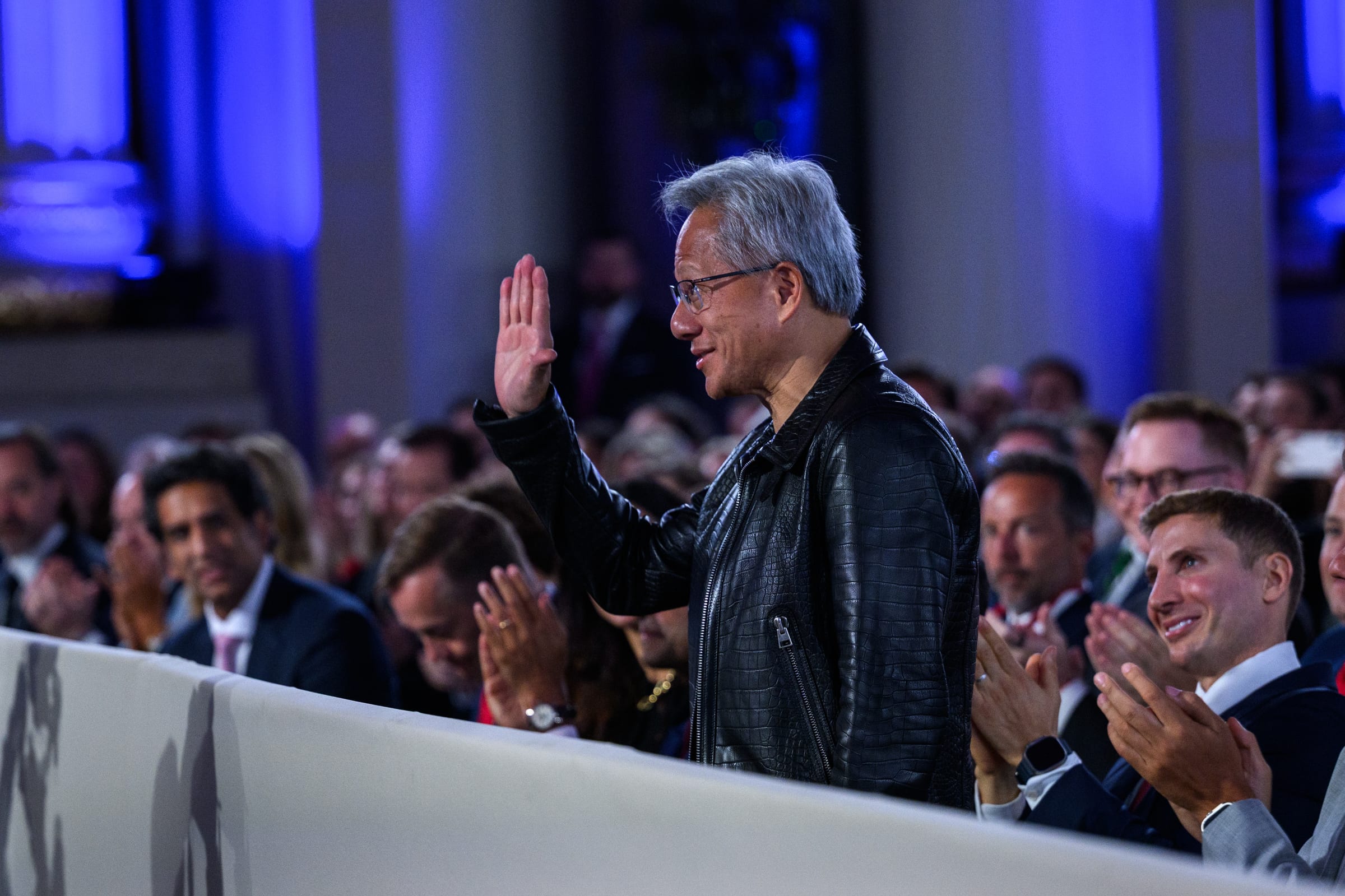
Jensen Huang was mid-panel at the All-In Summit in Los Angeles on Monday morning when his phone rang and he could not send it to voicemail. It was the president. Instead of stepping offstage, the Nvidia−3.89% — Nvidia, down 3.89 percent today CEO scrambled for a second microphone and put Donald Trump on speaker in front of the conference. "I'm onstage with the besties," Huang said. What followed was the clearest statement yet of where the most valuable company in the world now sits: on the side of full speed, and on the side of the man funding nothing but its own balance sheet. 12
"We're not going to let that happen, sir," Huang replied when Trump called the AI-safety panic a hoax, as the crowd broke into applause. 1
The call answered Amodei's weekend essay
The call was a direct answer to an essay published over the weekend. Anthropic$350B — Anthropic, private, latest valuation $350B CEO Dario Amodei, who helped build the models Huang's chips train, argued that AI capabilities are now improving fast enough that safety work cannot keep up, driven by what he calls recursive self-improvement. "We must slow the pace at which we improve the capabilities of AI models," Amodei wrote, warning that a misaligned swarm could be "6-12 months" from serious damage. He committed Anthropic to embedded third-party evaluators with employee-level access, and called for coordination among democracies and, eventually, with China. 3
The response was fast and it was not from the fringes. OpenAI's$500B — OpenAI, private, latest valuation $500B Sam Altman agreed and committed to the same embedded evaluators, delaying the company's IPO, saying it would be an "ill-advised moment" to go public. SpaceX's−5.26% — SpaceX, down 5.26 percent today Elon Musk posted "Dario is right." Demis Hassabis endorsed the direction. Microsoft's−1.38% — Microsoft, down 1.38 percent today Satya Nadella offered a cautious welcome. For about 36 hours, the people who build the frontier agreed it should slow. 4
Then Trump called Huang. "The robots will not be taking over," he said. "The whole thing is a hoax." On Truth Social he went further, writing that leading AI companies are already "REINED in" and that there is a "SICK conspiracy going on against AI and Data Centers, and the only one that is happy about it is China." His former AI czar David Sacks told the CEOs to "go ahead and pace the frontier themselves" and that the motivation to slow down is "not purely altruistic"; House Speaker Mike Johnson said industry, not Congress, should lead on safety. 25
On the other side of the hoax is a balance sheet
Here is where the story stops being about a philosophy of technology and starts being about a balance sheet. The president calling AI safety a hoax is not a man with no skin in the game. His family is the single largest beneficiary of the AI-and-crypto boom he is now defending from regulation. 678
A Reuters investigation found the Trump family added at least $2.3 billion from four crypto ventures since the 2024 election, while roughly one million investors in those same projects lost about $2.3 billion through the end of April. The largest source was World Liberty Financial, which directs 75% of governance-token proceeds to a Trump-controlled entity and brought the family more than $1.4 billion, while the token fell 87% from its September 2025 peak. The TRUMP meme coin produced about $616 million for the family as the coin dropped 97% from its January 2025 high. More than a dozen accountants and crypto experts reviewed the figures and called them reasonable; eight government ethics experts told Reuters the arrangement is a conflict of interest unlike any in modern presidential history. 89
Data
| Value | |
|---|---|
| World Liberty Financial | $1.4B |
| TRUMP meme coin | $616M |
The political power is real, but so is the direction of the money, and they point the same way. Full-speed AI needs chips, data centers, and stablecoins that move money across borders without friction. The family owns a piece of all three rails.
WorldClaw sells the models Washington wants blocked
The most awkward piece is WorldClaw. A Reuters report in August found that World Liberty Financial, in which the Trump family holds a reported 38% stake, is behind a Hong Kong platform reselling roughly 90 AI models, about 43 of them from Chinese companies. The menu reportedly includes Alibaba−1.57% — Alibaba, down 1.57 percent today and Baidu−2.78% — Baidu, down 2.78 percent today, both Pentagon-designated as aligned with China's military, plus Z.ai and DeepSeek. American officials have accused those labs of building on stolen US technology. Customers pay in USD1, World Liberty's own dollar-pegged stablecoin, meaning each sale can benefit the family. 6
The tension is not abstract, and it is not my spin; it is arithmetic. The harder the administration pushes to restrict a given Chinese lab, the more valuable a frictionless way to buy its models quietly becomes. The government's own top priority, throttling China's AI, increases the value of the resale channel the family firm is positioned behind. Rules written in Washington, money made everywhere else, settled in a token tied to the president's name. 6
The strongest answer, stated fairly
The counterpoint deserves to be made plainly, because it is the serious one. The White House says Trump holds no conflicts and acts only in the public interest. World Liberty and WorldClaw say they operate independently, and that listing a Chinese model is no more an endorsement than an app store vouching for every app it carries. Trump himself has said he did not know about some of the family ventures' earnings. And none of this is alleged to be unlawful: eight ethics experts conceded to Reuters that the conduct could remain legal if no regulatory decision was exchanged for money. 678
That answer is also why the question will not go away. If the family's crypto-and-AI interest were genuinely walled off from the office, the president would not need to weigh in on the pace of the frontier at all; the market and the labs could settle it. Instead, the most consequential policy verdict of the cycle is being handed down by the one person whose household is long the rails underneath it, by speakerphone, in front of a room of investors. The blunt version is more true: a president with a multibillion-dollar family stake in AI-adjacent infrastructure has declared the people warning about that infrastructure a "hoax." The hoax label does not require the money to be the motive. It only requires reading two documents side by side. 18
Three dates matter next
Three dates matter next. The CLARITY Act, the crypto regulation the administration is shepherding, faces a Senate floor vote and its ethics language is the live fault line. World Liberty's preliminary national bank charter, tied to the same USD1 token that pays for WorldClaw, moves toward final approval. And the House is out of session until after the November midterms, where data centers have become a Democratic cudgel and a GOP liability, with opposition climbing past seven in ten Americans and a 12-point shift against the buildout since February. 5710
Trump is right about one thing, and it is the part nobody wants to say out loud. Whoever wins AI, wins. The open question, as his family firm resells the Chinese models he says help the enemy, is which side of his own ledger is doing the winning. 16
Get Policy & Labor by email, free
The rules governments write for AI, and what AI does to jobs. In our daily email, every weekday.

More about NVIDIA
NVDA · Fiscal Q2 2027Revenue rose 106% to $96.2B, 92.5% of it from Data Center, “driven by the ramp of our Blackwell Ultra infrastructure”. Gains on equity stakes of $7.8B lifted net income to $59.7B.
Show as a table
| Line | Value |
|---|---|
| Revenue | $96.2B |
| Gross margin | 75.0% |
| Operating margin | 66.2% |
| Net income | $59.7B |
| Hyperscale | $48.7B |
| AI clouds & enterprise | $40.3B |
| Data Center | $89.0B |
| Edge Computing | $7.2B |
| Gross profit | $72.1B |
| Cost of revenue | $24.1B |
| Other income | $7.8B |
| Operating income | $63.7B |
| Operating expenses | $8.4B |
| Tax | $11.8B |
| R&D | $7.1B |
| SG&A | $1.4B |