Zuckerberg's $200 billion AI admission appears in no Meta filing
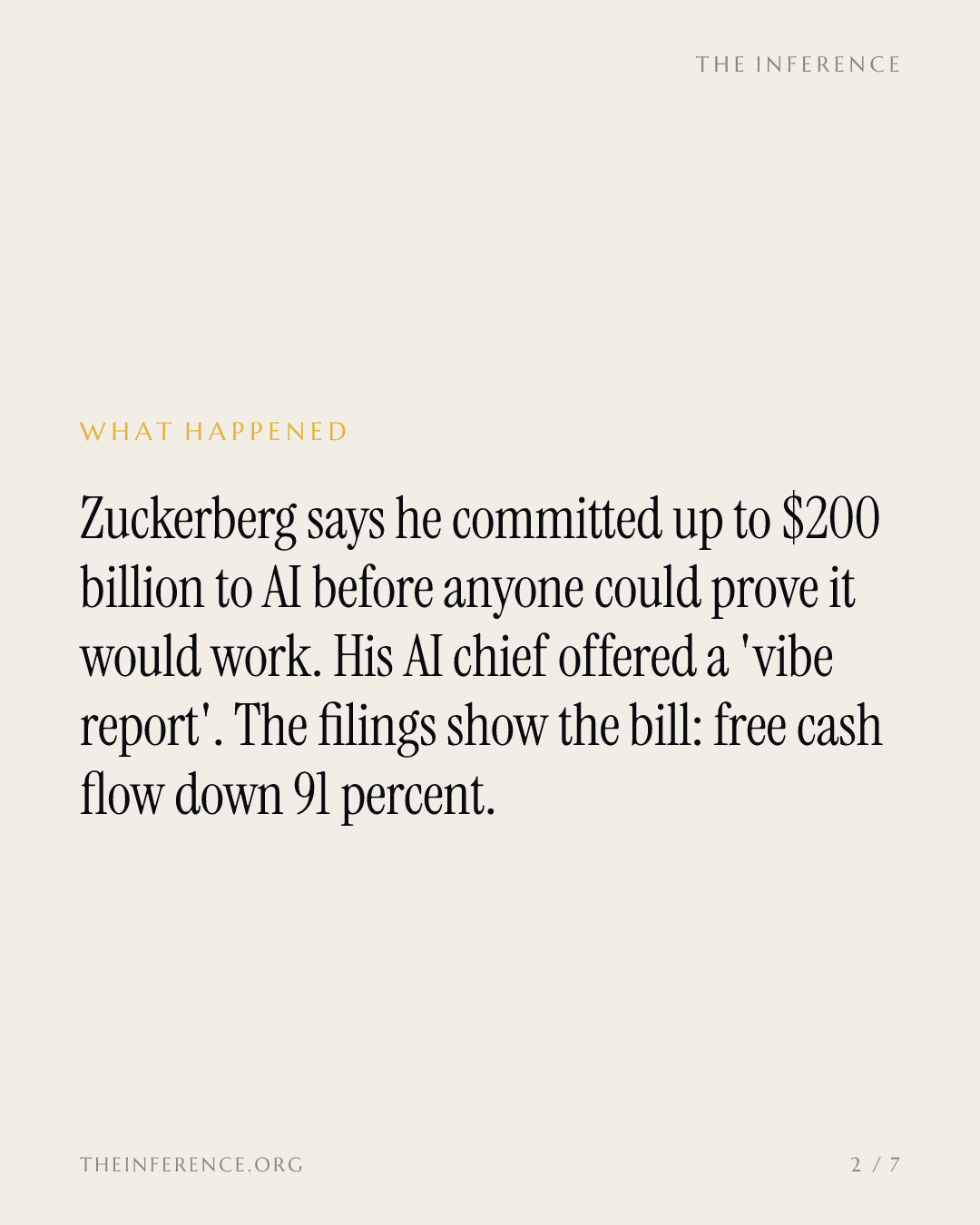
Meta's chief executive said on a podcast posted October 12 that he committed up to $200 billion to AI infrastructure before anyone could tell him it would work. The filings show only the bill: $784 million of second-quarter free cash flow.
 Vincent Jiang · 3 min read
The check was written on a vibe report
The day Meta−2.24% — Meta, down 2.24 percent today launched Muse Wonder, its first frontier-class AI model, Mark Zuckerberg explained how the money left before the models existed. "We're going to write this check for like, I don't know, $100 billion or $200 billion. You sure this is going to work?" he recalled asking Alexandr Wang, Meta's chief AI officer, on the Cheeky Pint podcast hosted by Stripe co-founder John Collison. Wang's own account: "not clear at all that it was going to work," with a "vibe report" the best he could offer. 12
Chief financial officer Susan Li warned repeatedly what failure would cost. "If it's bad, it's really, really, really bad," Wang recalled her telling him. Zuckerberg's verdict on the exchange: "I think Susan scared you a little bit." 12
Revenue grew 28 percent and the cash still left
Meta's second quarter tells the story in two lines. Revenue rose 28 percent to $60.80 billion, and profit still fell 14 percent 34. Free cash flow, as Meta reports it, after spending on equipment and finance leases, fell 91 percent to $784 million, from $8.55 billion a year earlier 34.
Capital spending passed $30 billion in the quarter, against $6.36 billion of depreciation and amortization, the part that actually reaches earnings 4. Full-year capex guidance now runs $130–145 billion, against $72 billion spent last year 34.
Meta's quarterly capital spending is up 82 percent year over year
Data
| Capital spending | |
|---|---|
| Q3 '23 | $6.5B |
| Q4 '23 | $7.59B |
| Q1 '24 | $6.4B |
| Q2 '24 | $8.17B |
| Q3 '24 | $8.26B |
| Q4 '24 | $14.43B |
| Q1 '25 | $12.94B |
| Q2 '25 | $16.54B |
| Q3 '25 | $18.83B |
| Q4 '25 | $21.38B |
| Q1 '26 | $19B |
| Q2 '26 | $30.12B |
The commitment nobody can audit
Alphabet+0.53% — Alphabet, up 0.53 percent today files its number: $811 billion of signed purchase commitments as of June 30, up from $332.4 billion in March, in the 10-Q, the quarterly SEC filing any investor can read 6. Meta files no comparable total 3. The $200 billion exists in a podcast quote, an outside estimate and a warning from the International Monetary Fund, and in none of Meta's filings 3.
Nikkei, the Japanese business daily, estimates Meta's off-balance-sheet debt at about $420 billion, nearly triple what Meta reports outright, including $27 billion borrowed against the Hyperion data center in Louisiana, a structure Meta co-owns with Blue Owl Capital, a private-credit investor, and occupies as sole tenant 35. The IMF's October 13 stability report calls these deals "wrong-way risk": the investments lose value precisely when the revenue behind them does 38.
Alphabet files its AI commitments, Meta's live in an estimate and a podcast
- Estimate
Data
| Value | Range | |
|---|---|---|
| Alphabet, quarterly SEC filing | $811B | — |
| Meta, Nikkei estimate (estimate) | $420B | $420–420B |
| Meta, podcast figure (estimate) | $200B | $100–200B |
Curiosity is not yet a habit
Zuckerberg's defense is that the bet fails only if AI itself fails, which ties Meta's stock to the whole industry rather than to his own execution 7. The early evidence is real: Muse Wonder went live at $4 per million input tokens and $20 per million output, with parity claims drawn from Meta's own testing 79.
The Muse agent app, separate from the model and debuted on September 8, reached 5 million downloads in 22 days 2. Sensor Tower, an app-analytics firm, puts its day-14 retention at 22.5 percent against ChatGPT's 26.8, after Muse led day one 73.3 to 41.3: Meta is winning curiosity faster than habit 7.
Muse led ChatGPT on day one; two weeks in, it trails on retention
- Muse agent app
- ChatGPT
Data
| Muse agent app | ChatGPT | |
|---|---|---|
| Day 1 | 73.3% | 41.3% |
| Day 14 | 22.5% | 26.8% |
The next verdict is the October 21 print
Shares are up more than 12 percent this year 1. Meta reports third-quarter results on October 21, and the last report took 8 percent off the stock 13. Two lines on that print will matter more than the podcast: free cash flow, and whether Meta starts publishing the commitments number Alphabet's investors already have.
Deepdive
AI-generated from this story and its cited sources. Not investment advice.