Accenture's plan leans on $8 billion of deals, and the acceleration it promises waits until 2029
At its first investor day since 2022, Accenture promised mid-to-high single-digit growth by fiscal 2029 on the argument that AI creates more work than it destroys. The nearer arithmetic shows 2 to 2.5 points of this year's growth bought with acquisitions, a margin gain of just 10 to 30 basis points, and the acceleration dated to the one year investors cannot test soon.
 Vincent Jiang · 3 min read
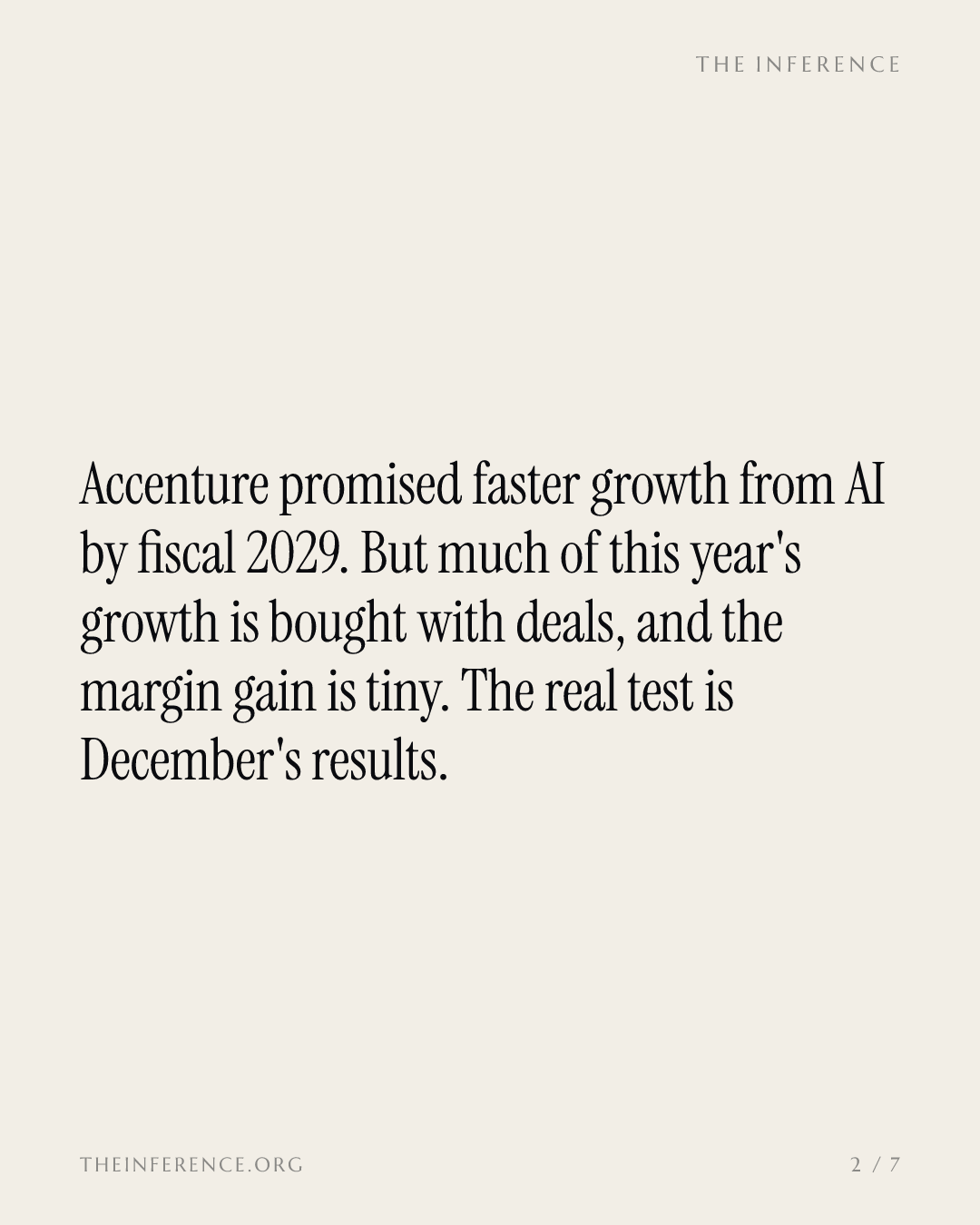
Julie Sweet, chief executive of Accenture+4.63% — Accenture, up 4.63 percent today, stood before investors on Wednesday October 14, 2026, at the company's first investor day since 2022 and promised that AI will create more demand than it destroys: new demand, she said, "will far exceed the demand that's being replaced" 2. The market wanted to believe her, and shares rose about 4% before the open, then gave back roughly half the gain once trading started 5.
The plan's own math is more modest than the promise
The three-year targets: at least mid-single-digit constant-currency revenue growth in fiscal 2027 and 2028, stepping up to mid-to-high single digits in fiscal 2029, with operating margin adding 10 to 30 basis points a year 1. But of this year's 3-6% local-currency growth guidance, 2 to 2.5 points are expected from acquisitions 1. Accenture is budgeting about $8 billion for deals in fiscal 2027, its most acquisitive year ever, after $4.9 billion across 17 purchases last year 1. Strip the bought growth and the organic rate sits at the low end of a company that has not grown more than 7% in dollar terms in any of the past four years; fiscal 2026 ended at $74.2 billion, up 6% 1.
Accenture has not topped 7% dollar growth in four years
Data
| Revenue growth, dollars | |
|---|---|
| FY2023 | 4.1% |
| FY2024 | 1.2% |
| FY2025 | 7.3% |
| FY2026 | 6.5% |
The margin math says AI savings go to clients
Chief financial officer Angie Park framed the internal logic: "productivity creates capacity, capacity funds growth" 1. The plan is to reinvest AI efficiencies into lower prices and more work, not to widen the take: from fiscal 2026's 15.4% operating margin, the target is only 10 to 30 basis points a year 1. HFS Research chief executive Phil Fersht put the missing piece plainly: growing the core, which is 94% of revenue and grows in the mid-single digits, will only move the needle if Accenture "changes the economics of how it delivers the work" 1.
The new mechanism is the mid-market, hired last week
The one genuinely new lever is Accenture Edge, a unit for clients with $300 million to $3 billion of revenue, taking Microsoft+0.55% — Microsoft, up 0.55 percent today software to mid-sized buyers from fiscal 2027 1. Its chief executive, Dharmendra Sinha, was hired from Rackspace+2.66% — Rackspace, up 2.66 percent today on October 9 after three decades spanning Cognizant+5.28% — Cognizant, up 5.28 percent today and Rackspace 3. Meanwhile capital returns, at least $9.5 billion in fiscal 2027 including $5.5 billion of buybacks, are promised to exceed issuance through the plan 24. Consensus had already penciled 4.4%, 4.9% and 5.9% growth across the three years, landing at the low end of the new range; the stock, down almost 13% over the past year and trading near 14.6 times forward earnings against a five-year average of 23.9x, is priced for decline, not acceleration 25. Sixteen analysts hold the stock rather than buy it 5.
Consensus already sits at the low end of the new range
Data
| Consensus revenue growth | |
|---|---|
| FY2027 | 4.4% |
| FY2028 | 4.9% |
| FY2029 | 5.9% |
The testable year is the one now running
The step-up is dated fiscal 2029, the year investors cannot verify soon; fiscal 2027 is the leg that can be judged, starting with first-quarter results in December 5. Buying the stock today means paying first for two years of partly-bought mid-single-digit growth. If the December print misses the mid-single-digit mark, the 2029 promise prices in nothing.
Deepdive
AI-generated from this story and its cited sources. Not investment advice.