AI and server revenue hit 20% of Alpha & Omega sales, but it still lost money
The company's fiscal first quarter shows AI and server revenue at a fifth of sales, from 5.5% a year ago, even as the PC base collapses and losses persist. December's guide is the falsifiable test of whether a mix shift becomes a profit story.
 Richard Tang · 3 min read
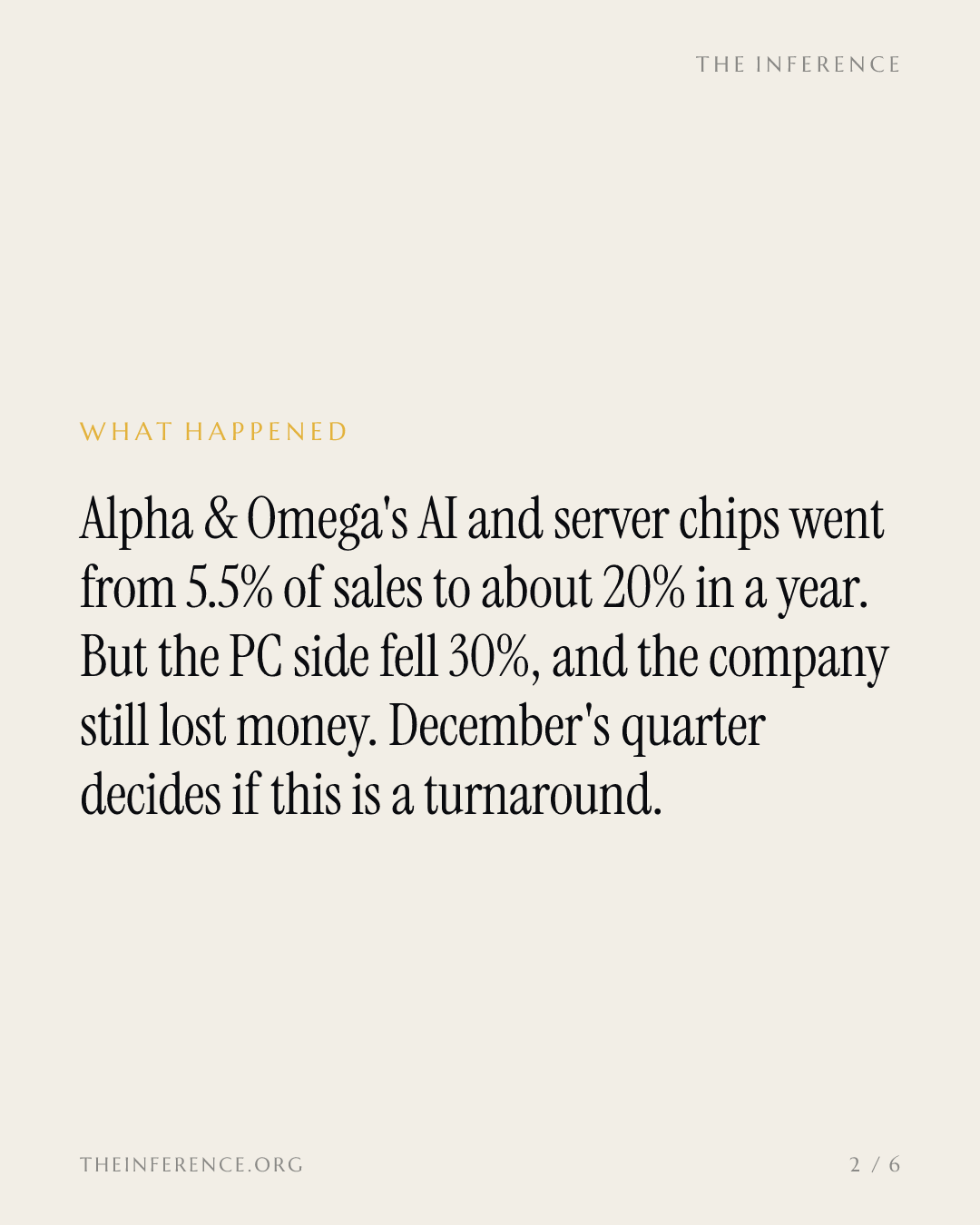
Alpha & Omega Semiconductor (NASDAQ: AOSL)+21.43% — Alpha & Omega Semiconductor (NASDAQ: AOSL), up 21.43 percent today is the clearest small-scale picture of what the AI buildout does to a company built for the PC era. Its fiscal first-quarter release, dated November 5, 2026, and covering the September quarter, shows both halves at once: AI and server revenue grew more than 250% year over year to about 20% of the company, up from 5.5% a year ago 2, while traditional PC revenue fell roughly 30% sequentially 3.
Total revenue still came in at $177.8 million, down 2.6% from a year ago, and the company swung from a small non-GAAP operating profit a year ago to a $1.0 million loss and a $0.07 loss per share 1.
The margin gain is real, but it runs through a shrinking base
The loss persists because a richer product mix has to outrun two things at once: a decaying PC base and rising operating expenses. CEO Stephen Chang attributed the improvement in gross margin, to 25.2%, mainly to a better mix as medium-voltage MOSFETs win sockets in AI power conversion 2. But computing revenue fell to $83.2 million because elevated memory costs and component shortages are crushing traditional PCs 2, and management expects no near-term PC recovery 3. Meanwhile operating expenses keep climbing, to $52.5 million GAAP from $47.4 million a year ago 1.
Flat revenue as gross margin stays near 23%
AI mix is building while the revenue base stays near $170 million
- Revenue
- Gross margin
Data
| Revenue | Gross margin | |
|---|---|---|
| Q2 '24 | 161.3 | 25.7 |
| Q3 '24 | 181.9 | 24.5 |
| Q4 '24 | 173.2 | 23.1 |
| Q1 '25 | 164.6 | 21.4 |
| Q2 '25 | 176.5 | 23.4 |
| Q3 '25 | 182.5 | 23.5 |
| Q4 '25 | 162.3 | 21.5 |
| Q1 '26 | 163.8 | 21.1 |
| Q2 '26 | 170.4 | 23.1 |
December is the falsifiable test
Management guides to about $180 million of revenue plus or minus $10 million, roughly 10% year-over-year growth against a seasonally soft quarter, with non-GAAP gross margin of 25.7% and $46 million of operating expenses 1. That combination edges toward non-GAAP break-even, and the AI line should set another record.
Hit it, and the argument that the mix shift becomes a turnaround has its first quarter of proof; miss it, and AOSL is a shrinking PC-era chip company with a fast-growing niche.
The market has already priced the doubt
AOSL closed November 5 at $18.48, down 12.7% in the day's AI rout before the results even landed, and was indicated lower again after hours, valuing the company near $642 million 54. Sell-side targets still average $40.50, but the fresh calls move the other way 54.
Needham kept its Buy and cut its target from $45 to $30, and Stifel−1.14% — Stifel, down 1.14 percent today cut on lower comps 67. Bulls have a cushion in $152.8 million of net cash, though only $10 million to $12 million remains on the buyback authorization 52.
What a reader does while the test runs
The AI-server business at AOS is real, diversifying across power-supply and module makers, and most of those sockets did not exist in the revenue base a year ago 2. That earns the builders credit; they are the ones turning a raw capability into a business.
The decision rule the evidence supports: avoid or short until the December quarter shows the AI fifth of revenue converting into non-GAAP profit, because until then the mix shift is unproven while the PC base erodes underneath it, and the $152.8 million net cash is the bulls' cushion if the test fails 5.
Get Chips by email, free
How AI demand is reshaping chipmakers, memory and the fabs behind them. In our daily email, every weekday.