Ambiq's officers have sold at every price from $72 down to $49
Form 4s filed October 16 add $1.38 million of October 14-15 sales by Ambiq's COO, CTO and CEO under pre-set 10b5-1 plans, taking the C-suite's ten-day total to about $4.5 million. At $49.88, the stock sits far under the $78 of June's offering, and the $85 and $90 analyst targets now rest on a chip ramp that has not shipped.
 Richard Tang · 2 min read
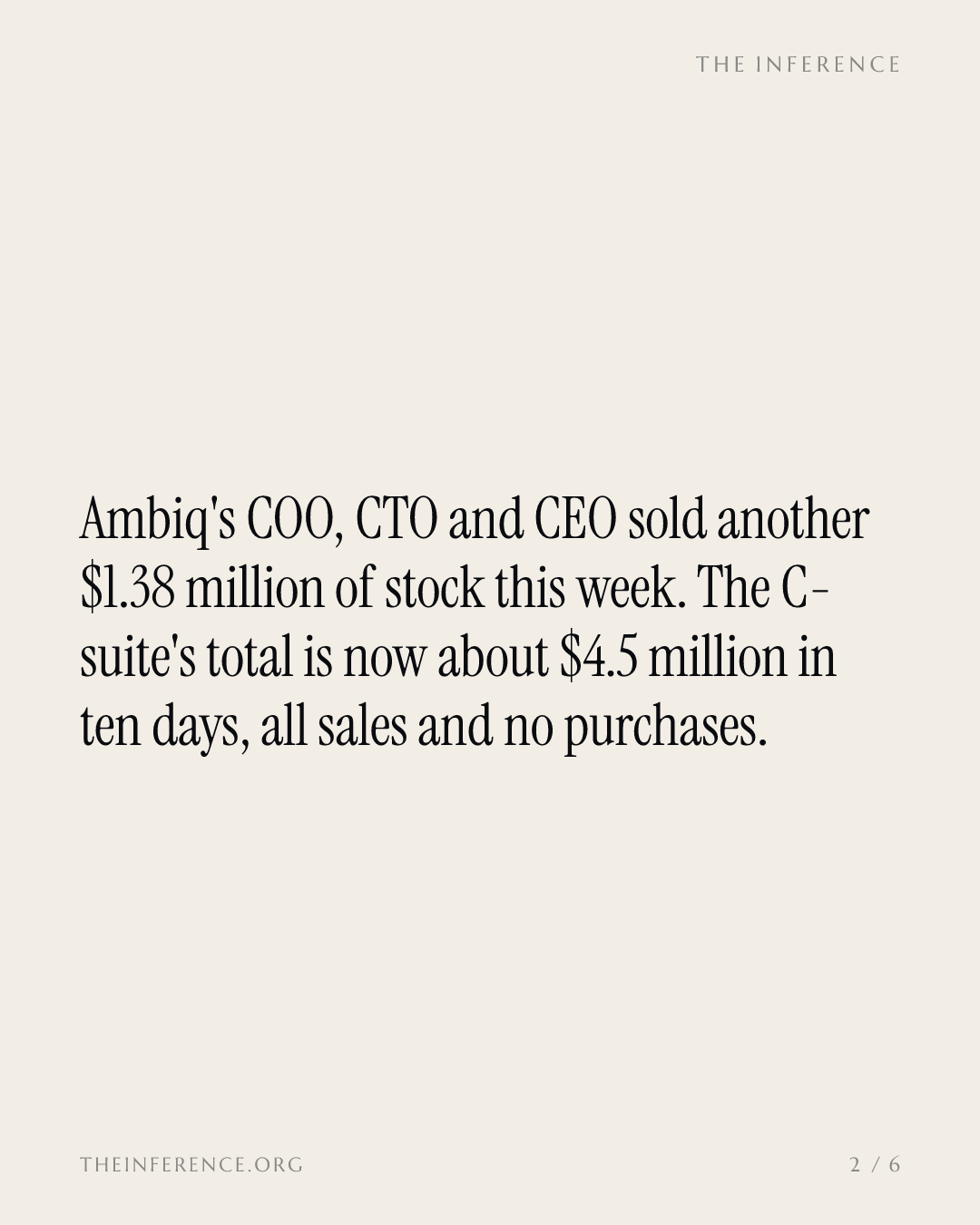
Three more Form 4s landed on October 16, and together they say something plain: Ambiq Micro's−4.22% — Ambiq Micro, down 4.22 percent today officers will sell at any price the market offers them. President and chief operating officer Sean Chen sold $772,000 of stock on October 14, and chief technology officer Scott Hanson and chief executive Fumihide Esaka followed on October 15 with $357,000 and $255,000 123. Added to the $3.1 million its four top officers reported in the week ending October 11, about $4.5 million has left the C-suite in ten days, and none of the filings reports a purchase 5. Ambiq, based in Austin, builds the ultra-low-power processors that run AI on battery-powered devices.
The sales run on plans set months ago
Every sale in the new filings worked the same way: options struck at $8.12 were exercised and the shares sold the same day, under Rule 10b5-1 plans, the pre-set trading schedules adopted on May 15 and June 5 123. Chen's own plan sold at $66 to $72 in the first week of October and at $50 to $54 on October 14 15. Each of the three kept a six-figure holding. The wave began after insider lock-ups expired in late August 5, and it has now run straight through a falling market: Ambiq closed at $55.86 on October 13 5, then finished the week at $49.88, far below the $78 the company charged for its own shares in its June offering 47. None of this is a verdict on the business; it is supply on a timer.
Four officers, ten days, about $4.5 million out
Data
| Value | |
|---|---|
| COO Chen | $1.7M |
| CEO Esaka | $1.4M |
| CTO Hanson | $1M |
| CFO Winzeler | $0.4M |
The analyst targets are pricing a ramp that has not shipped
The demand underneath is real. Second-quarter sales rose 90 percent from a year earlier, a fifth straight quarter of sequential growth 6. But Stifel's−1.65% — Stifel, down 1.65 percent today $85 target, Jefferies'−0.72% — Jefferies, down 0.72 percent today $90 and a seven-analyst average near $88 are pricing the hop after that: first revenue from the Apollo330 Plus and Apollo510 Light chips, meant to carry Ambiq beyond wearables and into customer devices early next year 56. Ambiq still loses money, guides the third quarter to $36-37 million, and its own forecast implies slower sequential growth and a wider loss than the second quarter's 68.
Revenue has risen five straight quarters; the guide implies a slower step
- Revenue
- Estimate
Data
| Revenue | |
|---|---|
| Q1 '24 | $15.21M |
| Q2 '24 | $20.25M |
| Q3 '24 | $20.27M |
| Q4 '24 | $20.34M |
| Q1 '25 | $15.73M |
| Q2 '25 | $17.87M |
| Q3 '25 | $18.17M |
| Q4 '25 | $20.74M |
| Q1 '26 | $25.06M |
| Q2 '26 | $33.9M |
| Q3 '26e (estimate) | $36.5M ($36–37M) |
The third-quarter report decides it
The plans will keep converting those $8.12 options into cash whatever the print says; that is what mechanical means 123. The analysts' targets cannot say the same, because a slipped ramp moves them long before it moves a schedule. Anyone holding Ambiq at $49.88 is holding that asymmetry: targets that need the new chips to arrive on time, against officers who sell on schedule regardless.
Deepdive
AI-generated from this story and its cited sources. Not investment advice.