Anthropic's Claude models tie at 58 on a coding index Cognition partly built, days before its Nasdaq IPO
A third of the refreshed index runs on FrontierCode, a benchmark built by Cognition, whose Devin agent announced one of the two tied winners, Claude Fable 5.2, on the day of its release. Anthropic's model lists on Nasdaq on November 19; Cognition's Devin has offers from $70 billion on the table.
 Richard Tangthree-minute read

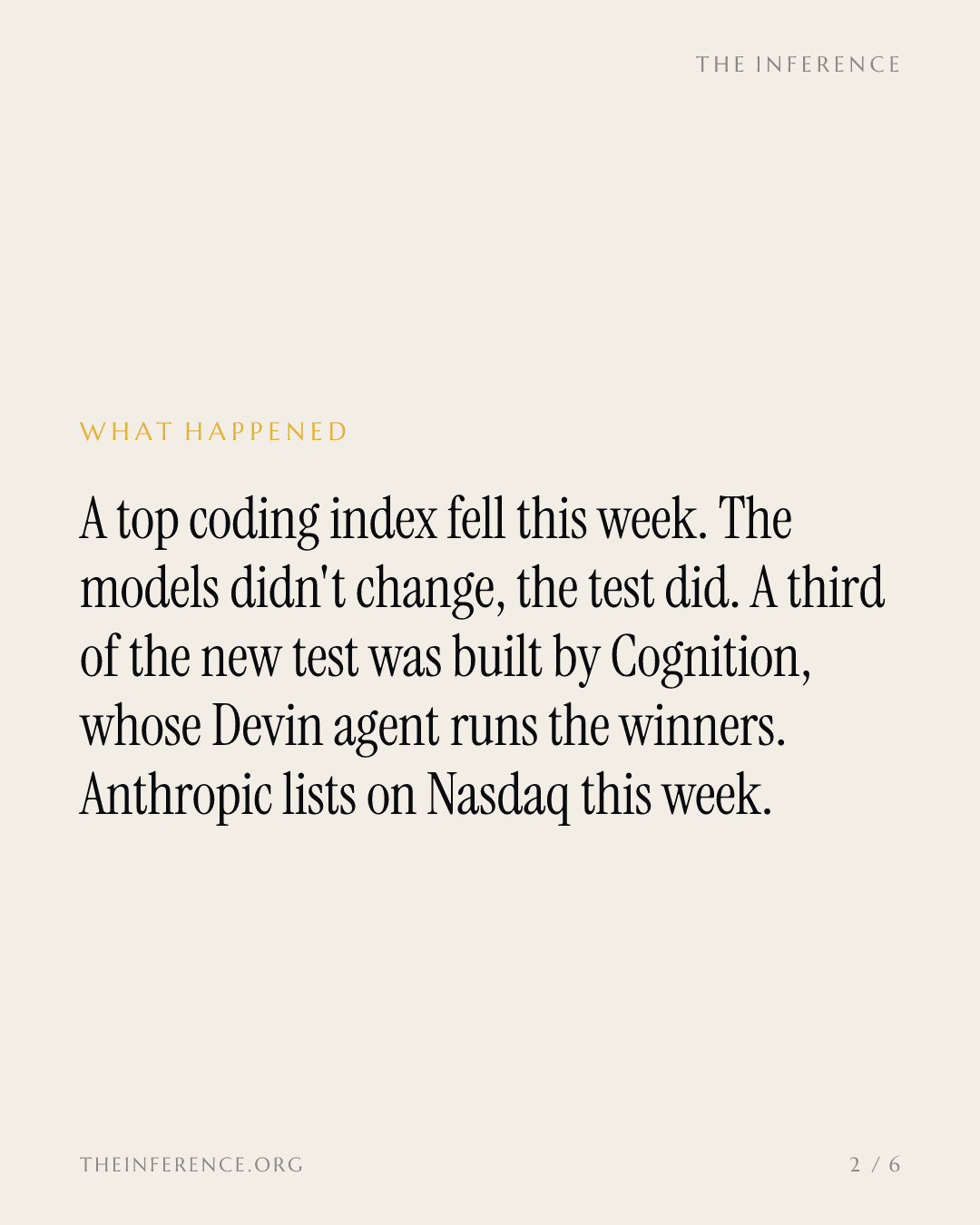
The yardstick in coding agents now sits inside a seller's shop. On November 13, 2026, Artificial Analysis, an independent model-benchmarking service, refreshed its Coding Agent Index, and the top composite fell from 61.7 to 58, with Anthropic's$350B — Anthropic, private, latest valuation $350B Claude Fable 5.2 and Claude Opus 5.5 tied at first 1. A third of that score runs on FrontierCode, a task suite built by Cognition~$10B — Cognition, private, latest valuation ~$10B, the startup behind the Devin coding agent 1.
Cognition announced Fable 5.2 inside Devin Desktop and Devin CLI on November 9, the day Anthropic released it 12. Anthropic's model lists on Nasdaq this week 3; Cognition's Devin, the harness that runs it, has fielded offers that could close a round before the year ends 4.
The top score fell from 61.7 to 58 when the index changed its tests
- Claude Opus 5.5
- Claude Fable 5.2
Data
| Claude Opus 5.5 | Claude Fable 5.2 | |
|---|---|---|
| Index v2.0 | 61.7 | — |
| Index v2.1 (Nov 13) | 58 | 58 |
Cognition owns the harness and the grading, not the champion
The champion is Anthropic's. Fable 5.2 leads the new index and wins Cognition's own test: 49.1 on FrontierCode 2.0 at the highest reasoning setting 2. The index runs version 1.1 of that suite; the 49.1 was scored on version 2.0, a different edition of Cognition's own benchmark 12.
Cognition's own small model is the discount instrument. SWE-2 Flash, released on November 4 and sold inside Devin at a fifth of SWE-2's price, wins one of eight rows on Cognition's launch table (56; our earlier take). What Cognition holds is the harness, the scaffolding around a model where a task gets its price; Devin's invoice folds model, harness and serving into one bill 6. Devin's business is running someone else's frontier model cheaply, and grading the result.
A leadership claim depends on which version of the test ran
FrontierCode grades an agent's work on whether a repository maintainer would merge it, closer to how a team judges code than any correctness test 1. But Cognition builds and versions the suite, and Artificial Analysis chose to swap version 1.1 into this refresh 1. Opus 5.5 fell from 61.7 to 58 on an unchanged model and a changed test; that is what a new grader does to an old score 1.
The chain underneath is short. A frontier model writes mergeable code; the harness turns it into a task with a price; routine engineering work then moves off people's calendars. The first two links are priced this month; the third is projection.
Anthropic prices this week; Cognition's offers run to year-end
Anthropic begins trading on Nasdaq on November 19, 2026, at a valuation of up to about $1.4 trillion 3. That is below the range investors contemplated a few weeks ago; the halo around AI, in one investor's words, "isn't as formidable" as it was 7. At the top of the range the shares trade at roughly 17 times the $81 billion annualized run-rate in the filing 3.
Cognition's offers run at five times Anthropic's run-rate multiple
Cognition is set to raise about $1 billion at roughly $47 billion, per Bloomberg, on a run-rate above $900 million, with no full-year figures yet published 8. It has separately received offers between $70 billion and $80 billion and may close a round before the end of the year 4. Per dollar of run-rate, Devin's harness is the expensive asset and the model it runs is the cheap one. Anthropic's opening trade prices the model on November 19; a Cognition term sheet, if it lands this year, prices the grader 4.
Cognition's offers price each dollar of run-rate about five times higher than Anthropic's IPO
- Estimate
Data
| Value | |
|---|---|
| Anthropic IPO, top of range | 17.3x |
| Cognition, $47B round | 52.2x |
| Cognition, $70B offer (estimate) | 77.8x |
| Cognition, $80B offer (estimate) | 88.9x |
Get Model by email, free
The AI labs, their models, and the business behind them. In our daily email, every weekday.





Reader comments
0 comments