Cognition's president says smarter models no longer win as Robinhood's fund buys in at $48 billion
Cognition's president says smarter coding models no longer win, days before Robinhood's listed fund paid into the company at a $48 billion valuation. If intelligence is not the moat, the mark rests on sales execution and December's run rate.
 Richard Tang · 3 min read

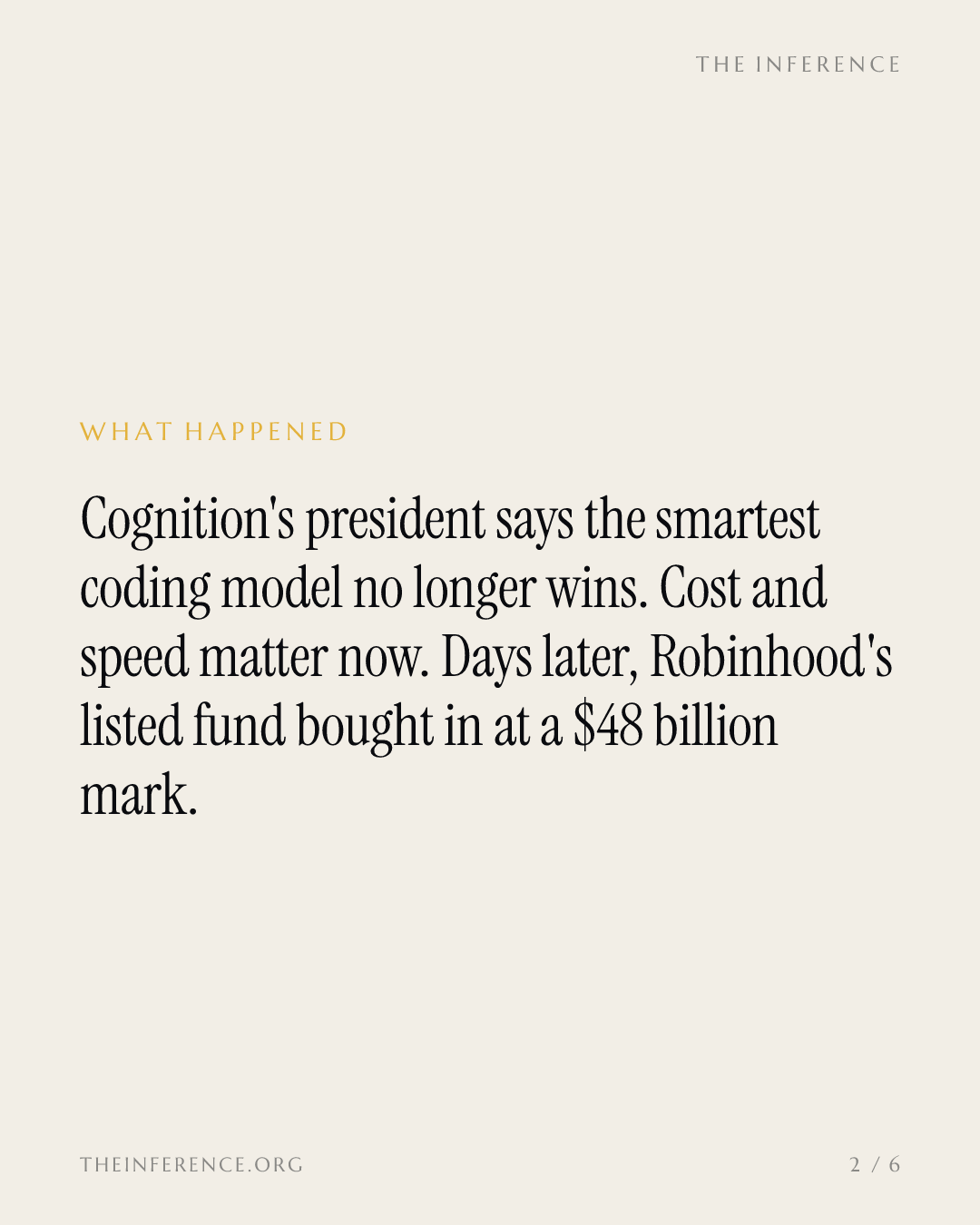
Cognition's~$10B — Cognition's, private, latest valuation ~$10B own president said the quiet part on Monday: for most software engineering tasks, being the smartest model no longer decides who wins. Once any model can finish the job, Russell Kaplan wrote, cost and speed are all that matter 1. That is a warning for every lab pitching coding ability as the reason to buy its newest model, and it lands three days before Robinhood's−1.89% — Robinhood, down 1.89 percent today listed fund paid into Cognition at a $48 billion mark 1.
Smarter buys less traffic than it used to
The intelligence behind that mark is saturating, so the mark now rests on sales execution and December's run rate. The evidence is a collapse in the reward for being smarter. The Information found that a 10-point lead in model intelligence bought nearly 69% more developer traffic in late 2025, and only about 20% now; Kaplan called the finding directionally consistent with Cognition's internal data 12. Devin's own scores show the ceiling: 13% on SWE-Bench at launch in March 2024, near 90% by mid-2026 2. When a benchmark is that close to cleared, headroom is gone. The valuation, meanwhile, was set in the old world: about $10 billion in September 2025, $26 billion in May, $48 billion after the September Series E 3.
The mark doubled in four months on the old premise, smarter models win
Data
| Cognition valuation ($B) | |
|---|---|
| Sept 2025 | 10 |
| May 2026 | 26 |
| Sept 2026 | 48 |
Cognition is answering with people, not parameters
So where does the moat go? Watch what Cognition is buying. In London it grew headcount more than 200% in six months and hired Mercedes-Benz's former global CIO plus transformation veterans from JPMorgan and State Street−0.01% — State Street, down 0.01 percent today, people whose job is getting Devin into production at banks and enterprises, not building models 5. That is a deliberate move up the chain.
The chain runs: intelligence saturates, so buyers pick on price, speed and reliability, so the product becomes the deployment workflow and the sales relationship, and that is a people-and-distribution game. Cognition is playing it. The speed half has hardware receipts: on CoreWeave's−2.97% — CoreWeave, down 2.97 percent today new Nvidia−0.54% — Nvidia, down 0.54 percent today Vera Rubin racks, Cognition measured 4.8 times the token throughput of GB200 on its SWE-2 coding workloads 6.
The money is already arguing the question
The market is arguing the same question with real money. Meta's−1.36% — Meta, down 1.36 percent today free cash flow turned negative in the third quarter for the first time since its IPO year, and the bill for believing intelligence still compounds keeps growing 7. Against that, Cognition's revenue story is intact: annualized run rate crossed $1 billion in late September, up from roughly $492 million in May 3.
For investors, the entry point is Robinhood Ventures Fund I (NYSE: RVI), which closed about $10 million into Cognition on October 23, roughly 1.5% of its portfolio, charging holders 2% a year 34. A stake that small cannot be an "own Devin" trade; it is a bet on the fund's whole late-stage book, entered at about 50 times run-rate revenue 34.
If Kaplan is right about saturation, that multiple is defended only by enterprise execution, the tenfold growth in Devin usage Cognition reports and the December run-rate print. The company itself has told you what to watch.
Get Model by email, free
The AI labs, their models, and the business behind them. In our daily email, every weekday.