Bank of America's $1.2 billion fine made auditable AI compliance the scarce good
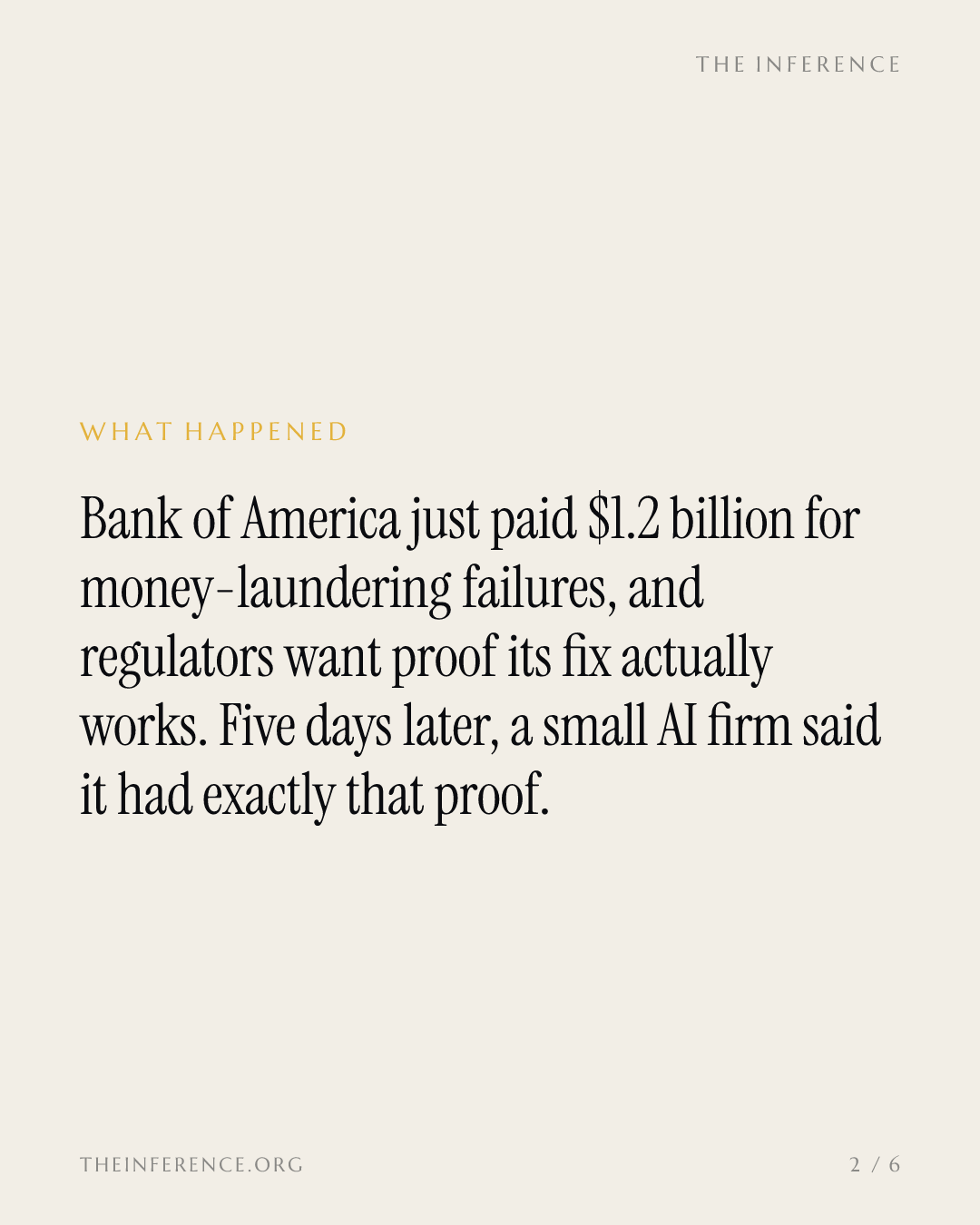
Bank of America's $1.2 billion charge for anti-money-laundering (AML) and sanctions failures came with a demand money cannot answer: prove the program works. Five days later, Bretton AI, which sells compliance agents to banks, said an accounting firm had independently validated its agents.
 Richard Tang · 5 min read

Bank of America's+0.51% — Bank of America, up 0.51 percent as of its last quote third-quarter results on October 14, 2026, carried a $1.2 billion non-tax-deductible charge for AML and sanctions failures 1. The money is the smaller half of the punishment. The consent order behind it requires a third-party lookback at suspicious transactions the bank missed, and an independent review of whether its transaction monitoring, customer due diligence and data governance actually work 2.
Software cannot answer that demand. The closest thing a bank can hand a supervisor is proof in the shape FinCEN's own rule proposal rewards: independent testing aimed at whether the program works, and demonstrable evidence of effectiveness that expressly includes the effective use of AI 3. Within days, Bretton AI, a San Francisco developer of compliance agents, announced a piece of that proof: an independent accounting firm had validated its agents 4.
October's fines ask whether the program works
The enforcement ran in sequence. On October 8, 2026, the Office of the Comptroller of the Currency (OCC), the US national bank regulator, fined American Express National Bank $350 million over a decade of unreported suspected trade-based money laundering, naming weak independent testing among the deficiencies 5.
On October 13, 2026, the Treasury Department moved against Bank of America 2. The Financial Crimes Enforcement Network (FinCEN) assessed a $1.2 billion penalty 6. The OCC imposed a $750 million civil money penalty, the largest in its history 2. The Office of Foreign Assets Control (OFAC) settled apparent sanctions violations for $11.6 million 2. The bank admits it willfully violated the Bank Secrecy Act 6. FinCEN's penalty is the third-largest in Treasury history, behind Binance in 2023 and TD Bank in 2024 12.
Bank of America's FinCEN penalty is the third-largest in Treasury history
Data
| Value | |
|---|---|
| Binance (2023) | $4B |
| TD Bank (2024) | $3B |
| Bank of America FinCEN penalty (2026) | $1.2B |
Bank of America absorbed $1.96 billion from three regulators in one day; Amex's OCC fine was $350 million
Data
| Penalty | |
|---|---|
| FinCEN: Bank of America | $1.2B |
| OCC: Bank of America | $0.75B |
| OCC: American Express | $0.35B |
| OFAC: Bank of America | $0.01B |
The rule is moving from paperwork to proof
FinCEN proposed on April 7, 2026, to replace the old test, whether the paperwork exists, with a harder one: whether the program works 3. Independent testing would be aimed at effectiveness rather than completeness, and FinCEN's director would weigh demonstrable evidence of effectiveness, expressly including the effective use of AI, in enforcement decisions 3.
Will Lawrence, Bretton's chief executive, made the commercial reading plain to Global Finance on October 20, 2026: a bank can hire more analysts, buy new technology and rewrite its policies without getting better at finding financial crime, and regulators want evidence that changes are working 1. That changes what a compliance budget is shopping for.
The auditor's letter becomes the product
On October 19, 2026 Bretton said Kaufman Rossin, the largest independent accounting and advisory firm based in Florida and one of the top 50 in the US, had completed an independent model validation of its know-your-customer (KYC), anti-money-laundering (AML) and sanctions agents 4. The review covered governance, model accuracy and stability, explainability, decision traceability, change management and ongoing monitoring 4.
Kaufman Rossin principal Jason Chorlins describes the design as large-language-model investigative reasoning combined with deterministic rule logic, structured output schemas and mandatory human review before any disposition 4. Lawrence's account of why such a document is rare: bank model-risk guidance such as the Federal Reserve's SR 11-7 was written for deterministic models, not generalized AI 7.
FinCEN's proposal would make independent testing, by internal staff or an outside party, the test of whether a program works 3, so the firm certifying that proof becomes the gatekeeper of what counts as evidence. Two limits remain: no supervisor has said it will accept a validation letter as proof, and the Kaufman Rossin review itself is unpublished, reaching the public only through Bretton's announcement 4.
BofA shareholders pay for remediation; Bretton is paid per finished case
Bank of America (NYSE: BAC) shareholders carry the charge and a remediation that, in Lawrence's account, can take years 1. Management says the people and technology for it are funded in the bank's expense run rate and that no asset cap constrains the bank; Morgan Stanley+3.61% — Morgan Stanley, up 3.61 percent today kept an Overweight rating (a buy-equivalent rating) on the shares while cutting its price target 8.
Bretton, whose customers include Robinhood+3.55% — Robinhood, up 3.55 percent today, Mercury and Gusto, bills per finished case, as in the MVB Bank alert-queue agreement we reported on October 9, 2026 49. The OCC's $750 million penalty is more than 3,700 times Bretton's average contract value of $201,000, a figure the company publishes itself 210. For a Bank of America holder this is money already spent; for a compliance vendor the same obligation is revenue, earned case by case.
Independent evidence at scale is the one missing piece
Almost every link from a capable model to a safer bank is built: agents that complete investigations, a person reviewing every output, a validated model, a rule proposal that rewards proof 34. The one missing link is independent evidence that the agents hold up at scale.
Three things decide what happens next. The first is whether any supervisor accepts an auditor's validation letter as proof that a program works; the validation itself is still unpublished. The second is whether Bank of America's funded remediation converts into per-case contracts like Bretton's August 2026 agreement 9. The third is whether the 66 regulatory deadlines landing this quarter make banks answer the proof question before FinCEN's rule is final 10.
Bank of America's shareholders have already paid for the gap between a compliance program on paper and one that works. The builders who close that gap with evidence will collect next, and this month's penalty has made the price of that evidence visible to every compliance budget in the country.
Get Policy & Labor by email, free
The rules governments write for AI, and what AI does to jobs. In our daily email, every weekday.