Bolt lost its UK tax appeal; Uber has $1.8 billion booked as coming back on the same dispute
The UK Supreme Court has refused Bolt's VAT appeal, and Uber's parallel case, paused behind it, now resumes against a precedent that has ruled out the commission-only reading. Uber reports on November 4 with £1.4 billion of paid assessments still booked as money coming back.
 Richard Tang · 3 min read
Bolt's lost appeal un-pauses Uber's bigger one
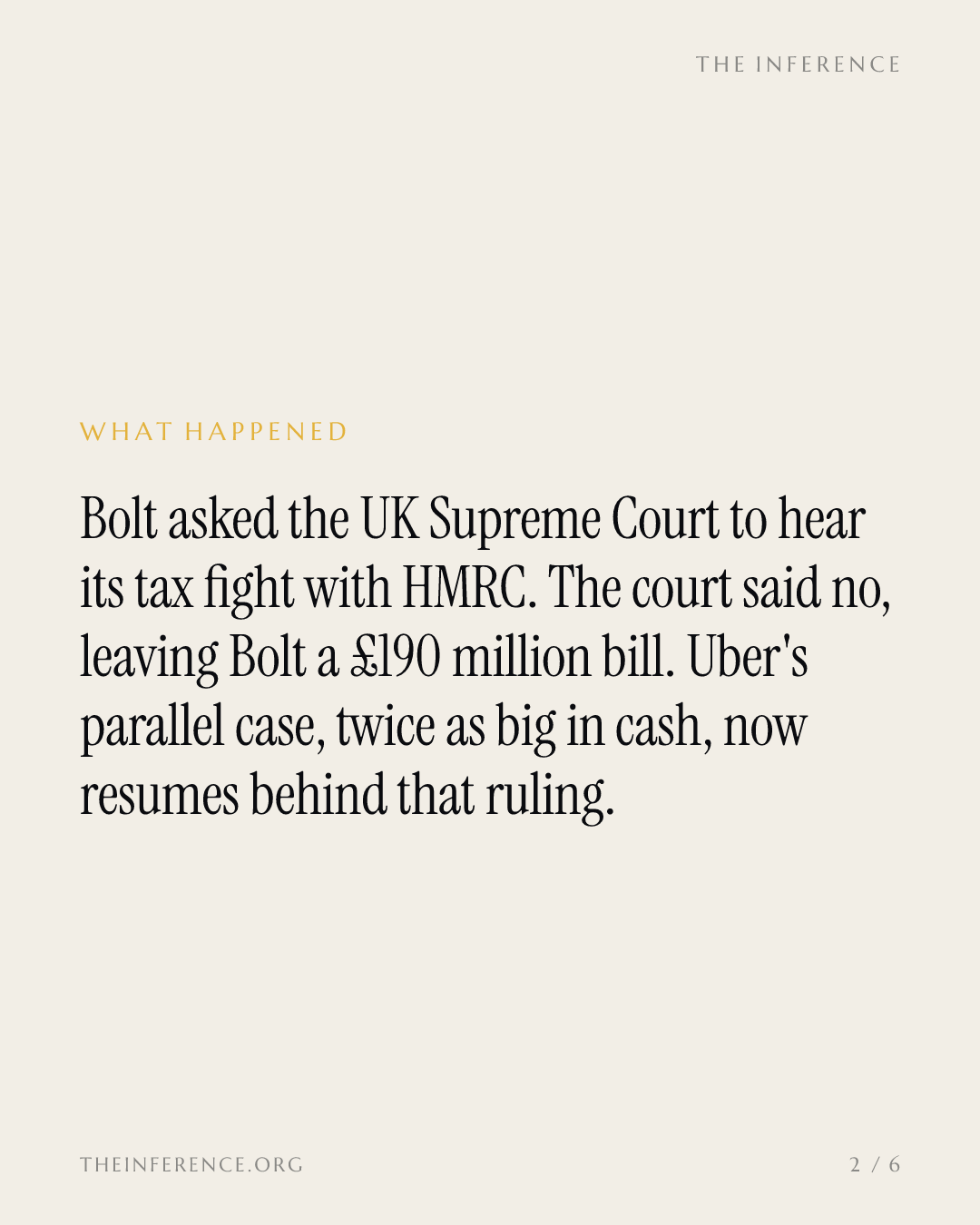
The UK Supreme Court has refused Bolt~$2B — Bolt, private, latest valuation ~$2B, the Estonian ride-hailing group, permission to appeal its value-added tax dispute with Britain's tax authority, HMRC, leaving an estimated £190 million bill 12. Uber−2.20% — Uber, down 2.20 percent today is fighting the same scheme with far more at stake: its latest quarterly filing shows about £1.4 billion ($1.8 billion) paid to HMRC against disputed assessments, money the filing still books as coming back 3.
The refusal leaves the commission-only reading with no court left to ask
The fight is over the tour operators' margin scheme, which let a platform pay VAT on its commission rather than the whole fare. Two lower courts had sided with Bolt before the Court of Appeal overturned them for HMRC in June 12. The Supreme Court said the case "does not raise an arguable point of law of general public importance which the Supreme Court ought to hear at this time" 12.
Uber's own appeal had been paused pending Bolt's outcome 4, and the filing records HMRC's intention not to enforce further assessments pending "the determination of the appeal of a competitor on a related matter" 3. That determination has now arrived, against the platforms.
The scheme is closed; the assessments are not
Two limits on the damage are in the same note: the scheme closed for private hire from January 2, 2026, and the cash left Uber in 2023 through 2025 3. So this is a bill for the past, but a loss would still erase the receivable from the balance sheet, and HMRC has assessments left to issue for years through 2025, which would take new cash 3.
The November 4 print is the first test
Uber reports third-quarter results on November 4, its first numbers since the refusal 5. The big cash calls land after that quarter closed. On October 6, with September done, Uber agreed to pay $2.3 billion in cash for ezCater, the corporate-catering marketplace 56. Behind it sits $14.8 billion agreed in July for Delivery Hero+1.61% — Delivery Hero, up 1.61 percent today, the Berlin food-delivery group 6.
The market's attention is on autonomy instead. Guggenheim analyst Taylor Manley reiterated a Buy this week with a $125 target, a case built on growth and the autonomous roadmap 7. The stock trades near $70, and the stated worry is robotaxis 7.
Uber has already paid HMRC $1.8 billion it still books as refundable
Data
| Value | |
|---|---|
| Bolt's UK VAT bill | $0.26B |
| Uber's payments to HMRC | $1.8B |
| Uber's cash for ezCater | $2.3B |
A robotaxi ride would likely end the fare-base dispute
The disputed base was built by Uber's pricing algorithms. Consumer Reports, the US product-testing nonprofit, put Uber's cut of each fare at 42% by the end of 2024 8. In 2022 that take was 32% 8. The platform reading taxed that cut; HMRC's taxes the whole fare, and the gap between the two bases across the disputed years is the money now sitting with the tax authority 3.
The dispute covers rides with a human driver's fare in the middle. The vehicles in Uber's robotaxi deployments come from the autonomy partners, Pony's Gen-7 robotaxis in London 4. A ride with no independent driver would likely make Uber the merchant of the journey outright, and the question of which base to tax would dissolve.
The cash is paid; the verdict is pending
The cash is already with the tax authority, the test case for bringing it home has been lost, and the first balance sheet to face that fact reports on November 4.
Deepdive
AI-generated from this story and its cited sources. Not investment advice.