CanSemi, a loss-making Chinese foundry, more than tripled on its Shenzhen debut after raising $919 million
CanSemi, a Guangzhou foundry with 6.5 billion yuan of accumulated losses, raised US$919 million in its Shenzhen listing; its shares more than tripled on debut. The wafers it plans to add land in the mature nodes SMIC earns from, and SMIC trades at 127 times earnings.
 Richard Tang · 3 min read
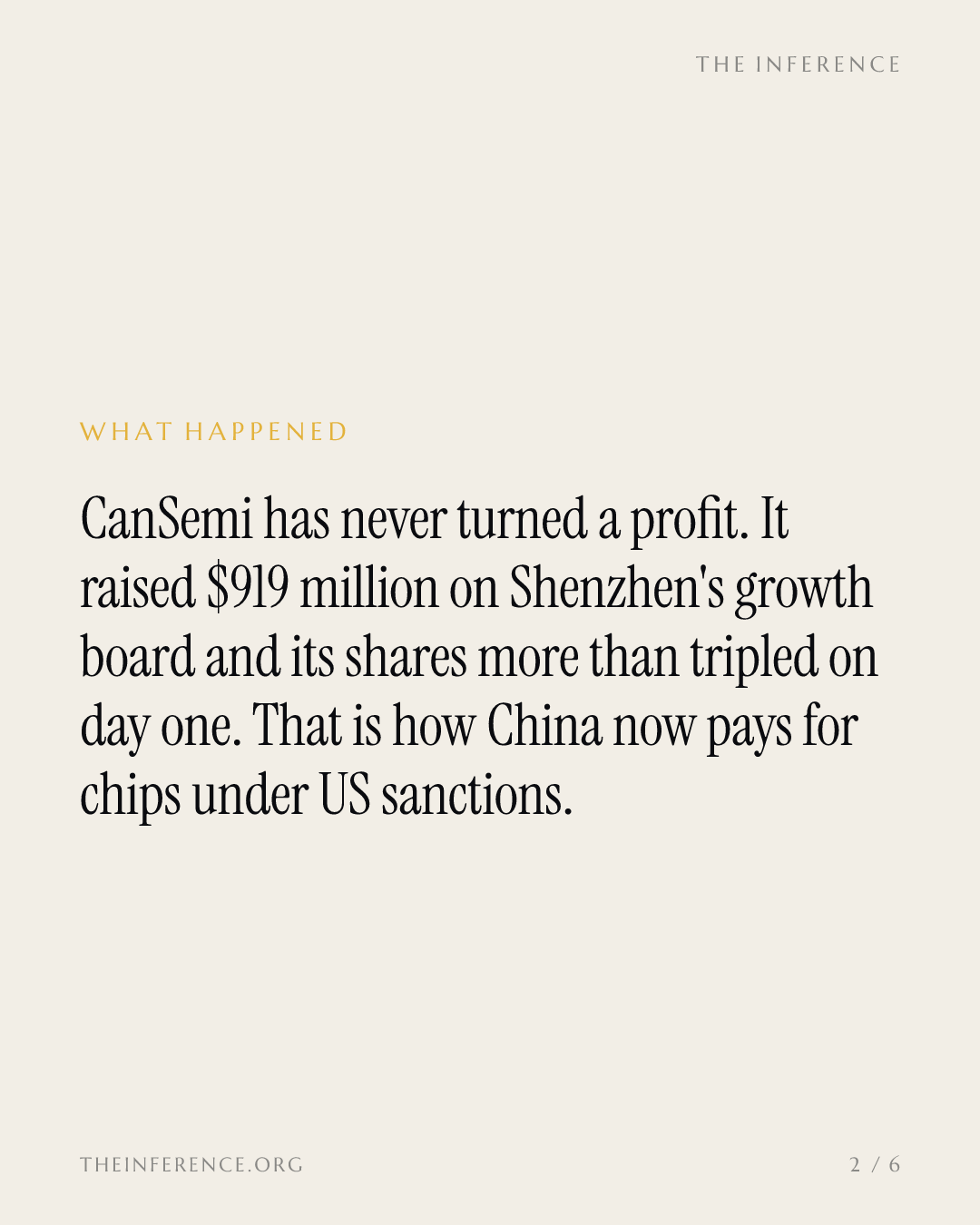
A foundry that has never made a profit listed on the Shenzhen Stock Exchange on Tuesday after raising about 6.16 billion yuan (US$919 million), and its shares more than tripled on debut 13. CanSemi Technology's listing shows how China finances chips under US sanctions: the rules were relaxed so a loss-maker could raise money to build capacity, and the market supplied it 13. The Guangzhou company, founded in 2017, lost 6.5 billion yuan between 2023 and 2025 1 and finished its first day valued at more than 100 billion yuan 3.
Beijing lists loss-makers so the capacity gets built
An unprofitable foundry usually cannot keep raising capital. CanSemi is the first money-losing wafer maker admitted to ChiNext, Shenzhen's growth board, under China's registration-based listing system, which vets a filing's disclosures rather than its profits 3. Beijing had already let the loss-making automotive foundry Xinlian Integrated list on Shanghai's STAR Market in 2023 1. The prospectus itself does not expect a return to profitability before 2029 at the earliest, and the offering was priced inside that window 1.
Three built phases give the site a planned 80,000 wafers a month of analog chips, power management ICs, image sensors and display drivers on 180-to-55-nanometer processes 1, and a fourth phase, under construction, lifts that to 120,000 34. The money was raised against that buildout schedule, so supply keeps arriving even when margins fall.
The new wafers land in SMIC's revenue pool
The 40,000 added wafers a month land in mature processes, where US equipment controls have pushed China to concentrate its buildout 1. SMIC, China's largest foundry, last guided revenue up 2 to 4 percent sequentially on a 26-to-28 percent gross margin, after running at 93.7 percent utilization in the second quarter 5.
Goldman Sachs+0.56% — Goldman Sachs, up 0.56 percent today kept its Buy rating on Tuesday, citing AI demand for analog and logic chips, capacity expansion and domestic sourcing among its drivers 5; the last two are what CanSemi's listing adds. Beijing fills SMIC's order book and its competitor list with the same hand.
The market pays richly for that story. CanSemi itself was priced at about 13 times last year's sales 2. SMIC trades at 127.1 times earnings, and Hua Hong Semiconductor, the other mainland foundry, at 197.8 6. United Microelectronics, the Taiwan foundry in the same mature-node business, trades at 21.9 6.
Mainland foundries carry earnings multiples far above Taiwan's UMC
Data
| Value | |
|---|---|
| Hua Hong Semiconductor | 197.8x |
| SMIC | 127.1x |
| UMC | 21.9x |
Korea repriced a Chinese capacity claim in a day
On Saturday, CXMT, a state-backed memory maker in Hefei that listed in Shanghai in July, said it would ship a next-generation DRAM design before the end of the year 178. The design, called 4F², is meant to shrink the area each memory cell needs by about a third, and Samsung is not expected to begin mass production of the same architecture until around 2028 1.
By Tuesday, Samsung had fallen 7.7 percent and SK Hynix 8.8 percent, and the Kospi, South Korea's benchmark index, was down more than 7 percent 9. The Associated Press read the fall as unease over the AI boom itself, sharpened by reports of CXMT's advance 9. No product had shipped; the claim alone moved two of the world's three biggest memory makers 79.
A memory claim, not a shipped product, knocked Korean chip shares down by more than 7 percent
Data
| Value | |
|---|---|
| SK Hynix | -8.8% |
| Samsung | -7.7% |
| Kospi | -7% |
The margin question is left to demand
The demand behind the buildout is real. Memory has climbed to near 30 percent of capital spending by the hyperscalers, the big cloud-computing operators 7, and AI demand is pulling on the analog and logic chips made on these same nodes 5. Cheap mature-node capacity works like a subsidy to the companies building on top of it, and the competition lands among the fabs, whose margins absorb each new entrant.
The supply side is settled by policy. Demand is the open question, and it shows up first in SMIC's fab utilization, then in its next margin guide. The multiples on the mainland foundries are a bet that demand absorbs all of it, and this week showed how fast that bet gets repriced.
Deepdive
AI-generated from this story and its cited sources. Not investment advice.