Checkr flags half of AI-engineer resumes for fraud. You can't buy the stock.
Across its resume-fraud beta, Checkr flagged 36% of inbound resumes for review; Treasury says fake remote IT workers sent nearly $800 million to North Korea in 2024. The seller of the fix is private, and the one listed screening company got bigger by buying its rival.
 Vincent Jiang · 3 min read
Half the engineering funnel trips the alarm
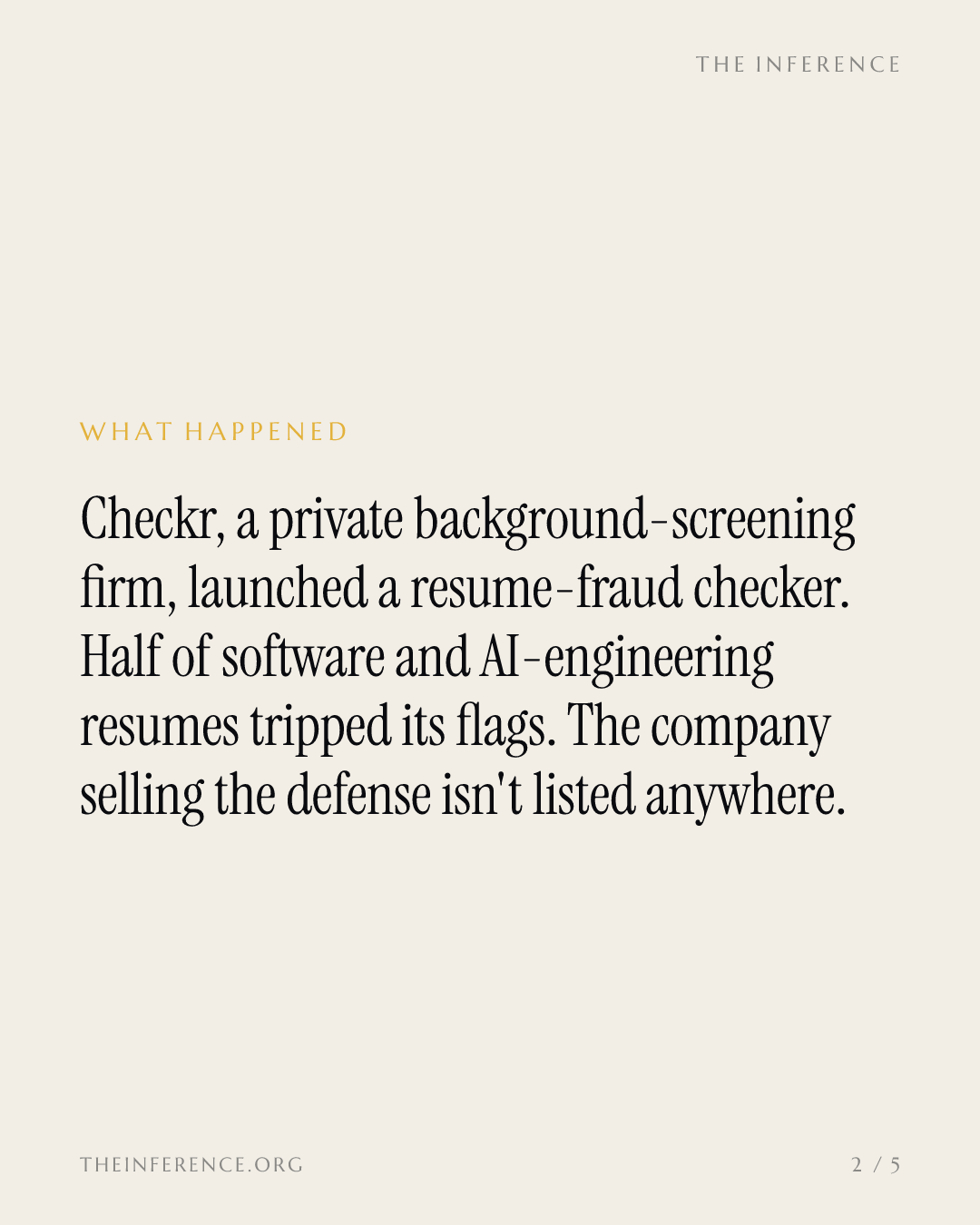
On October 8, 2026, Checkr, a private San Francisco background-screening firm, launched a Fraud Detection Suite with the first volume numbers behind the AI hiring-fraud scare 1. In its resume-fraud beta, 36% of inbound resumes triggered flags for further review; 50% of software and AI-engineering resumes did, against 23% to 27% for sales, marketing and operations 1. The pool employers fight hardest to hire from is now the pool that looks most fraudulent to an automated screener.
Half of software and AI-engineering resumes tripped fraud flags in Checkr's beta
Data
| Value | Range | |
|---|---|---|
| All inbound resumes | 36% | — |
| Software & AI engineering | 50% | — |
| Sales, marketing & ops | 23–27% | 23–27% |
Payroll leaking to Pyongyang
The money behind the flags is real. Treasury said in March that North Korean IT-worker schemes generated nearly $800 million in 2024 and sanctioned six individuals and two entities tied to them 2. The Justice Department has prosecuted stolen-identity schemes that placed fake remote workers at more than 100 U.S. companies 1.
That volume explains the flag rates. One worker cell traced by a Wall Street Journal investigation applied to more than 1,000 companies in just over three months, its applicants reading AI-generated answers in interviews and testing face-swapping software 2. By one count, reported losses to AI deepfake fraud passed $1.5 billion in the first nine months of 2025 3.
One-time checks become a subscription
Co-founder and chief executive Daniel Yanisse's pitch is that "AI has broken" a hiring model built on a resume, a video interview and a government ID 1. The replacement runs continuously: deepfake detection on interview recordings, selfie-to-ID biometrics licensed from the identity firm Socure 4, device and location signals, and reverification after the start date, sold across more than 140,000 customers on a data graph of more than 260 million U.S. identities 1.
In August, Checkr bought Truv, whose direct payroll and bank connections, the company says, reach 96% of the U.S. workforce; terms were not disclosed 6. A check priced per hire is turning into a service priced per employee.
A flag is not a fraud
Two cautions. Checkr's rates are its own beta flags, triggers for human review rather than confirmed fraud, and the firm sizing the threat is the firm selling the defense 13.
The buyer cannot buy the seller: Checkr is private. First Advantage, the only listed company that does nothing but background screening, grew by buying rather than selling, closing its $2.2 billion takeover of rival Sterling Check on October 31, 2024 5. Point-in-time figures put it near $5 billion of enterprise value at about 12 times trailing EBITDA, a profit measure; those numbers are not verified elsewhere 3.
The tell is the revenue line
The listed screeners have not shown the boom. Ainvest's point-in-time figures put Sterling Check's revenue down about 0.3% year over year on an operating margin just over 4% 3. If fraud defense were landing as billed volume, First Advantage's quarterly revenue would show it; nothing published yet does 3.
Watch that line, and Checkr's next flag-rate print. Half the engineering funnel tripping alarms is either the labor scam of the decade or the most sensitive filter ever sold, and no published audit yet tells the two apart.
Deepdive
AI-generated from this story and its cited sources. Not investment advice.