CMS Energy earns $1.44 adjusted while funding the fight against Michigan's utility money ban
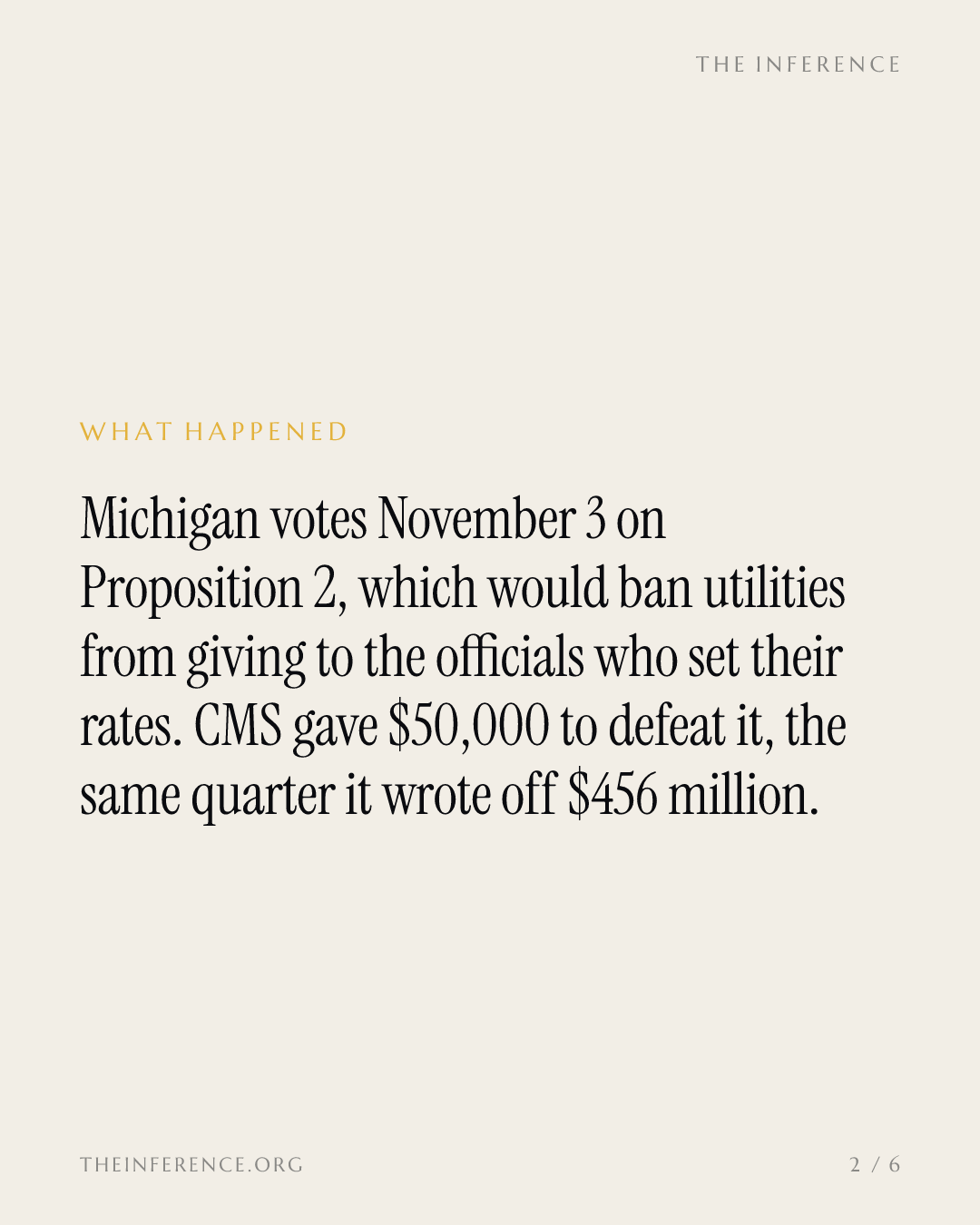
Michigan votes on November 3 on Proposition 2, which would bar utilities from giving to the officials and commissioners who set their rates. CMS Energy, which needs more than $24 billion of supply-plan spending approved, put $50,000 into defeating it the same quarter it wrote off $456 million.
 Vincent Jiang · 3 min read

A $50,000 check, a month out from the vote
On September 30, a month before the election, CMS Energy−0.75% — CMS Energy, down 0.75 percent today, the parent of Michigan utility Consumers Energy, wrote a $50,000 check to Protect MI Free Speech, the committee campaigning against Proposition 2 in the November 3 vote 1. Michigan Energy First, a dark-money group tied to rival DTE Energy+0.08% — DTE Energy, up 0.08 percent today that does not disclose its donors, had matched the sum on August 31; utility-linked giving to the committee now totals $215,000 1.
The check is small because the fight is lopsided: Protect MI Free Speech has raised about $851,000 from all sources, against more than $8.7 million for Michiganders for Money Out of Politics, the coalition behind the measure 2. Proposition 2 would bar regulated utilities and most large state contractors from political giving and force donor disclosure for pre-election issue ads, a utility-specific ban no other state has tried 32.
After the write-off, CMS is a regulated utility story
This morning CMS reported third-quarter GAAP earnings of $0.39 a share, against $0.92 a year earlier, after a $456 million impairment and restructuring at NorthStar Clean Energy, its non-utility arm, whose assets are now held for sale 45. Adjusted earnings, which exclude the write-down, were $1.44 against $0.93, and the company reaffirmed 2026 guidance of $3.83 to $3.90 and 2027 guidance of $4.08 to $4.17 4.
Shareholders barely felt it: $214 million of the quarter's losses landed on noncontrolling interests, and net income attributable to CMS held at $123 million, flat with the second quarter 4. The equity case now rests on the regulated core. Consumers wants more than $24 billion of spending through 2030 on a 20-year supply plan of gas, solar, wind and storage 6, money recovered, with a return, from customer bills at rates the commission sets 7.
Net income attributable to CMS fell in Q2 2026 and held flat through the NorthStar write-down
Data
| Net income attributable to CMS | |
|---|---|
| Q3 '24 | $0.25B |
| Q4 '24 | $0.27B |
| Q1 '25 | $0.3B |
| Q2 '25 | $0.2B |
| Q3 '25 | $0.28B |
| Q4 '25 | $0.29B |
| Q1 '26 | $0.34B |
| Q2 '26 | $0.12B |
| Q3 '26 | $0.12B |
The regulator is on the ballot
Michigan's utility rates are set by the Public Service Commission, a three-member board appointed by the governor, not elected 7. Proposition 2 would stop utility officials and their families from donating to statewide officeholders and to commission members 3.
The money record behind the measure: the two utilities' political action committees have given more than $1.97 million to current state officials, a Detroit News poll last month put support for the ban above 71 percent, and Consumers spent over $250,000 in a failed August primary bid against a Republican incumbent, a vocal critic of the data centers behind Michigan's electricity-demand growth, which we have tracked before 1.
The defense, and what to watch
Consumers spokesperson Katie Carey said the company follows all campaign finance laws and that the measure would "shift influence away from Michigan companies and toward wealthy national donors and special interests" 2. Karley Abramson of the Citizens Research Council, which takes no position, expects a constitutional challenge and doubts the utility ban survives: because commissioners are appointed, a quid pro quo is hard to prove, and super PAC spending is carved out either way 7. Business groups have promised to sue 3.
Watch the vote on November 3, then the lawsuits, then the rate cases: the $24 billion plan does not wait for any of them 3.
Get Power by email, free
How AI's hunger for electricity moves utilities, power plants and the grid. In our daily email, every weekday.