China clears DeepSeek and MiniMax to license AI abroad while $150 billion sits in the red
Six days after China proposed export controls on 23 AI technologies, state media says DeepSeek and MiniMax are the first labs cleared to license models overseas. The approval lands while the only two listed Chinese pure plays have erased $150 billion in value.
 Vincent Jiang · 2 min read
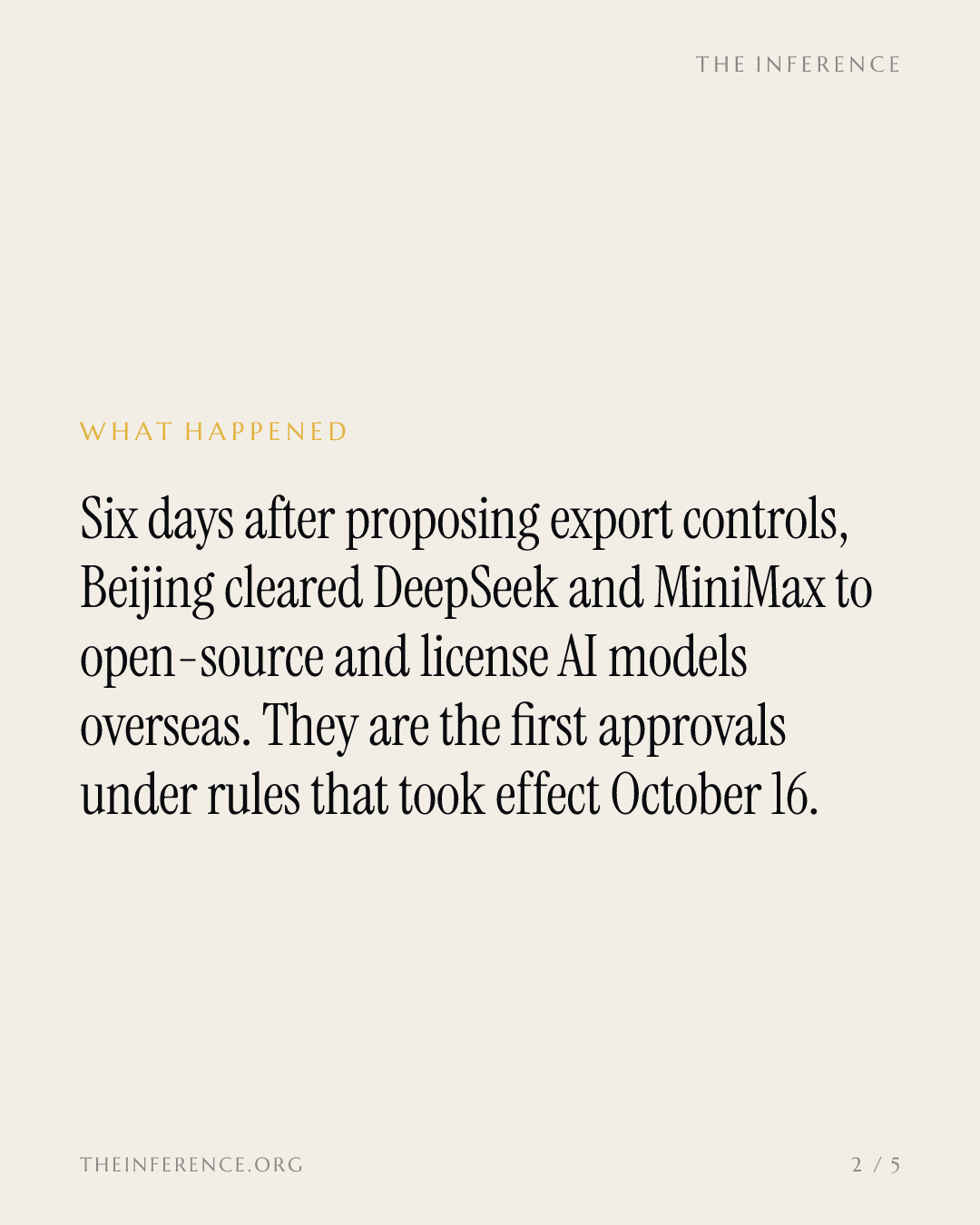
Six days after Beijing proposed export controls on 23 AI technologies, two names came through the gate: DeepSeek and MiniMax 14. State broadcaster CCTV's influential Yuyuantantian account confirmed on the night of October 22 that the two labs had completed registration and are cleared to open-source and license their models overseas, the first approvals under rules that took effect on October 16 14.
Who bleeds
The clearance lands on broken stocks. MiniMax Group and Z.AI, the only listed Chinese pure-play model developers, have shed a combined $150 billion in market value from their highs since their January debuts 3. MiniMax slid below its IPO price on Thursday, wiping out what had been a 650% gain at its March peak; Z.AI has tumbled 81% from its June high 3. New models did nothing: MiniMax's M3.1 Flash and Zhipu's GLM-5.3-FlashX got cold receptions 35.
The complication
JPMorgan strategists said this week they prefer Z.AI over MiniMax for its coding capability 3. The state's first pass went the other way: MiniMax, which already earns most of its revenue outside China, is cleared, while Z.AI has no announced registration 13. For the first time, a hard regulatory fact sits between the two tickers, and it points against the bank's pick.
The receipts
The rules are narrower than the panic suggested. MOFCOM says API access, websites, apps and already-public open-source releases do not count as regulated exports, and expedited "automatic licensing" applies to open-sourcing; only technology ownership transfers, overseas licensing deals and foreign ownership changes require registration first 14. Yuyuantantian framed the message plainly: most AI technology remains freely exportable 1.
The counterpoint
Approval is not profitability. Both listed labs remain unprofitable, global price wars with OpenAI$1.18T — OpenAI, private, latest valuation $1.18T and Anthropic$350B — Anthropic, private, latest valuation $350B squeeze margins, and JPMorgan−1.56% — JPMorgan, down 1.56 percent today does not expect Chinese AI models to break even before around 2028 35. January brings lockup expiries, about 178 million Z.AI shares and 25 million MiniMax shares, plus possible DeepSeek and Moonshot AI IPOs competing for the same investor cash 35.
What to watch
The gate is now an instrument of allocation. Every other Chinese lab's overseas licensing ambition waits on a state approval that can be granted or delayed, and the next registration filings will show whether Beijing is running a queue. Deep dive below for the draft rules and the filings behind each number 14.
Get Model by email, free
The AI labs, their models, and the business behind them. In our daily email, every weekday.