Colorado weighs widening who can appeal county denials; 93 miles of Xcel's line sit denied
The petition accepted November 5 would widen who can appeal a county denial while 93 miles of Xcel's Power Pathway already sit denied and 4 gigawatts of expected data center agreements wait behind 2,400 planned miles of line. For an investor, county permits now gate the build.
 Vincent Jiangthree-minute read

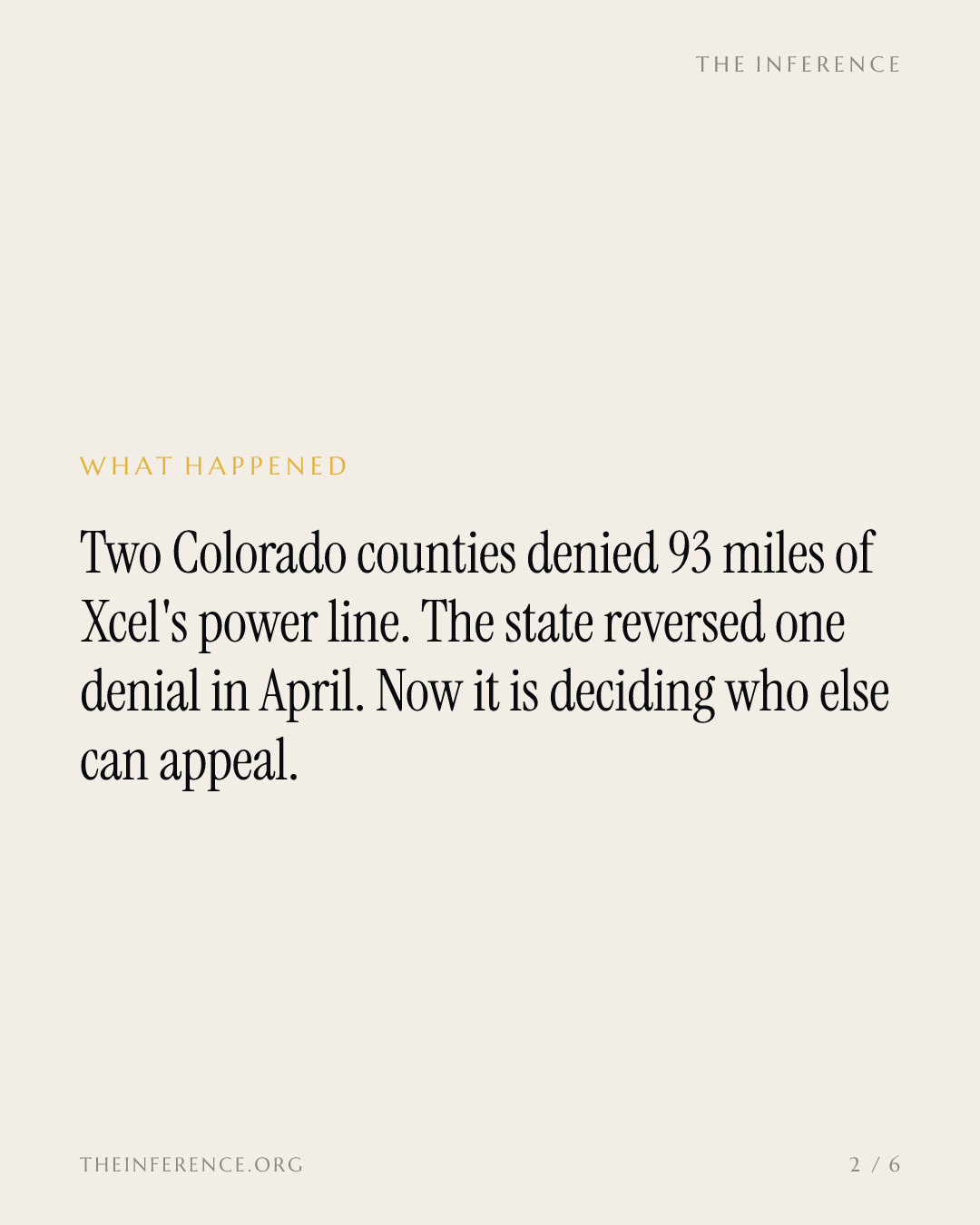
Elbert County, Colorado denied Xcel Energy's+0.83% — Xcel Energy, up 0.83 percent today permit for a 48-mile segment of its Eastern Plains Power Pathway, the transmission network that moves Eastern Plains wind and solar to the Front Range 1. El Paso County denied a further 45 miles 1. Xcel appealed both, telling the state that the denials unreasonably impair its ability to provide safe, reliable and economical service statewide 1.
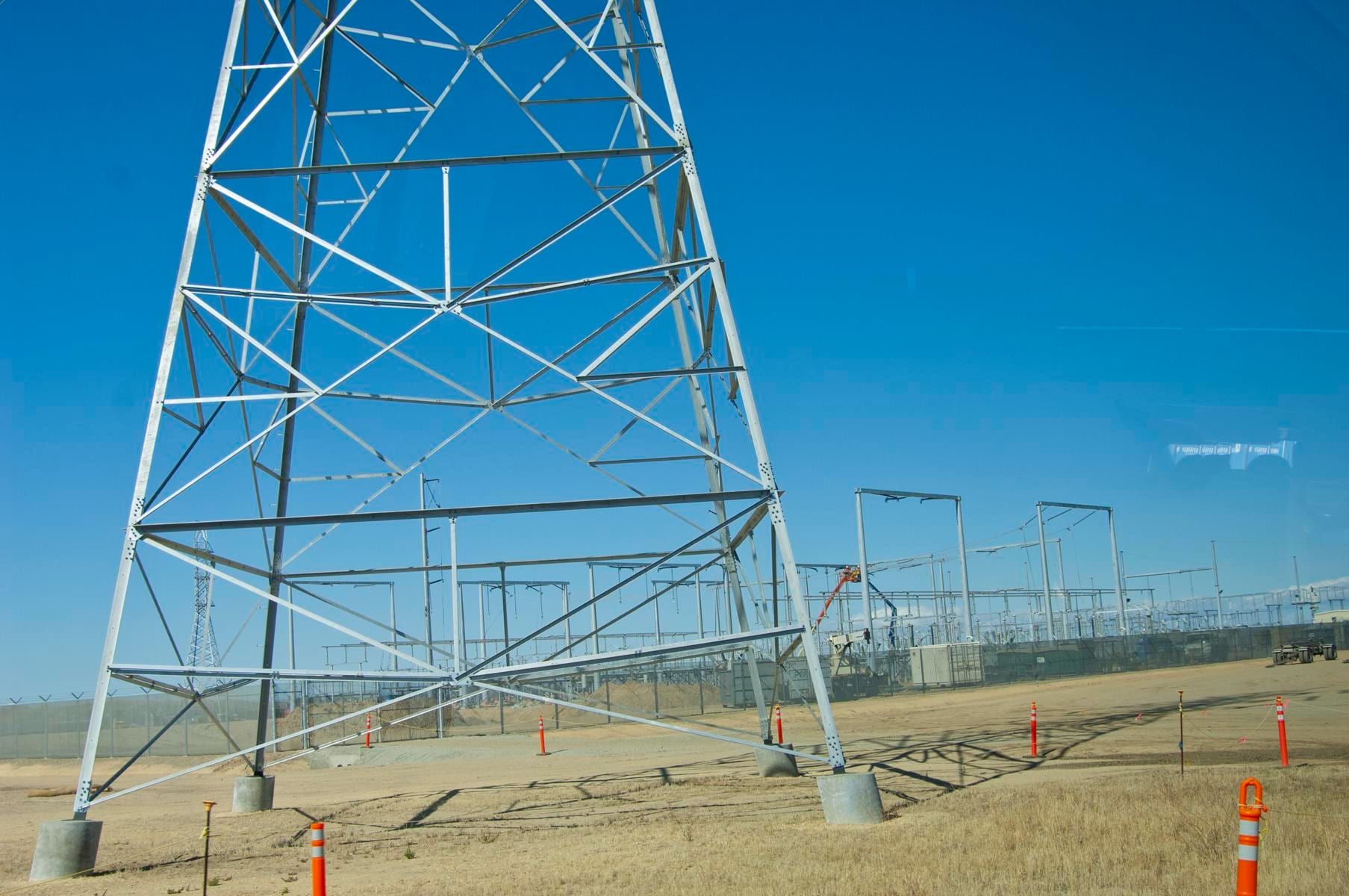
The Colorado Public Utilities Commission reversed Elbert County in April, and the county board answered that its local input had been "ignored, disregarded and determined to be insignificant" 1. On November 5 the commission took up a petition that decides who else can make the same move 1.
Xcel's $70 billion plan runs on 2,400 miles of new transmission
Xcel Energy (NASDAQ: XEL) published a $70 billion capital plan for 2027 through 2031 on October 29, 17% larger than the plan it replaces 23. Electric transmission takes $18.56 billion and 2,400 miles, and every mile built becomes rate base, the asset Xcel earns its regulated return on, so a county refusal keeps an earning asset off the books 23.
About $7 billion of the plan serves data centers already under contract, and Xcel expects agreements for another 4 gigawatts of data center load by the end of 2027 3. A further $10 billion of spending sits outside the base budget, for pending generation requests, high-voltage transmission and the infrastructure behind those agreements 3.
Xcel's capital spending has outrun operating cash in all nine quarters
- Capital spending
- Operating cash flow
Data
| Capital spending | Operating cash flow | |
|---|---|---|
| Q3 '24 | $1.78B | $1.74B |
| Q4 '24 | $2.22B | $0.66B |
| Q1 '25 | $1.99B | $1.03B |
| Q2 '25 | $2.43B | $1.08B |
| Q3 '25 | $3.06B | $1.77B |
| Q4 '25 | $3.44B | $0.21B |
| Q1 '26 | $3.02B | $1.7B |
| Q2 '26 | $2.95B | $1.1B |
| Q3 '26 | $3.29B | $2.07B |
The appeal door is open to only one class of utility
Colorado's 1974 law gives cities and counties first say over major utility facilities through their own permitting process, called 1041 powers, and state law lets a utility appeal certain denials to the commission 1. But the appeal is written for a "public utility", a term applied mainly to investor-owned utilities like Xcel 1. Municipal utilities, electric cooperatives and the private developers who build many projects have no settled right to file 1.
The Energy Office asked the commission to widen the appeal to three more players
The Colorado Energy Office petitioned on September 4 to declare that municipal utilities and cooperatives may appeal, that a utility may appeal for a private developer whose project sits in an approved resource plan, and that some technologies missing from current law are covered 1. It creates no new override; it widens who can use the existing one 1.
The build it protects is split across four utilities, and Colorado's is the third-largest pot 2.
Colorado's utility takes $16.1B of Xcel's $70B capital plan
Colorado's share is $16.1B of a $70B build that needs county permits
- Base capital plan, $B
- Estimate
Data
| Base capital plan, $B | |
|---|---|
| SPS (TX, NM) (estimate) | $25.82B |
| NSP-Minnesota (estimate) | $24.84B |
| PSCo (Colorado) (estimate) | $16.1B |
| NSP-Wisconsin (estimate) | $3.6B |
Counties call the state's route a do-over
Former Elbert County Commissioner Christopher Richardson wrote that the counties' 1041 authority is about "how and where, not whether, infrastructure is built", and that granting appeals tells utilities they can "go through the motions locally, and if you do not like the outcome, come to the PUC and ask for a do-over" 1. The petition does not answer that charge.
It widens who can take a county decision to the state, and leaves the county deciding first 1.
30 days to join, then the Elbert precedent decides
Other parties have 30 days to join the case, and an administrative law judge takes the next steps 1. What to watch: whether counties file to oppose the widened appeal, and how the commission's April Elbert reversal shapes its weighing of any future denial 1. The Inference reported Xcel's $8 billion raise on November 5; the money is raised and the plan is printed, and 93 of its 2,400 miles still need a county's signature 123.
Get Policy & Labor by email, free
The rules governments write for AI, and what AI does to jobs. In our daily email, every weekday.