Commerce cleared New Matrix, whose Beijing address is an empty office, to assemble Nvidia's H200 chips
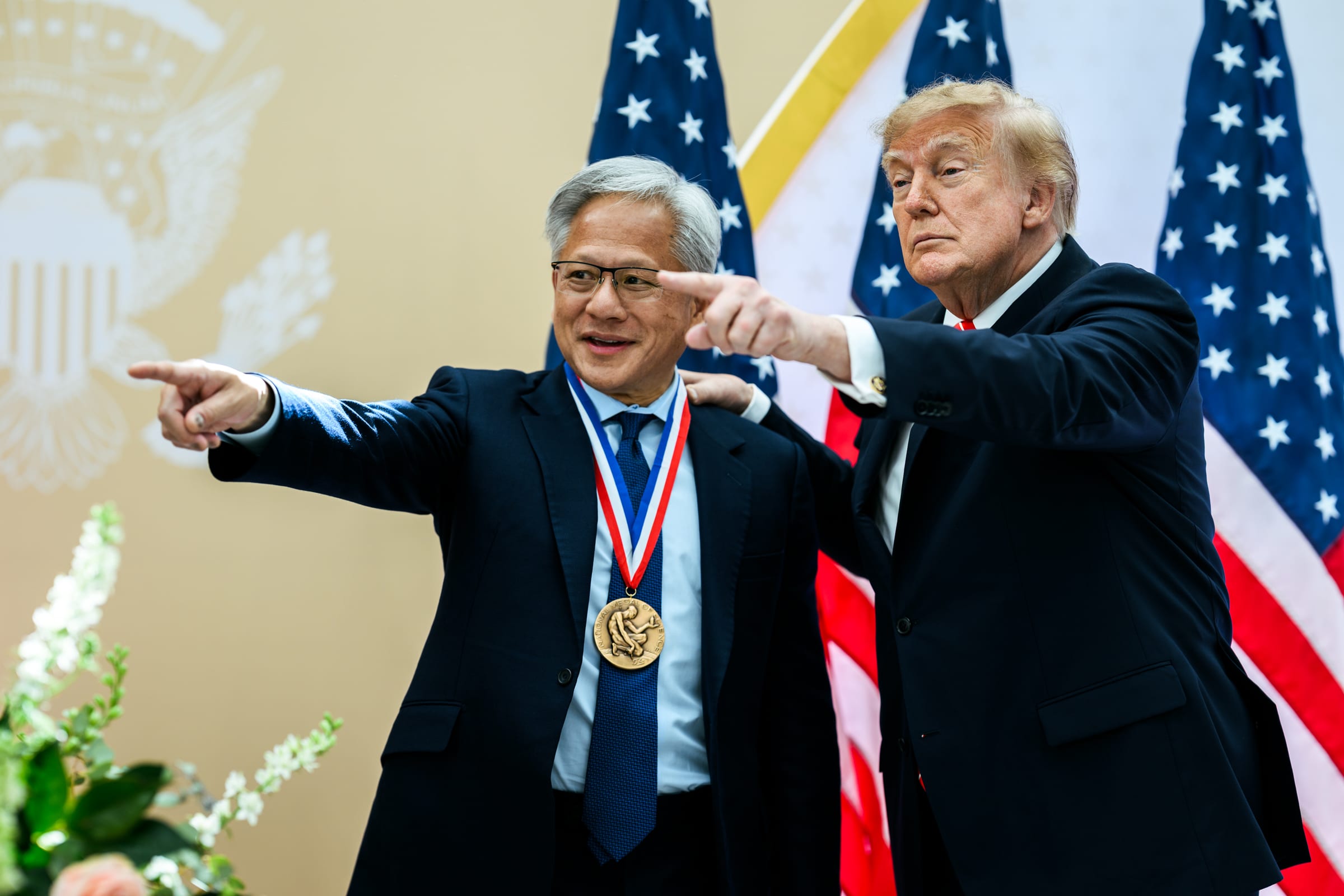
The Times found that a buyer cleared to assemble Nvidia's H200 chips has no working office and owners tied to a fund Washington blacklisted in 2024. Congress wants Nvidia's answers on November 18.
 Vincent Jiangthree-minute read
BEIJING and WASHINGTON, November 7, 2026.
The office that does not exist passed the security review
In a new industrial park on the northwest fringe of Beijing, the listed address of a company called New Matrix is a hollow gray shell, wires dangling from the ceiling where lights should be, the building directory omits the firm, and the property manager has no record of it; the company was created 17 months ago 1.
Earlier this year it was approved to assemble Nvidia's+3.65% — Nvidia, up 3.65 percent today H200 chips, the advanced AI processors President Trump allowed to be sold to China late last year, into AI computers 1. The Commerce Department was required to review buyers for national security risk before the chips could move, and New Matrix passed 1.
The pattern is the finding
Chinese corporate records tie New Matrix's owners to a prominent private equity fund the US government placed on a trade blacklist in 2024, and two analysts who reviewed the records believe the firm may be a front for companies associated with that fund 1.
The Times reports this as a pattern, not a one-off: Commerce keeps clearing Chinese firms with ties to trade-restricted entities to buy and handle Nvidia's chips 1. Who pays and who benefits is plain. Nvidia banks China revenue today, whoever stands behind New Matrix receives the machines, and the US security account absorbs the leak risk.
The market has started counting the risk
Nvidia traded near $187 on Friday afternoon, well below the 52-week high of $243.37 it set on October 6, and tech stocks have sold off since the midterms as scrutiny fears compound existing doubts about trillion-dollar data-center buildouts 2. That is a drawdown of roughly 23 percent in a month, a sign investors are starting to price the political channel, not just the demand curve 2.
Congress has already booked the room
Bloomberg reports the incoming Democratic majority intends to summon Jensen Huang and other Silicon Valley executives to testify publicly on whether Nvidia is doing enough to keep its chips out of the hands of China and other US adversaries, steps Republicans largely avoided over the past two years 3.
Three Republican House committee chairs, Brian Mast, John Moolenaar and Rick Crawford, have already asked Huang for a closed-door briefing on November 18 about his interactions with Alice Huang, a Megaspeed executive, the Chinese-linked tech firm she represents, and Nvidia's security protocols against foreign espionage; he was asked to accept the date or propose an alternative by November 11 4. A separate Times report on November 6 says a memo that circulated among top Trump policymakers last spring cited intelligence that Alice Huang was an asset of China's Ministry of State Security, recruited to collect information on the Nvidia chief 5.
The strongest counter, and what it misses
Neither the Times nor any published report shows an H200 reaching a restricted end user through New Matrix 1. The front claim rests on corporate records and two analysts' reading of them, and the firm could prove to be a sloppily documented assembler rather than a conduit.
But the review exists precisely to catch a buyer with no office and a blacklisted landlord, and it approved one anyway.
What to watch
The November 11 deadline decides whether Huang accepts the room or starts a standoff. The November 18 briefing, the day after earnings, decides what the three chairs do with what they hear. And Commerce's next clearance list decides whether the pattern widens or the license channel tightens.
The other gate is already jammed: about 600,000 H200s sit in Hong Kong because Beijing withholds approval for large-scale imports, so Washington now clears buyers Beijing will not let take delivery 6. The Inference followed this corridor from the US side earlier this week, when Huang was asked to brief the House committees 6. If the clearance process becomes a scandal, the license channel is what gets closed, and Nvidia's China business closes with it.
Get Policy & Labor by email, free
The rules governments write for AI, and what AI does to jobs. In our daily email, every weekday.

More about NVIDIA
NVDAFiscal Q2 2027Revenue rose 106% to $96.2B, 92.5% of it from Data Center, “driven by the ramp of our Blackwell Ultra infrastructure”. Gains on equity stakes of $7.8B lifted net income to $59.7B.
Show as a table
| Line | Value |
|---|---|
| Revenue | $96.2B |
| Gross margin | 75.0% |
| Operating margin | 66.2% |
| Net income | $59.7B |
| Hyperscale | $48.7B |
| AI clouds & enterprise | $40.3B |
| Data Center | $89.0B |
| Edge Computing | $7.2B |
| Gross profit | $72.1B |
| Cost of revenue | $24.1B |
| Other income | $7.8B |
| Operating income | $63.7B |
| Operating expenses | $8.4B |
| Tax | $11.8B |
| R&D | $7.1B |
| SG&A | $1.4B |