CoreWeave named VAST Data a partner, then agreed to buy SSDs directly from Solidigm; backlog $132.5 billion
CoreWeave's Q3 filing names VAST Data a partner and, in the same document, commits to buying SSDs directly from Solidigm, against a $132.5 billion backlog and $37-39 billion of capex. The question is what a storage software layer is worth when its biggest customer class buys the hardware itself.
 Vincent Jiangthree-minute read
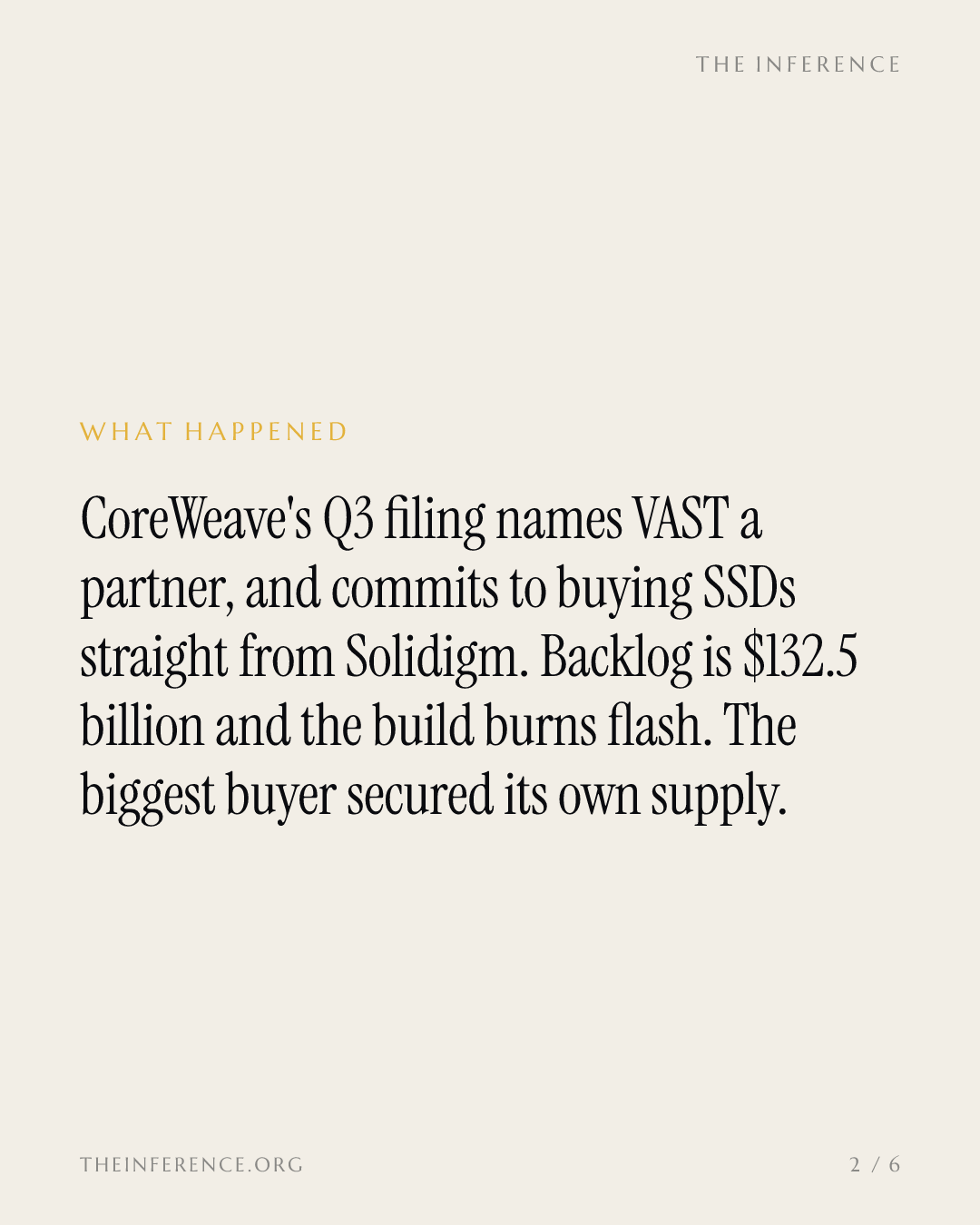
On November 10, 2026 CoreWeave+16.01% — CoreWeave, up 16.01 percent today filed the Form 8-K carrying its third-quarter results, and two lines in it touch the same shelf of the supply chain 1. The AI cloud provider named VAST Data~$9.1B — VAST Data, private, latest valuation ~$9.1B, the AI storage software company, in its new CoreWeave Partner Network of production-validated integrations, next to Grafana Labs and CrowdStrike+0.62% — CrowdStrike, up 0.62 percent today 1. The same release disclosed a multi-year agreement with Solidigm securing priority access to enterprise SSD capacity for CoreWeave itself 1. One document makes VAST a partner CoreWeave sells with, and shows CoreWeave buying the flash underneath that partnership at the source.
The commitment buys the queue position
A week earlier, VAST had said that 14 of its more than 1,000 customers committed over $10 billion in aggregate in the first three quarters, four of them over $1 billion each 2. It also said it aligned more than 200 exabytes of flash capacity with supply chain partners through 2029 2.
VAST's pitch is that a commitment buys the queue position when flash runs short. CoreWeave's Solidigm deal is the countermove: the biggest buyer standing in that queue just secured its own supply, from the flash maker, while keeping VAST's software on the price list. CoreWeave had already put $1.17 billion behind VAST and reported VAST's chief executive, Renen Hallak, calling the buildout one where "data sits at the center" of the new AI stack 2. What is new since November 10 is the direct-purchase line sitting beside the partnership line in one filing 2.
The build consumes the flash
CoreWeave's own numbers show why buyers are verticalising. Revenue backlog reached about $132.5 billion at the end of September, up 138% from a year earlier, against $3.66 billion of quarterly revenue, up 168% year over year 1. Full-year 2026 capital expenditure guidance rose to $37–39 billion, the fourth quarter's interest expense is expected at $1.05–1.15 billion, and about $9 billion of customer prepayments and deposits are expected to land in the next three months 1. The build converts commitments into shipments, and shipments consume flash.
Revenue has grown for nine straight quarters, to $3.66B in Q3 2026
Data
| Revenue | |
|---|---|
| Q2 '24 | 0.4 |
| Q3 '24 | 0.58 |
| Q4 '24 | 0.75 |
| Q1 '25 | 0.98 |
| Q2 '25 | 1.21 |
| Q3 '25 | 1.37 |
| Q4 '25 | 1.57 |
| Q1 '26 | 2.08 |
| Q2 '26 | 2.58 |
| Q3 '26 | 3.66 |
CoreWeave's capex keeps outrunning its operating cash
Capex ran ahead of operating cash in all five quarters
- Capital expenditure
- Operating cash flow
Data
| Capital expenditure | Operating cash flow | |
|---|---|---|
| Q3 '25 | 2.39 | 1.69 |
| Q4 '25 | 4.06 | 1.56 |
| Q1 '26 | 7.7 | 2.98 |
| Q2 '26 | 6.42 | 0.68 |
| Q3 '26 | 9.44 | 1.98 |
What the software layer is worth
The tension is now priced in both directions. VAST's claim is that it allocates the scarce thing; the $30 billion valuation from its Series F earlier this year, which included NVIDIA−5.72% — NVIDIA, down 5.72 percent today, rests on it 2. CoreWeave's filing points the other way: a customer large enough to buy queue position directly needs the storage layer less than the storage layer needs customers like it.
Neither claim is audited, and the backlog behind the build is contracted demand, not earned revenue, recognized only as capacity is delivered 3. The tell to watch is whether CoreWeave's next filings name VAST in its own infrastructure, or only in its storefront, and what price the listed fund holding VAST carries against that private mark.
Get Data Center by email, free
Who is building AI's data centers, and who is paying for them. In our daily email, every weekday.