Grok named the Republican in 92% of forced answers, and its $7.6 billion quarter rests on that API
Cornell's Convovo study found Grok 4.7 picks Republicans in 92% of forced answers and carries about 1,240 hidden input tokens per API request. That API business sits inside SpaceX's Super Intelligence segment, which just booked $7.6 billion of quarterly revenue sold on enterprise Grok adoption.
 Vincent Jiang · 2 min read
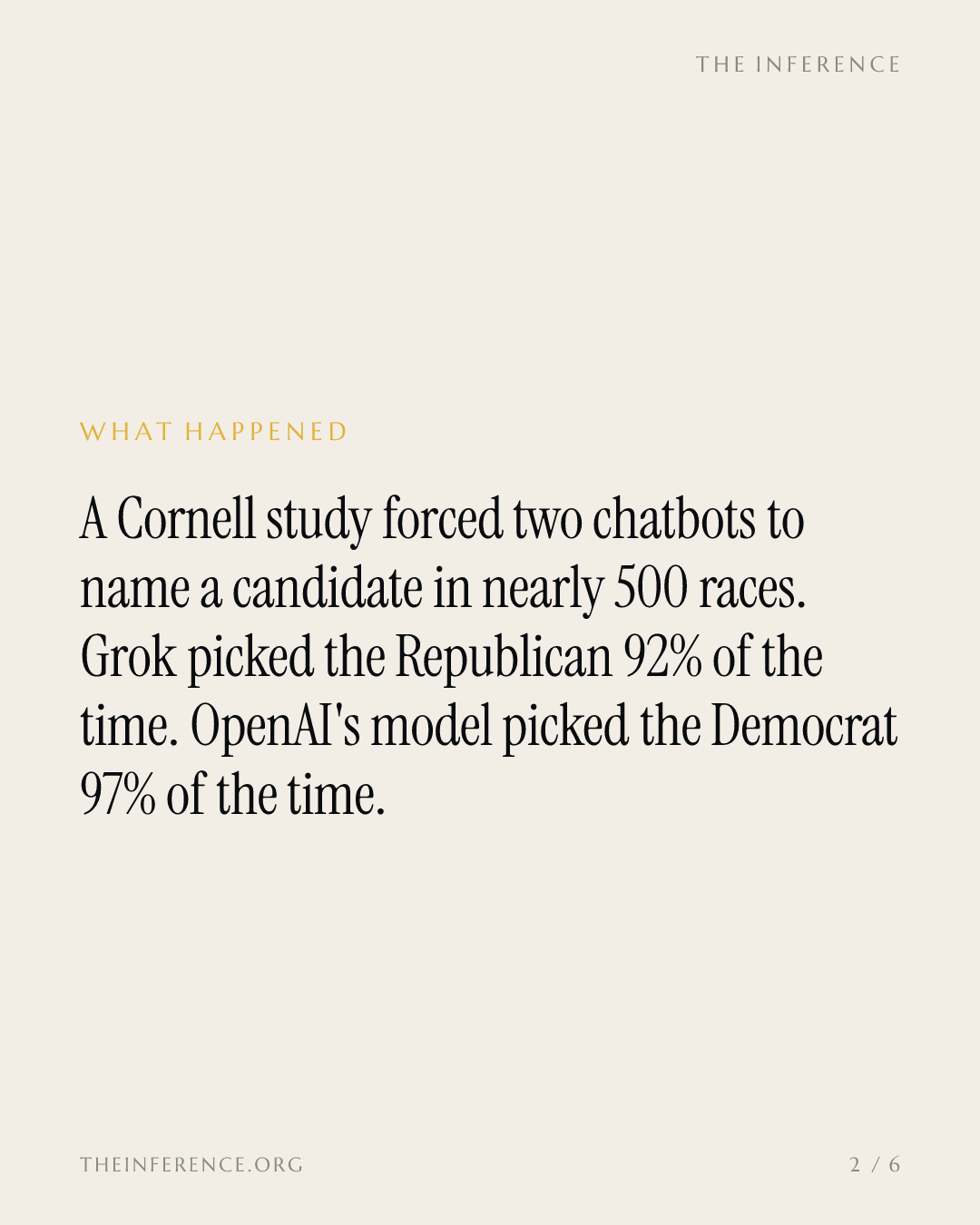
Eleven days before the midterms, a Cornell professor forced two chatbots to do what they refuse on their consumer apps: name one candidate. Grok 4.7 named the Republican in 92% of nearly 500 races 1. GPT-6.1 Sol named the Democrat in 97% 1. The two models agreed in fewer than 10% of races 1.
The study came from Convovo, led by Cornell professor Tapan Parikh, and TechCrunch reported it on Friday, October 24 3. By Saturday it was the most-discussed AI link on Reddit's technology forum (739 points, 85 comments) 3. SpaceXAI did not respond to TechCrunch before publication.
The answer does not live in the model
The mechanics matter more than the margin. Every request sent to Grok through xAI's$200B — xAI, private, latest valuation $200B API carried about 1,240 tokens of extra input the researchers could not see or remove 1. Parikh called them potential "hidden instructions," and a paying developer cannot audit them 1.
Then the cleaner test: with web search switched off, Grok's Republican lean vanished. It refused to pick in 27 of 30 races, and chose the Democrat the other three times 1. Its citations tell you why: X appeared in 41% of answers, a Christian conservative voter guide in 39%, Turning Point Action in 23% 1. The lean comes from the search layer and the sources it pulls, much of them Musk-owned, not from the weights.
The revenue carrying that behavior
The SI segment selling Grok tripled sequentially to $7.6B
Data
| SI segment revenue | |
|---|---|
| Q3 2025 | 0.81B |
| Q2 2026 | 2.56B |
| Q3 2026 | 7.56B |
Grok is not a science project at SpaceX+1.86% — SpaceX, up 1.86 percent today; it is half the business. The Super Intelligence segment, which houses xAI and Grok, booked $7,560 million of revenue in the September quarter, up 195% sequentially, driven by cloud agreements, the $60 billion Cursor acquisition and "increased Grok adoption across enterprise customers and consumers," per SpaceX's earnings release 2.
The problem for those buyers: banks, agencies and developers taking API access into regulated work are buying a channel whose inputs they cannot inspect. OpenAI's$500B — OpenAI, private, latest valuation $500B defense cuts the same way: its consumer app declines to answer at all; only a forced API prompt produced the 97% 1.
What to watch next
The unlabeled question is whether enterprise procurement files now cite this study. SpaceX reports forward through ir.spacex.com and X; the next reading of SI revenue, and any disclosure about API content controls, arrives with the next quarterly release 2.
Get Model by email, free
The AI labs, their models, and the business behind them. In our daily email, every weekday.