CXMT's memory push cut Tokyo Electron 7% twice in three sessions; October 30 tests its China line
China is Tokyo Electron's biggest regional market, and the Chinese DRAM maker leading that buildup set off the selloff that cut the stock about 7 percent twice in three sessions. The October 30 report brings the first full-year guidance and the first regional split since the rout.
 Vincent Jiangthree-minute read
Two seven percent drops, both traced to Hefei
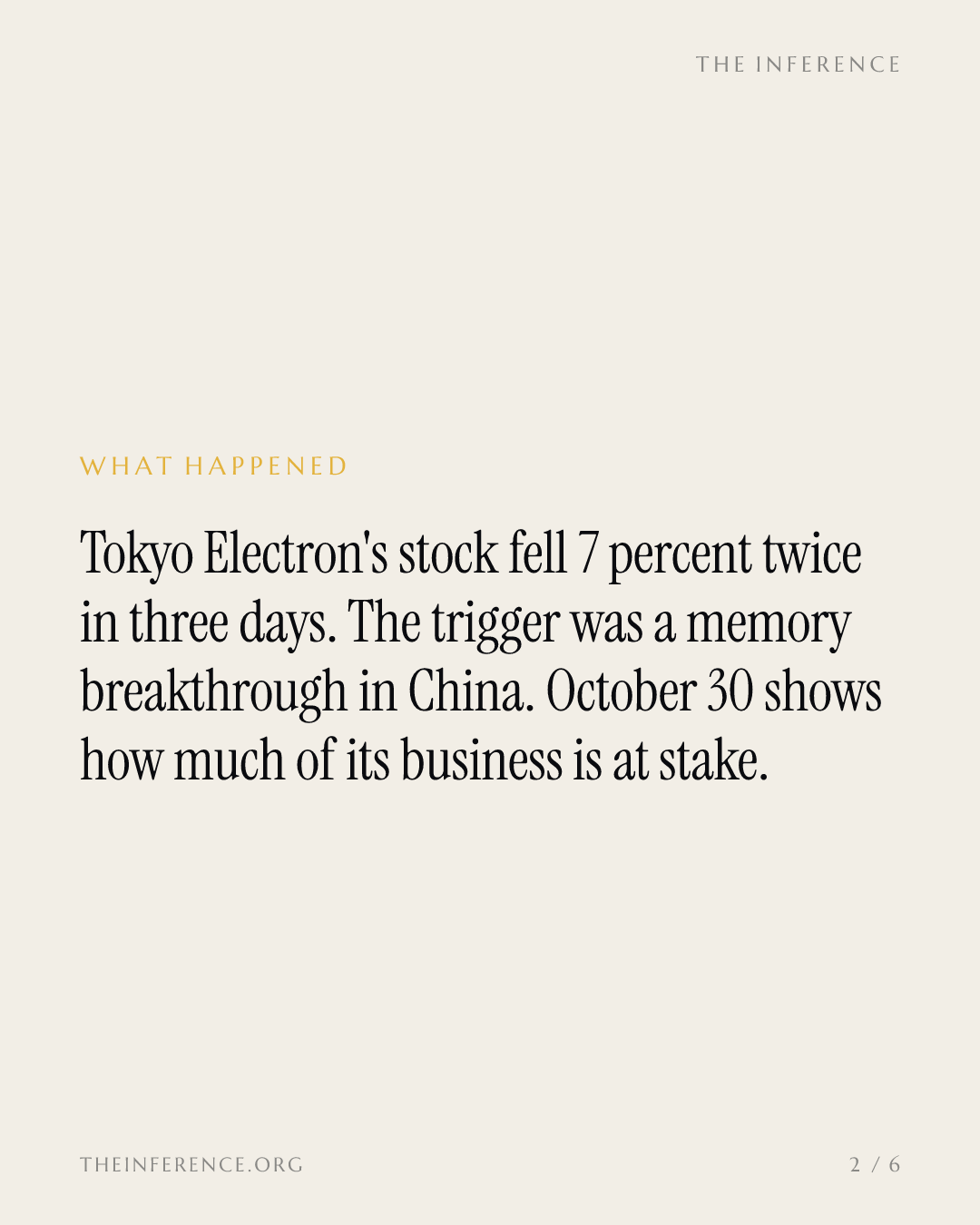
Tokyo Electron−5.60% — Tokyo Electron, down 5.60 percent today, the Japanese maker of fab tools that coat, etch and clean silicon wafers, dropped 7.2 percent on October 13, the day a disclosure from ChangXin Memory Technologies−4.98% — ChangXin Memory Technologies, down 4.98 percent today, China's largest DRAM maker, on its denser 4F² memory cell sent Samsung down 7.39 percent and SK hynix+2.95% — SK hynix, up 2.95 percent today down 10.09 percent 123. It fell another 7.30 percent on October 15 as investors questioned debt-funded AI spending 123.
SK hynix fell hardest on the day CXMT's 4F² cell news landed
Data
| One-day move, October 13 | |
|---|---|
| Tokyo Electron | -7.2% |
| Samsung | -7.39% |
| SK hynix | -10.09% |
CXMT had forecast on October 17 that third-quarter revenue rose more than sixfold to 119.7 billion yuan ($16.8 billion), its first formal swing to profit, in the quarter The Inference covered here 1. The 4F² cell cuts area per memory cell by a third without the extreme-ultraviolet scanners that export curbs keep from China, and a fifth-generation process, in volume since September, reaches 11.95 nanometers on quadruple patterning for 50 percent more chips per wafer 14.
CXMT fills Tokyo Electron's order book with one hand and drains its customers' margins with the other.
China is still the biggest line on the invoice
China bought 222.9 billion yen of Tokyo Electron tools in the April to June quarter, up slightly from 212.1 billion a year earlier and still the largest regional line at 30.4 percent of sales 5. The share is down from 49.9 percent two years ago; the growth simply moved 5. Taiwan, where TSMC+7.02% — TSMC, up 7.02 percent today builds advanced logic, bought 186.1 billion yen, up 66.9 percent, and Korea, home of Samsung and SK hynix, 152.4 billion, up 72.6 percent 5.
China is Tokyo Electron's biggest market; Taiwan and Korea are its growth
Data
| Sales by destination | |
|---|---|
| China (+5% y/y) | ¥222.9B |
| Taiwan (+67% y/y) | ¥186.1B |
| Korea (+73% y/y) | ¥152.4B |
Behind the Chinese demand sits a state-backed machine: 238.0 billion yuan of equipment assets at midyear, a May IPO that raised 57.9 billion yuan, and a capacity target of 350,000 wafer starts a month by the end of 2026, rising toward 550,000 by 2028 1.
October 30 prices the customer and the threat
Tokyo Electron reports on October 30, when it issues its first full-year guidance after June-quarter revenue of 732.39 billion yen, up 33.3 percent, and a raised first-half outlook of 1.62 trillion yen, up 37.3 percent 35. One detailed Japanese analysis sets the dividing line: the bull case needs full-year revenue guidance above 3.4 trillion yen; the bear case shows up as China falling well under 200 billion yen a quarter 5.
The market leans bull. Tokyo Electron itself sees the wafer-equipment market passing 190 billion dollars in 2027 5, and the average analyst target of 15,310.91 yen sits 44 percent above the October 16 close of 10,630 yen 6. Saxo Bank chief investment strategist Charu Chanana called the selloff a repricing of the cost of capital rather than a technology problem 2. The tell on October 30 is the China line in yen, not the percentage share 2.
Get Chips by email, free
How AI demand is reshaping chipmakers, memory and the fabs behind them. In our daily email, every weekday.