FirstEnergy nearly doubles contracted AI load in nine months to 7.9 GW, and Ohio votes on who pays
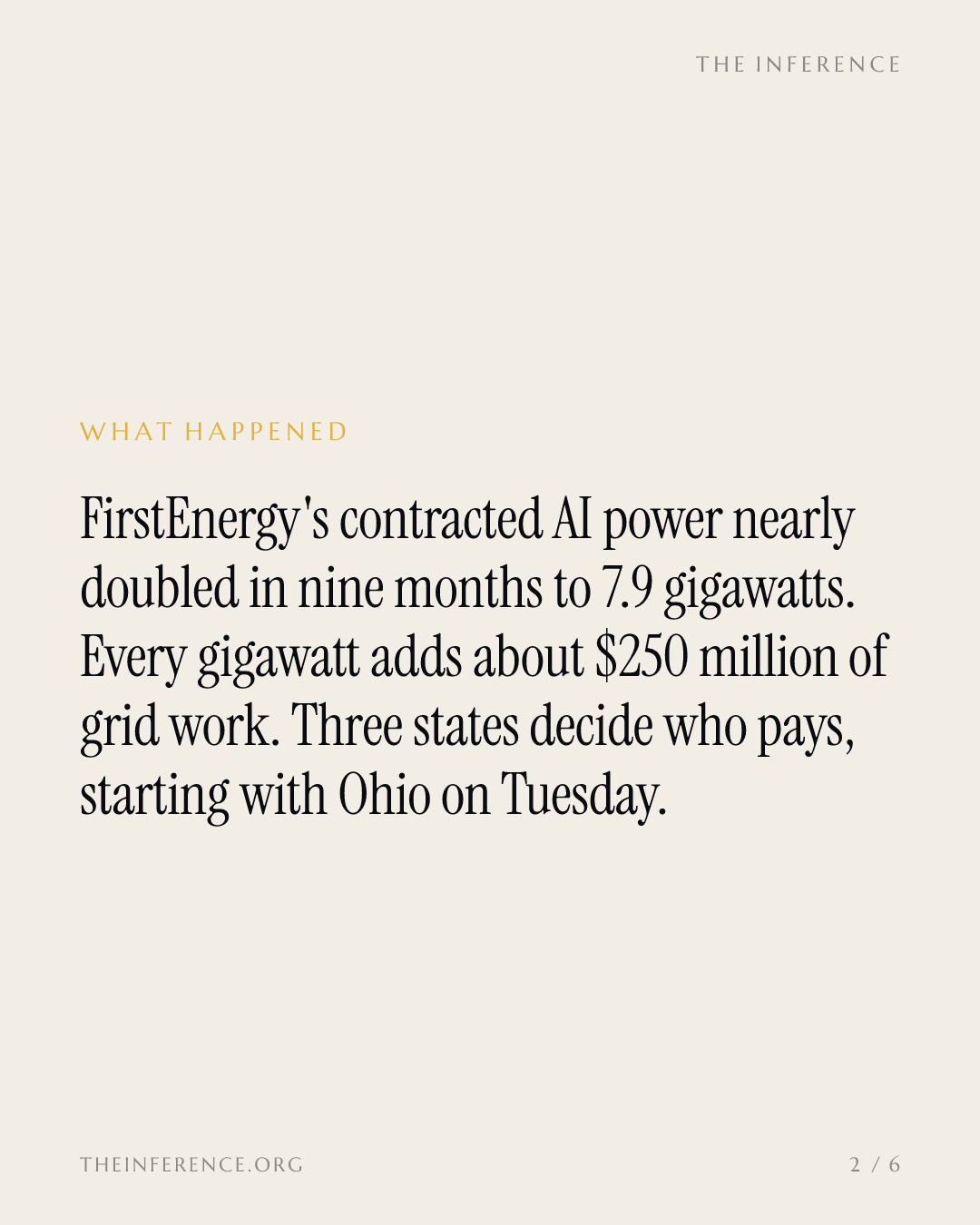
FirstEnergy's contracted data-center load nearly doubled in nine months to 7.9 gigawatts, and management put numbers on the shareholders' share of the $36 billion buildout. Regulators in three states, starting with Tuesday's Ohio vote, decide whether the structure pays.
 Vincent Jiang · 3 min read
FirstEnergy+0.70% — FirstEnergy, up 0.70 percent today, the Akron-based utility serving about 6 million customers in six states, is building a $36 billion grid on the back of artificial intelligence demand, and the open question is who funds it 13. On the October 28 earnings call, chief executive Brian Tierney reported contracts to supply data centers through 2036 reached 7.9 gigawatts at the end of the third quarter, up 23% from 6.4 gigawatts at the end of June and 90% above the end-2025 level, with another 4 gigawatts in active negotiation and a 26-gigawatt total pipeline 123.
Contracted load rose 23% in a quarter; the 26 GW pipeline looms behind it
Data
| Value | |
|---|---|
| Contracted, Q2 2026 | 6.4 |
| Contracted, Q3 2026 | 7.9 |
| Total pipeline, Q3 2026 (contracted + prospective) | 26 |
Every contracted gigawatt adds a quarter-billion to the grid
The buildout carries a price tag. Each contracted gigawatt requires roughly $250 million of transmission upgrades, so FirstEnergy expects its $19 billion transmission plan to grow by at least 25%, or $4.75 billion, inside that $36 billion five-year capital program 13. Someone funds that.
Management's answer: the data centers pay. In West Virginia, where Monongahela Power and Potomac Edison want to build the $2.7 billion Maidsville gas plant, offtakers have signaled openness to fund much of it through a surcharge 13. For shareholders, the cost is quantified: up to $2 billion of new equity through 2030 and up to 35% equity funding on incremental projects 3.
The money case is priced, and regulators hold the gates
For investors, the demand fact is now priced against a payout that depends on regulators. FirstEnergy reaffirmed 2026 core earnings guidance of $2.62 to $2.82 a share and expects growth near the top of its 6% to 8% range through 2030 3. Analyst targets sit at $50, against a $46.83 close on October 29, so the stock trades on the buildout converting, not on demand appearing 35.
Three gates decide that. The West Virginia certificate for Maidsville, expected in the fourth quarter, unlocks the plant's contracts 13. Pennsylvania's commission has already rejected FirstEnergy's data-center billing plan 3-2, as reported when this covered the Q2 buildout 5. And February's updated capital plan gives the transmission uplift and equity needs their first full numbers, after New Jersey's affordability review reaches resolution expected later this year or early next 3.
The politics that sets the mood votes Tuesday
Then there is Ohio. On October 29, the Energy and Policy Institute reported that super PACs backing Senator Jon Husted received $2 million this year from two 501(c)(4) groups FirstEnergy secretly funded in 2018, years before the company agreed to pay $275 million in refunds and fines over its bribery schemes 4. A New Jersey review could reshape investment there too, with resolution expected this year or early next 3.
When this covered the Q2 buildout on October 26, banks' $50 targets were betting on 4.3 gigawatts and the politics was the caveat 5. What is new since: the contracted load nearly doubled in nine months, the transmission uplift got its first number, the shareholders' equity share was quantified, and the dark-money report landed four days before Ohio votes 134. The decision rule: 7.9 gigawatts is a demand fact, but the earnings are a regulatory variable, set in three states starting with Tuesday's ballot 134.
Get Power by email, free
How AI's hunger for electricity moves utilities, power plants and the grid. In our daily email, every weekday.