A tariff Duke is writing in South Carolina decides who pays for AI's power plants
Duke Energy told South Carolina regulators it will seek the large-load tariff it settled in North Carolina, while two methane plants totaling 2,720 megawatts move through permitting behind it. The rule inside that tariff, more than the turbines, decides whether the AI buildout is billed to the companies that cause it or to millions of households.
 Richard Tang · 3 min read

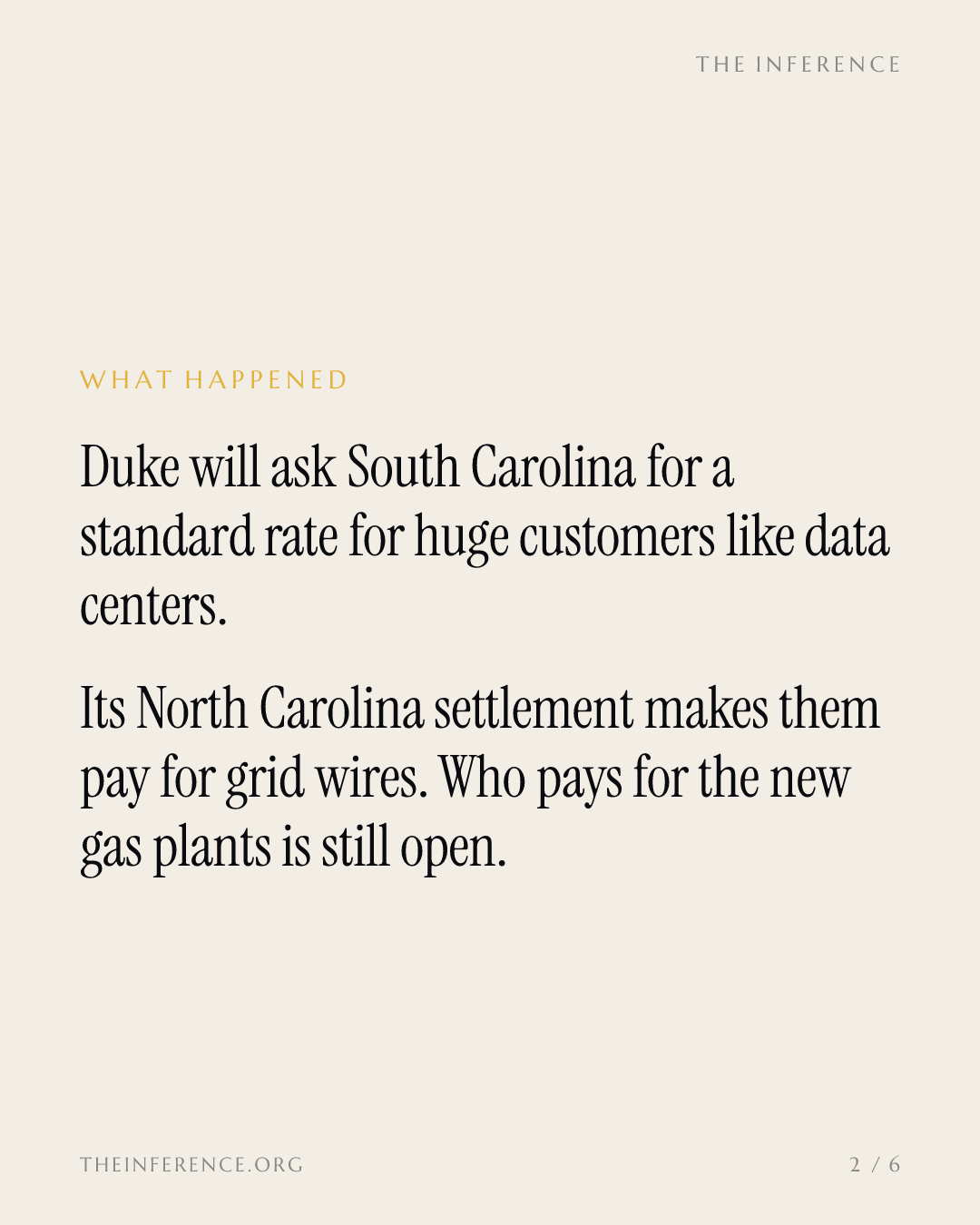
Duke Energy+1.53% — Duke Energy, up 1.53 percent today told South Carolina regulators this week it will seek a large-load tariff: a standard published rate for very large customers, set by regulators, that any data center can take rather than a contract negotiated one customer at a time.
It is a reversal after years of individual contracts, with "broad agreement" on key principles even as details remain in dispute, while Dominion Energy+2.46% — Dominion Energy, up 2.46 percent today, which also serves the state, plans to keep signing bespoke deals 1. One utility is now writing the rule that decides who pays for the AI buildout, across two states at once.
The tariff covers wires, and nobody has settled the plants
A data center is a customer no rate class was built for: it arrives huge, and it can leave. The North Carolina settlement, signed by Amazon−2.01% — Amazon, down 2.01 percent today, Google, Meta−0.53% — Meta, down 0.53 percent today and Microsoft−1.62% — Microsoft, down 1.62 percent today, makes large loads pay upfront for their own substations and post security for shared transmission; we reported the terms on October 15 2.
Governor Josh Stein describes the rest of the deal: contracts on a public template, minimum-purchase guarantees, and a duty to cut use when the grid is strained, which lasts only the first five years 3. The Federal Energy Regulatory Commission approved the federal transmission layer on October 9, one commissioner calling the protections "meaningful, if imperfect" 4.
Stein and Jackson want data centers to pay for the plants
Generation is the open link. Stein and Attorney General Jeff Jackson want the loads that force new plants onto the system to pay for them, pointing to what other states extracted from the same companies 3. "North Carolina should be receiving these same kinds of commitments, but right now we're getting none of them," Stein said 3. Jackson's objection is narrower: the settlement has large users covering transmission lines, but who pays for power plants is left unclear 3.
Other states won clean-energy megawatts from data-center developers; North Carolina won none
Data
| Value | |
|---|---|
| Google, Minnesota | 2,000 MW |
| Meta, Ohio | 1,200 MW |
| Amazon, Indiana | 960 MW |
| North Carolina's haul | 0 MW |
The gas is already in permitting
The bill being written is concrete: Duke filed its pre-construction notice this month, an initial regulatory step, for two methane plants of 1,360 megawatts each on the Yadkin River in Davie County, North Carolina, with gas storage across the river in Davidson County 5 6. The Southern Environmental Law Center has appealed Davie County's view that the plants are permitted "by right" in a residential-agricultural zone with no public hearing; the hearing is due by November 23 5. Davidson County's commissioners vote on their rezoning on November 9 6.
If the tariff stops at the wires, households are the backstop
If the tariff stops at wires, the cost of those plants lands on Duke's 8.7 million customers through their rates 7, including the North Carolina households whose rate case we reported on October 23. Duke's construction spending already runs well ahead of the cash its operations generate 8. In Lexington, the Davidson County seat, residents wore "No Gas Plants, No Data Centers" shirts to the planning hearing; Duke says demand is driven mostly by manufacturing and migration, not data centers 6.
Duke's construction spending now outruns the cash its operations generate
- Capex
- Operating cash flow
Data
| Capex | Operating cash flow | |
|---|---|---|
| Q3 '23 | $3.05B | $3.52B |
| Q4 '23 | $3.29B | $2.57B |
| Q1 '24 | $3.21B | $2.47B |
| Q2 '24 | $3B | $2.95B |
| Q3 '24 | $2.99B | $3.52B |
| Q4 '24 | $3.09B | $3.38B |
| Q1 '25 | $3.15B | $2.18B |
| Q2 '25 | $3.28B | $2.86B |
| Q3 '25 | $3.45B | $3.63B |
| Q4 '25 | $4.14B | $3.66B |
| Q1 '26 | $4.09B | $1.51B |
| Q2 '26 | $4.15B | $2.76B |
The dates that decide it land within weeks
Duke reports third-quarter results on November 5 9, two days after midterms in which voters decide 34 data-center ballot measures across 30 counties 10. North Carolina's Utilities Commission is expected to rule on the settlement by mid-November 2; the plants' full certificate application follows early next year, after the state's resource-plan order due by year-end 5. The settlement covers the wires; extending it to generation is the fight now before the commission.
The South Carolina filing will show which principles Duke treats as settled; the mid-November order will show whether the tariff reaches power plants; the November 23 hearing will show whether the 2,720 megawatts stay on schedule. The buildout should proceed, priced to the customer who causes the cost: that is the counterweight that keeps AI off the backs of households least able to pay.
Get Power by email, free
How AI's hunger for electricity moves utilities, power plants and the grid. In our daily email, every weekday.