Harvey's agents burned 15.6 billion tokens in 14 days; Figma's gross margin fell to 83.7%
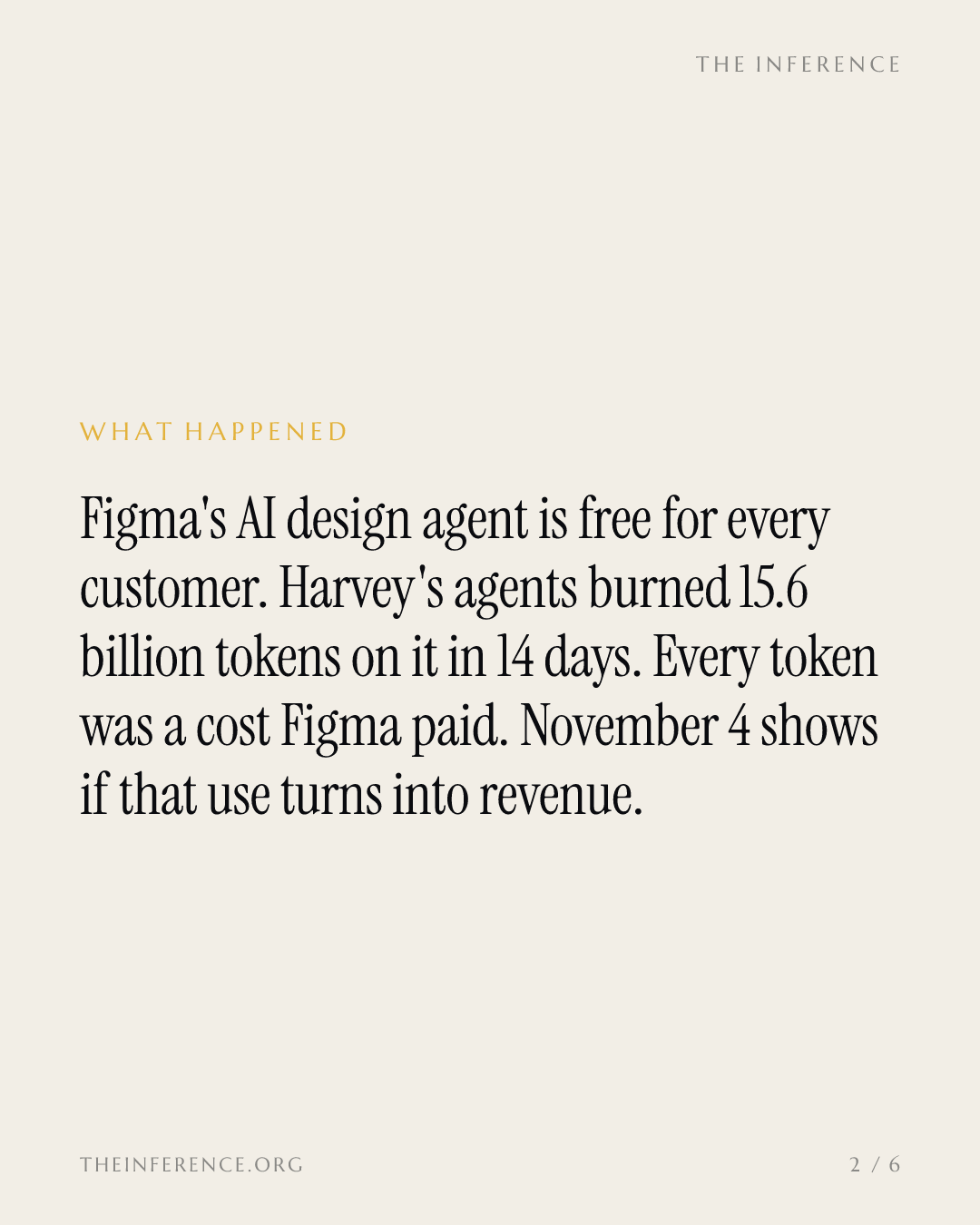
Harvey's October 21 account is the first customer-side count of design work run entirely by agents on Figma's canvas, and every token of it is a cost Figma pays. The November 4 third-quarter report decides whether that consumption converts into paid credits or stays free.
 Vincent Jiangtwo-minute read
Figma's+2.01% — Figma, up 2.01 percent today AI design agent has been free for every customer for about a week, and the company's own filings show what that costs: gross margin fell from a 92.4% peak in the December 2024 quarter to 83.7% in June 2026, even as revenue grew 48% to $370 million 2. On October 21, a customer finally showed what the free agent buys 1. Harvey$15.5B — Harvey, private, latest valuation $15.5B, the legal-AI software company, published a full account of design production run by agents inside Figma 1.
Revenue still compounding at 48% even as margins slip
Data
| Revenue | |
|---|---|
| Q1 '24 | $0.16B |
| Q2 '24 | $0.18B |
| Q3 '24 | $0.2B |
| Q4 '24 | $0.22B |
| Q1 '25 | $0.23B |
| Q2 '25 | $0.25B |
| Q3 '25 | $0.27B |
| Q4 '25 | $0.3B |
| Q1 '26 | $0.33B |
| Q2 '26 | $0.37B |
One customer's agents, counted
Harvey's agents built a launch film scene by scene in Figma Motion, keep 44 reusable demo flows, and generate a tailored product film for each target account 1. The numbers are concrete: a batch of 36 films rendered in 69 minutes, and when Harvey hit Figma's daily call cap, overnight agents scripted and voiced the next 97 1. One operator, Shawn, burned 15.6 billion tokens across Figma, ElevenLabs~$3.3B — ElevenLabs, private, latest valuation ~$3.3B and Figma Weave in 14 days 1.
The cost lands on Figma
Usage at that scale is exactly the bill Figma carries. CFO Praveer Melwani said products in beta carry no charge and Figma "bears the cost of inference without offsetting consumption revenue" 2. Harvey's engineers even worked around Figma's own limits: queued agents pushed calls to two-minute timeouts until they split work across three parallel files 1. The free agents recruited a power user; the question is whether that becomes revenue.
November 4 decides it
Two lines tell. Over 80% of customers spending more than $10,000 a year already consumed AI credits weekly at the end of June, and net dollar retention stood at 136% 23. But Q2 brought a GAAP operating loss of $117.3 million, R&D spend more than doubled to $167.3 million, and the stock sits down about 43% this year 23. Figma reports Q3 on November 4, its first print since the agent reached every customer 23.
Meanwhile CEO Dylan Field calls MCP "not a perfect protocol" even as Figma adds more than 20 agent partners, citing security limits on what data it exposes 45. If Harvey-style consumption converts to paid credits, the giveaway worked. If not, Figma is running a compute-scale service on seat prices. The November 4 count answers which 45.
Figma's gross margin slid from 92.4% to 83.7% while the agent went free
Data
| Gross margin | |
|---|---|
| Q3 '24 | 90.6 |
| Q4 '24 | 92.4 |
| Q1 '25 | 91.5 |
| Q2 '25 | 88.8 |
| Q3 '25 | 69.4 |
| Q4 '25 | 82.1 |
| Q1 '26 | 79.4 |
| Q2 '26 | 83.7 |
Figma's gross margin under GAAP, by fiscal quarter, from its SEC filings 2. The June 2026 quarter is the latest reported before November 4 2.
Learn more in our earlier piece on the margin slide and what the credit data already showed.
Get Applications by email, free
How AI is changing the software people and companies use. In our daily email, every weekday.