Heights Capital buys $2 billion of IonQ stock at $40, down from $93 last year; dilution runs past a third
Heights Capital Management has committed at least $7 billion to IonQ in just over a year, but each round prices lower and the dilution now runs through raises, warrants and all-stock acquisitions. Public holders are funding all of it.
 Vincent Jiang · 3 min read

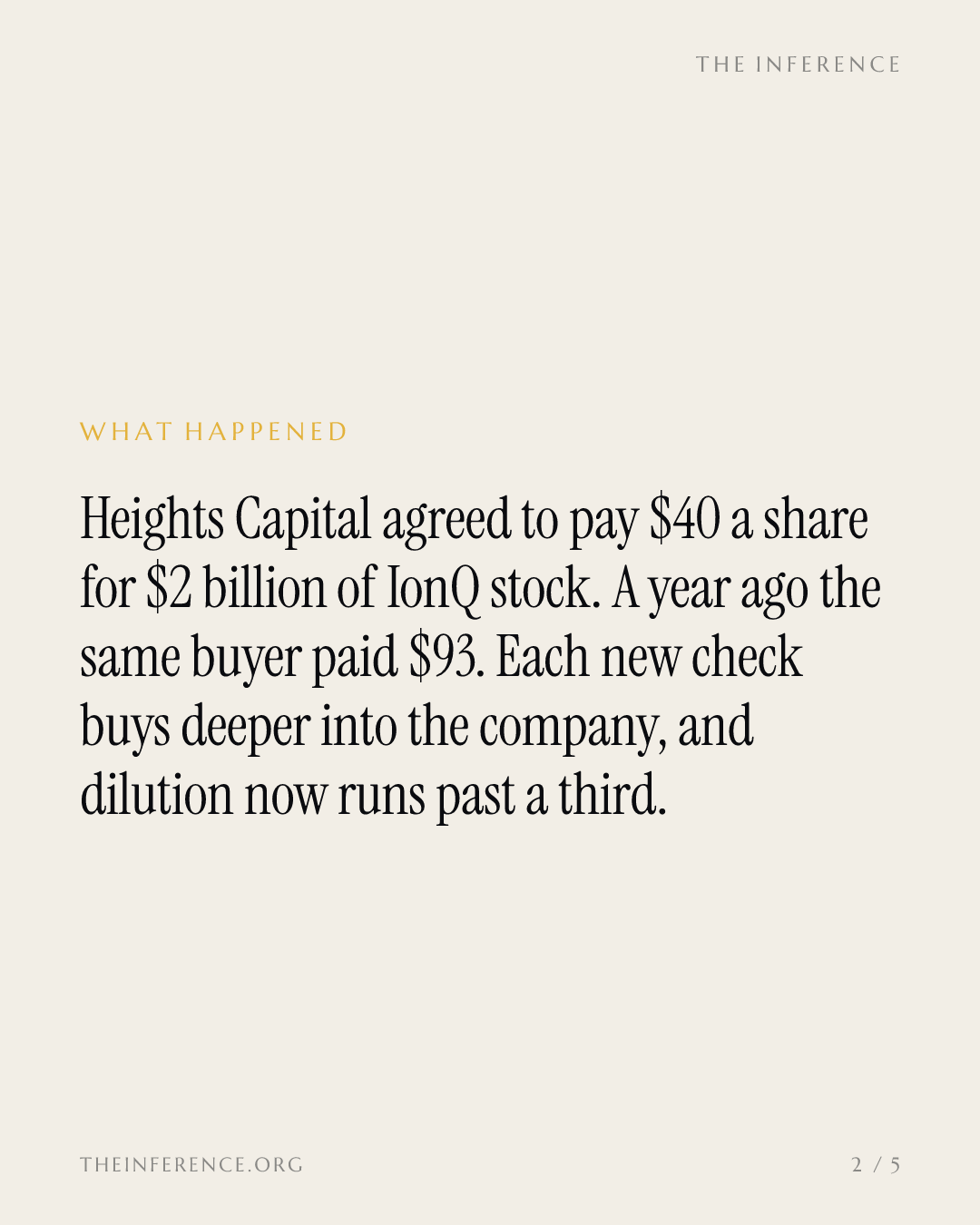
Heights Capital Management, an affiliate of trading firm Susquehanna International Group, agreed on October 14 to pay $40 a share for $2 billion of IonQ−0.19% — IonQ, down 0.19 percent today stock 3. In October 2025 the same buyer paid $93 3. The same $2 billion now buys about 2.3 times the shares it did a year ago, and the stock fell 9.5% on announcement day even though Heights paid a 15% premium to Tuesday's close 3.
Each Heights deal buys IonQ cheaper relative to the market
Data
| Value | |
|---|---|
| Jul 2025 deal | 25 |
| Oct 2025 deal | 20 |
| Oct 2026 deal | 15 |
Each deal costs the public holder more of the company. The sliding premium is the paper trail: in July 2025 Heights paid about 25% above market, last October 20%, now 15% 3. The whale keeps writing checks, and each check buys deeper into the register.
The dilution runs through raises, warrants and acquisitions
The offering is 20.5 million shares and pre-funded warrants at $40, plus seven-year warrants for 100 million more shares struck at $69.46, a 100% premium to the prior close 4. Counted fully, IonQ's share count rises from about 409 million to roughly 559 million, more than a third 3. The warrants also block Heights from holding over 4.99%, so converting them means selling into the market along the way 3.
Dilution does not stop at the raise. On October 12 IonQ agreed to buy Elisity, a zero-trust cybersecurity firm, in an all-stock deal worth up to $1.3 billion, about 11% of its $11.5 billion market value 2. That lands on top of the $1.8 billion purchase of SkyWater, the chip foundry that also manufactures for rival D-Wave, which we covered when the deal closed July 31 2.
Shareholders fund the acquisitions in stock, then fund the cash hoard in shares too. What they get back is a buffer: the raise lifts net tangible book value from $0.98 to $5.48 a share, so a cash crunch looks less likely even as one buyer gains pricing power over every new dollar 3.
Public holders pay a different price than the whale
The stock is down 43.6% over the past year while the S&P 500 gained 15.1%, sits 56.6% below its May 29 close of $72.07, and has fallen at least 50% within the year in four of the last five calendar years 2. The clearest verdict on price is the multiple: fiscal 2026 revenue guidance of $280 million to $290 million against a market cap of roughly $11.5 billion is about 40 times the guide 2. Heights pays $40 with long-dated options attached; the market pays full freight 2.
What decides it
Heights' own terms set the scoreboard. Its warrants pay nothing below $69.46, and even Wall Street's average 12-month target of $66.63 sits under that strike 3. Management has put the first combined revenue outlook with SkyWater on the next quarterly report, followed by commissioning the first 256-qubit customer systems in the first half of 2027 2. Judge those two datapoints when they arrive: if revenue outruns the new stock, dilution was the entry fee; if not, the whale keeps setting the price.
What to watch
The next quarterly report brings the first revenue outlook counting SkyWater, and the first 256-qubit customer systems are scheduled for the first half of 2027 2. Both dates are priced into a stock that has halved in four of the last five years. The whale has already voted with $7 billion; the next two readings say whether the vote was right 2.
Get Deals by email, free
The acquisitions, rounds and contracts that move AI money. In our daily email, every weekday.