IBM's software grew 8%, but half came from Confluent's $11 billion deal and lapses in Q2 2027
IBM said more than four of software's nine points of growth were organic, after a flat spring. About half the segment's increase still matches what Confluent sold on its own before the $11 billion deal.
 Richard Tang · 2 min read

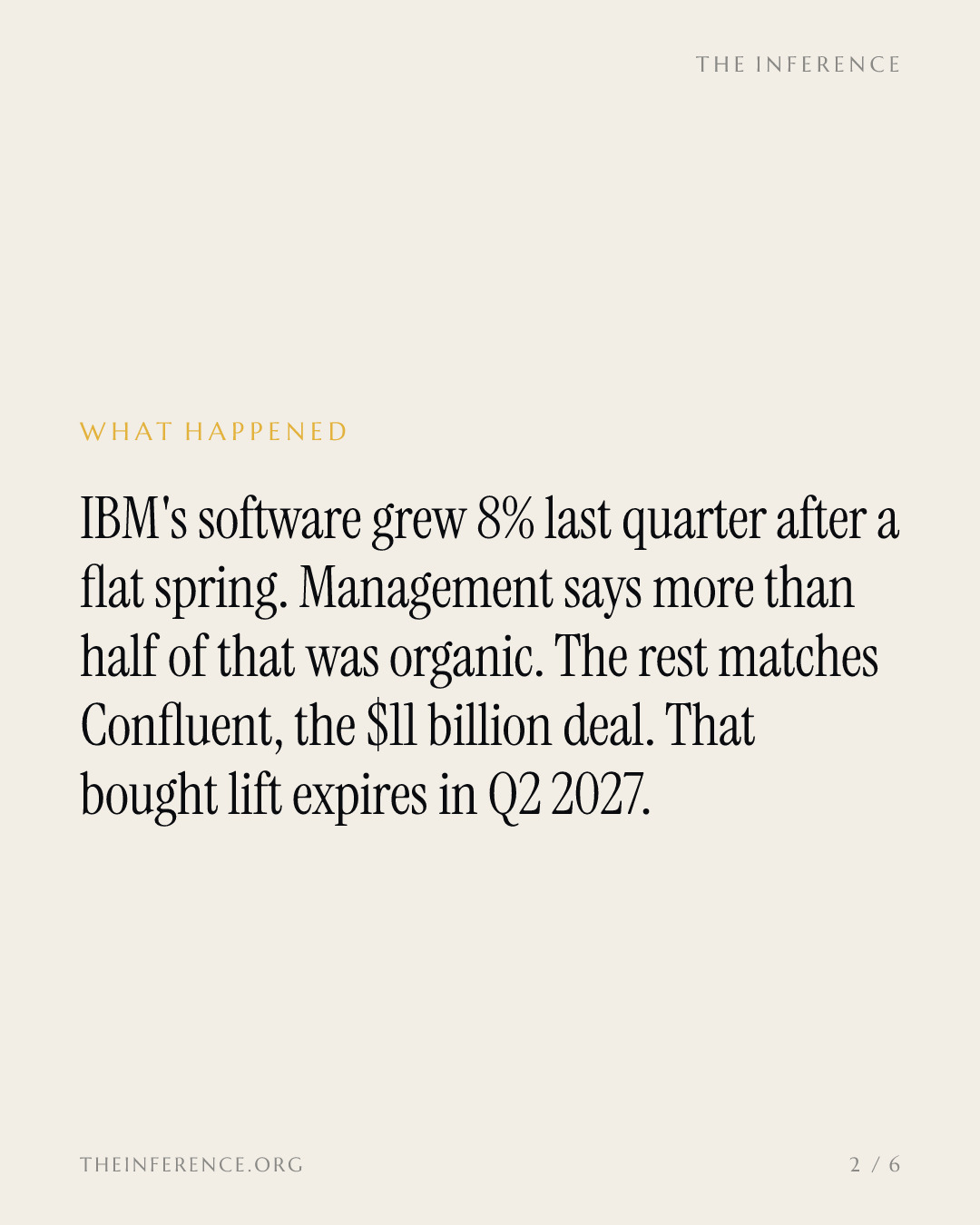
The receipts from Wednesday settle half the argument over IBM's−0.82% — IBM, down 0.82 percent today software business. Software revenue grew 8% 1, and on the call chief financial officer Jim Kavanaugh said more than four of the segment's nine points of constant-currency growth were organic 2. A quarter after IBM said its own software sales were flat 3, that is a real inflection, and it clears the low bar Bank of America's+0.50% — Bank of America, up 0.50 percent today pre-print note set when it had the organic line shrinking 3. The other half of the growth arrived by acquisition, and that half has an expiry date.
IBM paid $11 billion for the gap between models and enterprise data
Confluent moves data between a company's systems as events happen, on Apache Kafka. AI agents are only as current as the data feeding them, and Krishna told analysts that 72% of enterprises report insufficient real-time data infrastructure while most enterprise data never leaves company walls 2. IBM closed the purchase on March 17 at about $11 billion 3, made Confluent the data foundation of its agent stack, and launched Streamhouse to fuse live and analytical data 2.
Turning a model into something an enterprise can run is the work that deserves the reward, and IBM chose to buy the company doing that work for data. The data line grew 20% at constant currency 1, and Confluent bookings rose about as fast 4.
What IBM built and what it bought still cannot be separated
IBM publishes no Confluent revenue line, the gap we flagged when the deal closed 5. Software added $595 million over the year 5. Confluent sold $298.5 million on its own in that year-earlier quarter 6, about half the increase. Strip that run-rate out and the segment grew roughly 4%, which matches management's own organic claim 5.
A quarter of the acceleration came from deals recovered from the spring stumble, when slipped contracts drove a 25% one-day share drop 7. IBM has also not published its generative AI book of business since January 5, so these estimates are all the market has.
IBM software growth stalled at 5% in the spring and rebounded to 8%
Data
| Software revenue growth | |
|---|---|
| Q3 2025 | 10% |
| Q4 2025 | 14% |
| Q1 2026 | 11% |
| Q2 2026 | 5% |
| Q3 2026 | 8% |
The bought half expires next spring
Acquired sales count as growth for one year, so Confluent's lift disappears in the second quarter of 2027 3. IBM raised its full-year software guide to 7–8% 4, which says management expects the recovery to outlast the calendar. Holders paying about 22 times earnings own the unverified half: whether the data line holds its pace once the bought lift is gone 7.
Half of the rebound came with an acquisition receipt attached. Spring shows what IBM actually built.
Get Platforms by email, free
The cloud, data and developer software AI is built on. In our daily email, every weekday.