Intel shareholders sue over what the company said while selling $23 billion of stock at $95
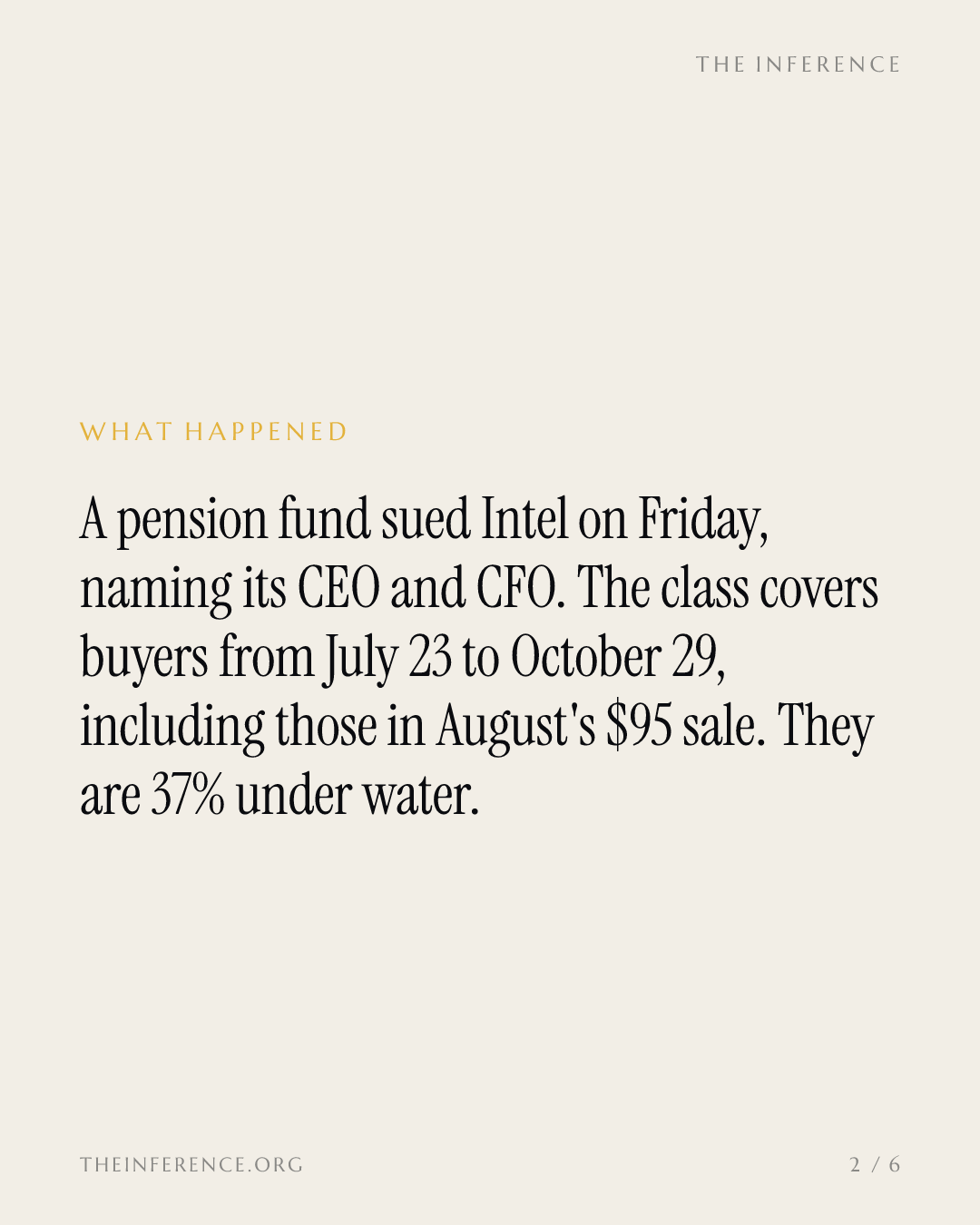
The proposed class action, filed Friday in San Jose, names CEO Lip-Bu Tan and CFO David Zinsner and covers everyone who bought Intel between July 23 and October 29, a window that captures August's $23 billion share sale at $95. Those buyers are about 37% under water at Friday's close.
 Vincent Jiangtwo-minute read

A Michigan pension fund filed a proposed class action against Intel−10.54% — Intel, down 10.54 percent today on November 13 in federal court in San Jose, accusing the chipmaker of hiding how badly PC demand and excess inventory would hurt revenue 12. CEO Lip-Bu Tan and CFO David Zinsner are named defendants, and plaintiff firm Robbins Geller Rudman & Dowd lists the case as 26-cv-13758 in the Northern District of California 2. Intel fell another 3.8% overnight to $57.37 on the news 1. The company has not responded to requests for comment 3.
The class period brackets the stock sale
The suit covers anyone who bought Intel shares between July 23 and October 29, 2026, a window that swallows the whole thing 12. In mid-August, inside that window, Intel priced an upsized share sale at $95, about 242 million shares and roughly $23 billion once underwriters' options were exercised, to fund its contract chipmaking buildout 2. The complaint argues Intel had motive to withhold bad news while raising that capital 1. At Friday's $59.66 close, buyers in the deal sat 37.2% under water 2.
Guidance took 28.6% off the stock in one session
On October 29 Intel guided fourth-quarter revenue to $15 billion to $16 billion, about $1.5 billion below consensus, and warned the PC slowdown would persist 23. The stock fell 28.6% the next day, erasing about $140 billion of market value 1. Client computing revenue ran $8.1 billion in the third quarter, down 9% 23. Zinsner told investors the PC slowdown would continue "at least through the first half of next year" 2.
Intel stock sits 40% below the $95 price of its August share sale
Buyers in the August $95 offering are the class the lawsuit covers
Data
| INTC share price | |
|---|---|
| Aug 10 offering | 95 |
| Oct 29 close | 92.07 |
| Oct 30 | 65.76 |
| Nov 13 close | 59.66 |
| Nov 16 pre-market | 56.75 |
Guidance puts Intel back below $16 billion after two quarters above it
- Revenue
- Estimate
Data
| Revenue | |
|---|---|
| Q3 '24 | $13.3B |
| Q4 '24 | $14.3B |
| Q1 '25 | $12.7B |
| Q2 '25 | $12.9B |
| Q3 '25 | $13.7B |
| Q4 '25 | $13.7B |
| Q1 '26 | $13.6B |
| Q2 '26 | $16.1B |
| Q3 '26 | $16.5B |
| Q4 '26 guide (estimate) | $15.5B ($15–16B) |
Intel's defense: a memory squeeze it disclosed in full
Intel's position is that the damage came from a memory squeeze it then disclosed in full. Tan told analysts in October of an "unprecedented memory crunch" 3, and TrendForce still projects PC DRAM contract prices up 13% to 18% in the fourth quarter, with notebook shipments down roughly 14% to 16% 4. The unresolved question is timing: when Intel was required to say what its own executives were saying. Lead-plaintiff motions close January 12, 2027 2. That date, not the next earnings print, sets the clock.
Get Chips by email, free
How AI demand is reshaping chipmakers, memory and the fabs behind them. In our daily email, every weekday.





Reader comments
0 comments