Japan Buys the Fabs, GlobalFoundries Runs Them, Washington Takes 4%
GlobalFoundries will build and run two fabs at Malta, New York under a U.S.-Japan initiative worth up to $21 billion, and will own neither: Japan pays, the two governments take the equity and the cash flows, and GF collects fees. What is left for shareholders is the AI-photonics money and a fill problem in 2029.
 Richard Tang · 3 min read
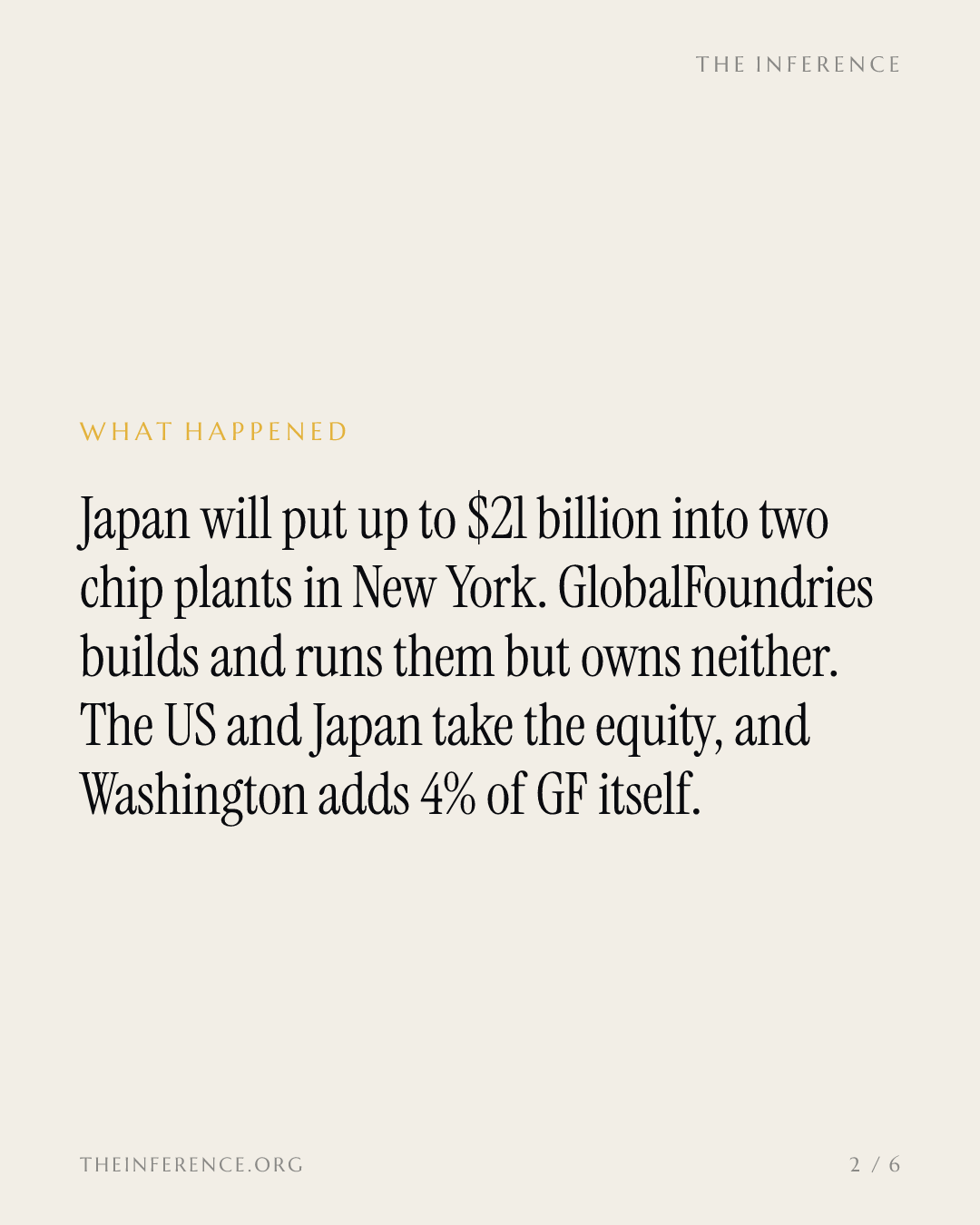
GlobalFoundries (Nasdaq: GFS) said on October 14 that it will build and operate two new 300mm wafer fabs at its Malta, New York site with up to $21 billion of Japanese capital, and own neither of them 12. The United States and Japan will jointly own the plants, while GF earns fees for building and running them and licenses its manufacturing technology to them 23.
For GFS holders, that swaps a capex story for a fee story: the buildings sit on someone else's balance sheet and GF is paid to run them. The price of the swap sits in three lines of the deal: the equity Washington takes, the subsidy money it re-aims at AI hardware, and the fee-and-license terms themselves 12.
Japan supplies the capital, GF supplies the operations
An initial investment of about $10 billion funds the first fab, with Japan providing all the capital; groundbreaking on the permitted, shovel-ready site is set for later this year 13. A second fab would follow on roughly the same amount, and free cash flows from the plants split evenly between the two countries before shifting ninety percent to the United States 12.
Chief executive Tim Breen told Reuters the first customers include Japan's Renesas Electronics and iPhone maker Apple+1.05% — Apple, up 1.05 percent today, with priority for American and Japanese buyers; GM, Cirrus Logic and Tokyo Electron supplied endorsement quotes 21. Mubadala Investment Co, the Abu Dhabi sovereign fund that is GF's majority owner, is diluted along with every other holder 2.
Washington grows its stake and re-aims the money at AI
In a separate agreement, the Commerce Department takes equity in GF of approximately four percent, at a price the filing does not disclose; Breen told Reuters that brings total U.S. government ownership to about seven percent 12. Washington has paid itself in equity before: it took ten percent of Intel in exchange for subsidies in 2025, and in July it took a GF slice inside a $300 million silicon-photonics research award 45.
The rest of the deal's paper follows demand GF can already see. $955 million of its award under the CHIPS and Science Act, the U.S. chip-subsidy program, now goes to silicon photonics, silicon-germanium and advanced packaging at Malta and at Burlington, Vermont 1. That is the end market where GF revenue grew 62 percent in the second quarter, a seventh straight quarter of double-digit growth 6.
A week earlier, TSMC−2.62% — TSMC, down 2.62 percent today signed a multi-year, $2 billion agreement for GF to make silicon interposers for its AI packaging at Malta, with volume production ramping in the first half of 2028 7.
The new wafers still need a market
The fabs will make foundational chips, the older-geometry parts that power cars, factories and grids, and that business has not grown: GF's quarterly revenue has sat between roughly $1.55 billion and $1.85 billion for three years, while margins recover as utilization of the plants it already runs rises 86.
Three flat years: GlobalFoundries has not grown into the fabs it already runs
Data
| Revenue | |
|---|---|
| Q3 '23 | $1.85B |
| Q4 '23 | $1.85B |
| Q1 '24 | $1.55B |
| Q2 '24 | $1.63B |
| Q3 '24 | $1.74B |
| Q4 '24 | $1.83B |
| Q1 '25 | $1.59B |
| Q2 '25 | $1.69B |
| Q3 '25 | $1.69B |
| Q4 '25 | $1.83B |
| Q1 '26 | $1.63B |
| Q2 '26 | $1.79B |
The first 900,000 wafers a year of new capacity arrive in 2029; a second fab of the same size would follow on no date the filing gives, into automotive and industrial demand that has yet to expand 1. The equity, the fee model and the reallocation are signed facts; the fill rate is a projection, and it is the link that now limits the trade.
Japan supplies the capital, Washington takes the equity, and GlobalFoundries still has to sell the wafers. The first two are settled. The third decides the stock.
Deepdive
AI-generated from this story and its cited sources. Not investment advice.