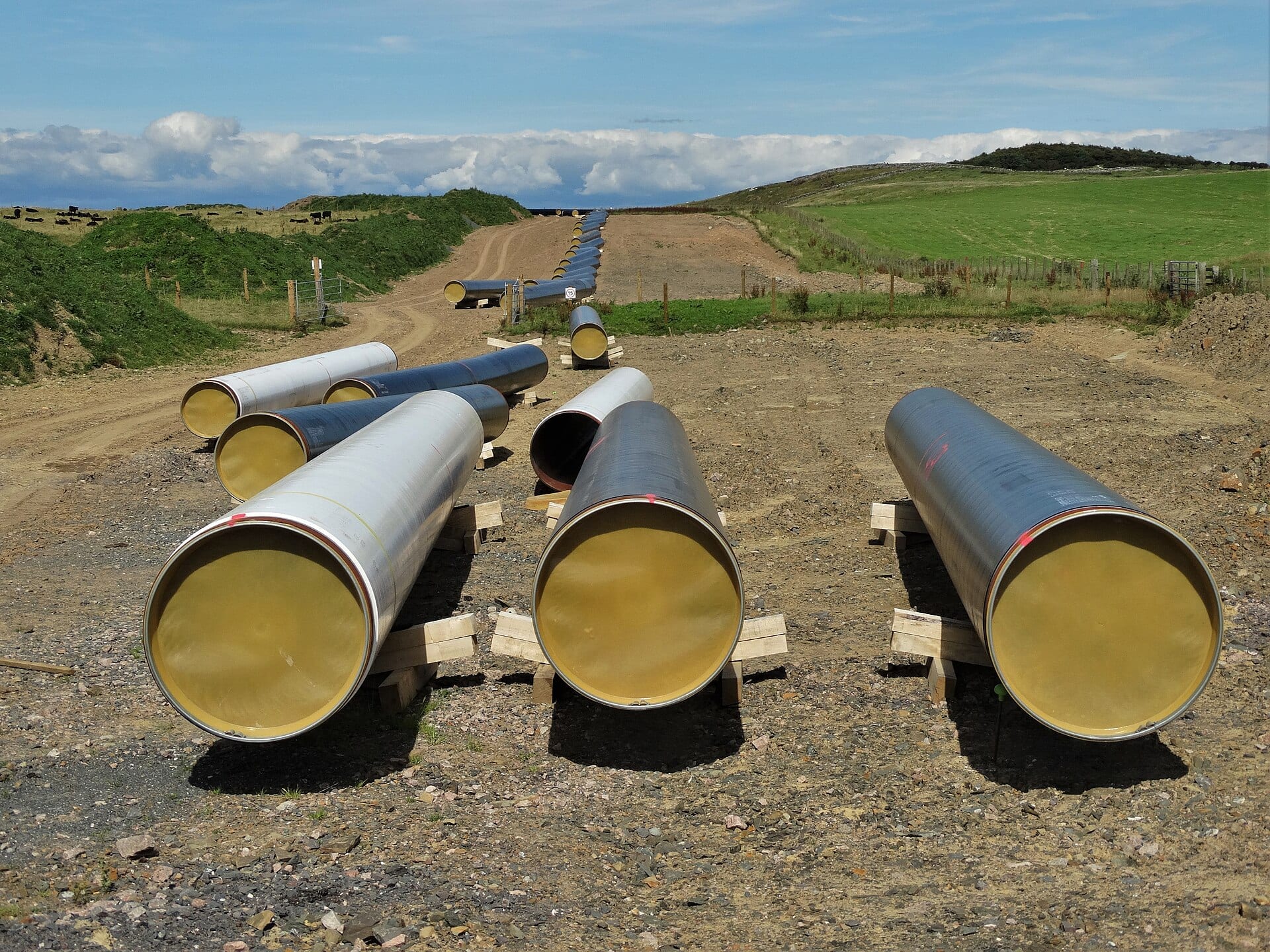
Kinder Morgan sued 141 landowners for a $5.2 billion gas corridor; foes call the AI demand case 4x overstated
Opponents of the $5.2 billion Mississippi Crossing corridor told a federal appeals court this month that the data-center demand case behind it is more than four times overstated. Southern Company half-owns the pipe, buys its gas and parents the forecast; it reports November 5.
 Richard Tang · 4 min read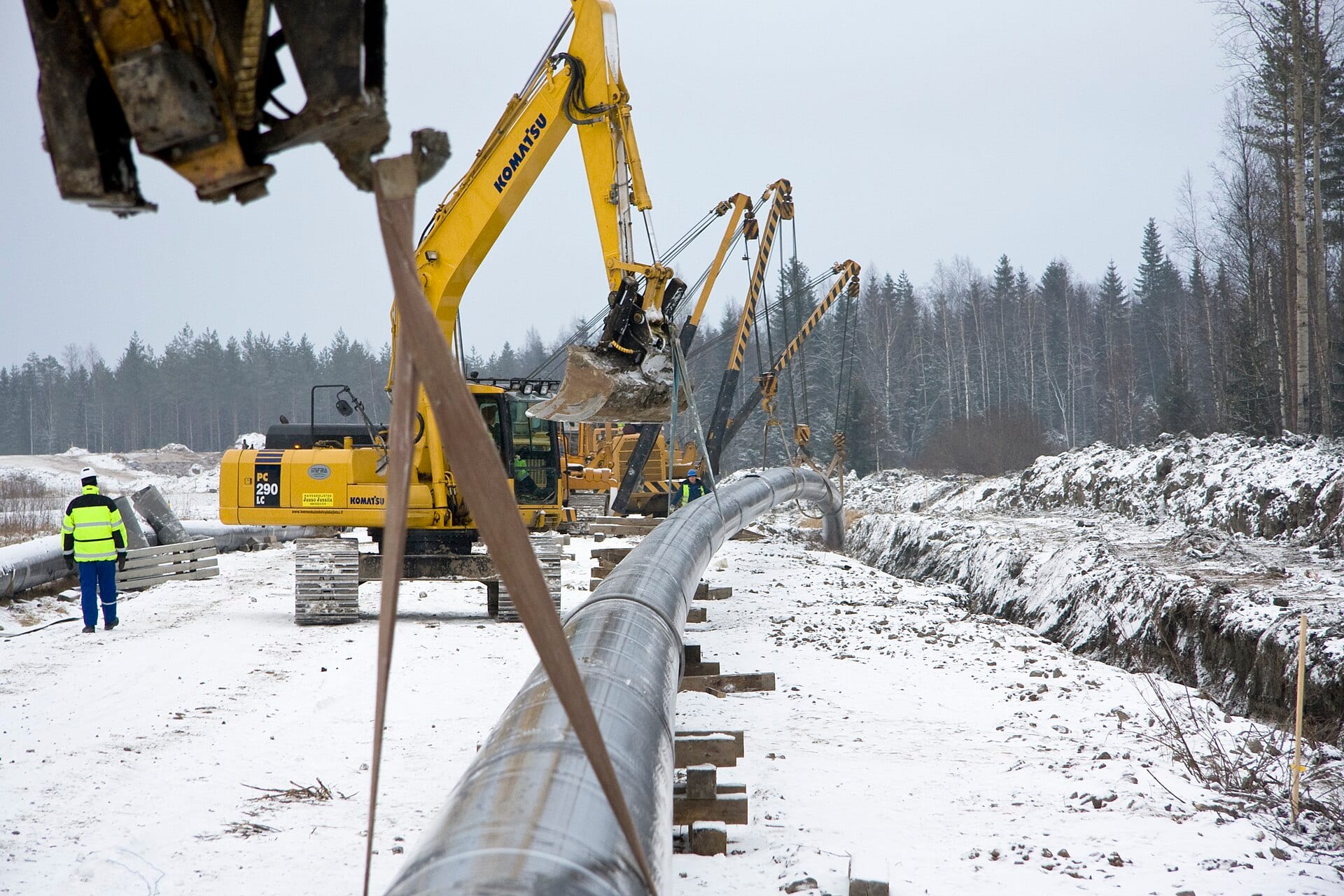
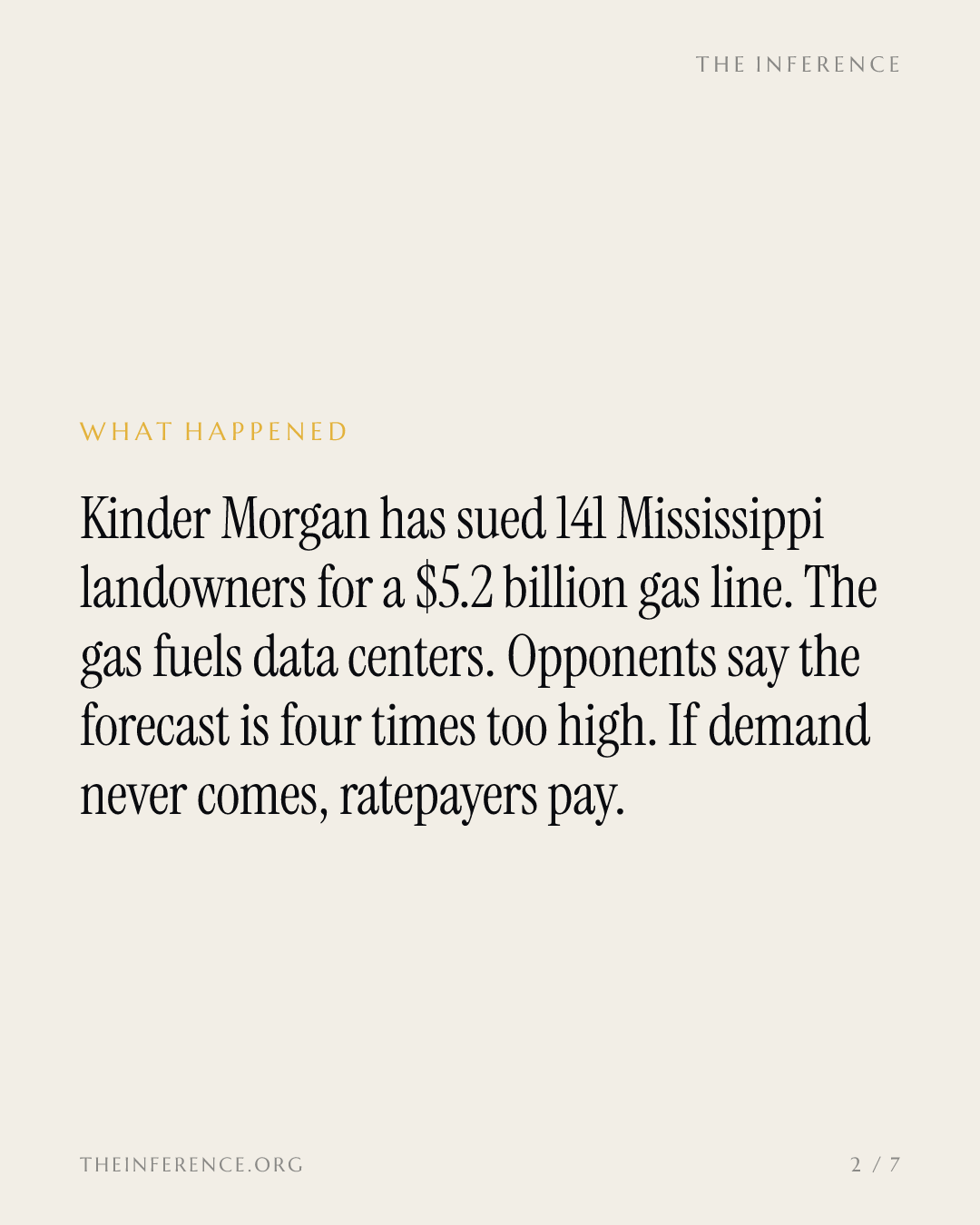
Kinder Morgan's+4.11% — Kinder Morgan, up 4.11 percent as of its last quote pipeline arm has sued 141 Mississippi landowners since July to make way for a $5.2 billion gas corridor across the state 1. The corridor's demand case is a data-center forecast, and an analysis by London Economics International for the project's opponents puts that forecast at more than four times what the utilities' own public records show 2.
Southern Company+2.15% — Southern Company, up 2.15 percent today sits on every side of the transaction. Southern Natural Gas, its 50/50 venture with Kinder Morgan, is the project partner; its utilities are slated to buy the gas through the added capacity; and its subsidiaries' load forecasts underwrite the need case 1 3. Southern reports third-quarter results on November 5, the first demand number since federal certification 4.
The forecast runs from an OpenAI campus to a Mississippi farm
Begin with demand that is already under contract. Georgia regulators cleared Georgia Power, Southern's subsidiary, to serve an OpenAI$1.18T — OpenAI, private, latest valuation $1.18T data center near Savannah, and OpenAI pays the full cost of the infrastructure that serves it 5. The 25-year agreement covers roughly 3.2 gigawatts 5. The same regulator has let Georgia Power roughly double its grid for data centers, and executives said in July that the new capacity they had forecast was already spoken for 6.
From there the forecast becomes pipe. Kinder Morgan's finance chief counts more than 200 gigawatts of large-load connection requests across Southern, Dominion, Duke, Florida Power & Light and the Tennessee Valley Authority 3. The Federal Energy Regulatory Commission accepted that case and on July 31 approved the Mississippi Crossing and South System Expansion 4 pair 7. Southern buys as well as forecasts: it has signed a 20-year deal for two-thirds of the capacity on Boardwalk's new Kosciusko Junction gas line 7.
Eighty percent signed, then 141 suits
Eminent domain is the last hop. Its Tennessee Gas subsidiary had reached agreements with 80% of the Mississippi parcels as of October 7 1. Of its 141 condemnation suits, 36 were settled by October 13 1. A lumber company holding land in two counties has countersued over "grossly inadequate" payment, and Bobbie Miller of Isola, whose family land sits on the route, has refused every offer 1.
105 of the 141 condemnation suits were still open on October 13
Data
| Parcels | |
|---|---|
| Suits filed since July | 141 |
| Settled by Oct 13 | 36 |
| Still open | 105 |
The courtroom fight is over how much of that demand is real
The Natural Gas Act makes FERC approval hinge on public need, and on October 1 the Southern Environmental Law Center, ten community groups and two landowners asked the federal appeals court in Washington to set the certificates aside 3 8. Their senior attorney Megan Gibson points to "evidence of plausible self-dealing" in the affiliate contracts used to demonstrate need 2. Kinder Morgan answers that it scopes projects to customer need, does not overbuild, and does not comment on what it calls meritless litigation 1 2.
The market is already marking the risk: analysts at Truist+1.10% — Truist, up 1.10 percent as of its last quote cut their Southern target to $93 from $97 this week, citing regulatory uncertainty in Georgia 4. Who pays if the demand never arrives is already fixed in the Georgia deal. Georgia Power agreed to backstop certain new-generation costs through 2031 if data-center contracts fail to materialize, a protection framed as shifting execution risk onto the utility and away from ratepayers 5. The project's opponents read the same risk the other way: a pipe built for demand that never arrives lands on ratepayers in Southern's own states 1.
November 5 is the first number that can settle it
Kinder Morgan's capital spending says which way the builder is betting.
Kinder Morgan's capex hit a 12-quarter high the quarter before FERC approved the corridor
Data
| Capex | |
|---|---|
| Q3 '23 | $0.65B |
| Q4 '23 | $0.63B |
| Q1 '24 | $0.62B |
| Q2 '24 | $0.58B |
| Q3 '24 | $0.66B |
| Q4 '24 | $0.77B |
| Q1 '25 | $0.77B |
| Q2 '25 | $0.65B |
| Q3 '25 | $0.79B |
| Q4 '25 | $0.82B |
| Q1 '26 | $0.8B |
| Q2 '26 | $0.98B |
Only a fraction of the requested load is under contract, and the size of that fraction is the dispute. When Southern reports, compare contracted gigawatts with the queue behind them. If contracts keep catching up with requests, the corridor's case holds and the four-times critique weakens; if the queue grows while contracts stall, the critique is the better description of what was built. Either way, the downside lands on Miller's family and on ratepayers along the route 1.
The AI buildout is real where the customer pays its own way. This corridor is a bet that every request becomes a contract, and the contracted number is where that bet gets settled.
Deepdive
AI-generated from this story and its cited sources. Not investment advice.