McKinsey: agent token bills could reach 20% of bank labor costs; JPMorgan caps Claude Code at $2,000 a month
McKinsey's Global Banking Annual Review warns that agent token bills could reach a fifth of banks' labor costs, and the caps are already policy at JPMorgan, Cisco and Rippling. The money moves from whoever sells tokens to whoever meters them, the week Anthropic set its IPO terms.
 Richard Tangthree-minute read

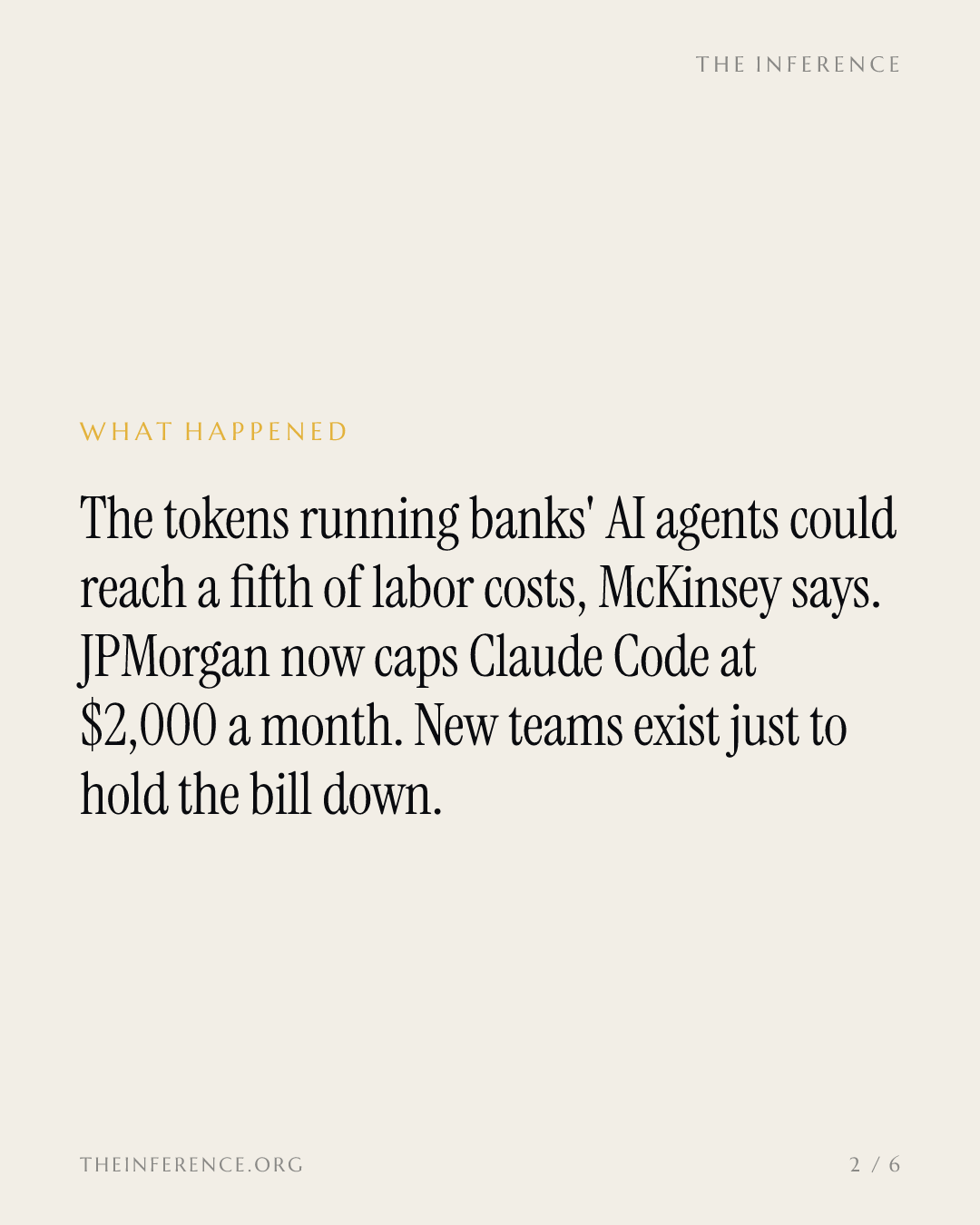
McKinsey put a number on the bill this week: the tokens that run banks' AI agents could reach a fifth of total labor costs, its Global Banking Annual Review says 1. Banks are treating that as a procurement problem, and the procurement is already staffed. Responsibility for controlling AI spending has shifted to new teams, which some banks call AI FinOps, whose job is to hold the agent bill down 1.
Why chat-era cost controls fail on agents
The first round of controls routed simple employee queries to cheaper models. That stops working once agents run, Vik Sohoni, a McKinsey senior partner and co-author of the review, told Reuters, because agents talk to each other and the tokens compound 1. The spread defeats forecasting: the cost of the same task can differ by as much as 30 times depending on which agent runs it, McKinsey found 3. So banks ration instead, deploying agents where returns are clearest. Wholesale credit monitoring is one of those places, with human credit officers keeping the final lending calls 18.
The caps are already policy
JPMorgan capped some engineers' use of Claude Code, Anthropic's$350B — Anthropic, private, latest valuation $350B coding tool, at $2,000 a month 2. Cisco+2.00% — Cisco, up 2.00 percent today is handing token budgets to managers across a 32,000-person organization 2. Rippling, a workforce-management software startup, added monthly caps and model routing after projecting its uncapped token bill could reach 40% of its research and development headcount budget 2.
Rippling cut its projected token bill from 40% to between 10% and 15%
Monthly caps and model routing cut Rippling's projected token bill by more than half
- Estimate
Data
| Value | Range | |
|---|---|---|
| Rippling, no caps (R&D budget) (estimate) | 40% | — |
| Banks, McKinsey (labor costs) (estimate) | 20% | — |
| Rippling, with caps (R&D budget) (estimate) | 15% | 10–15% |
The cap is now a product
The buyer capping tokens still buys software that polices agents. On November 3 the cybersecurity firm CrowdStrike+0.62% — CrowdStrike, up 0.62 percent today agreed to buy Fiddler, which records what agents do, and Dreadnode, which attacks them with more than 100 known methods before launch 4. It also shipped an AI Kill Switch, a control that lets a human stop any agent; the Wall Street Journal put the two deals near $495 million 45.
"The more certain a company is that it can stop any agent, the more agents it can put to work," chief executive George Kurtz said 4. The shares still fell almost 10% within two days, in a pullback across richly valued software 5. Its December 1 report should be the first clean read on whether enterprises keep buying agent capability or only the oversight around it 5.
The shop that sold the case now supplies the ceiling
McKinsey built the adoption case, calculating that agent deployments pay for themselves in about ten months 7. Its review now supplies the figure a bank can reach for when a vendor asks for a bigger budget. That lands the same week Anthropic, the AI lab behind Claude, which primarily sells to other businesses, set IPO terms at $70 to $78 a share 6. At the top it would be worth up to about $1.4 trillion, on customers who are installing meters on its product as they buy it 6.
The bottleneck has moved from what agents can do to what a task costs. Pricing a task is now real work, done by AI FinOps teams inside banks and by vendors selling routing, caps and oversight, and it decides where agents run next. Whoever does that work well is turning a capability into something a bank can afford to run, and that is where the value now sits.
Get Economy by email, free
How AI moves rates, banks, payments and the wider economy. In our daily email, every weekday.