Meta burned cash for the first time in three years, then minted stock only Zuckerberg's entities approved
Meta just posted its first negative free-cash-flow quarter in three years of filings, on $34.91 billion of quarterly capex. The same night it created non-voting Class C stock, approved by Mark Zuckerberg's own holding companies, with a doubling-linked dividend ladder that stands in for his pay.
 Vincent Jiang · 4 min read

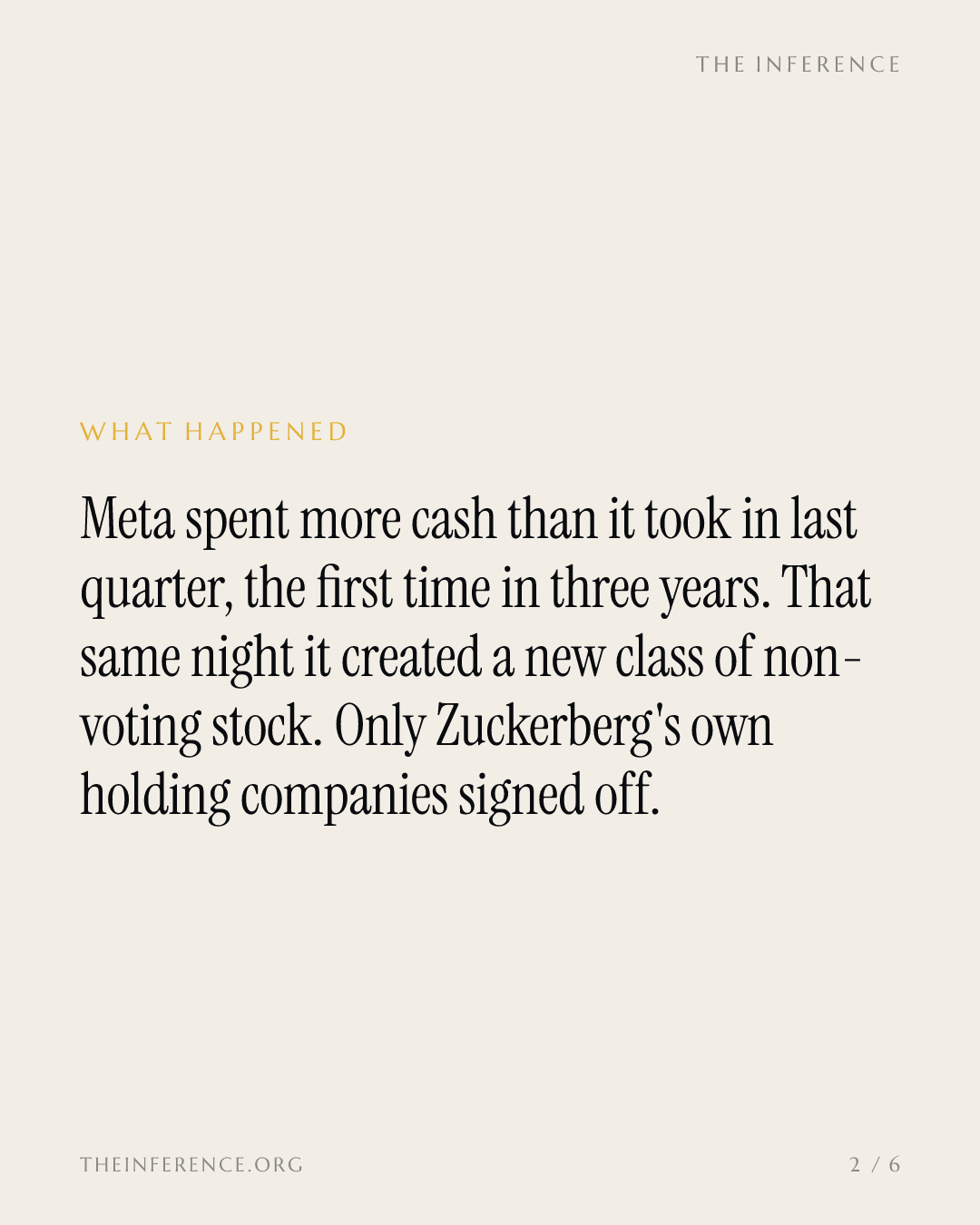
Meta+2.51% — Meta, up 2.51 percent today spent $34.91 billion on property, equipment and finance leases in the third quarter and collected $32.79 billion of operating cash, leaving free cash flow at negative $2.12 billion, its first negative quarter in the twelve on file back to late 2023 1 2 3. The same evening's filings created the instrument that funds the next round: a new class of non-voting Class C stock, ratified by a written consent signed entirely by Mark Zuckerberg's holding companies 1 6.
Capex crossed above the cash line
Revenue rose 26% to $64.60 billion, and the operating margin halved to 20% from 40%, mostly on a $9.89 billion charge toward the August settlement with 52 state attorneys general over teen mental health, a deal worth up to $18.59 billion 1 2. Meta bought back no stock in the quarter, against $3.33 billion a year earlier, while sitting on $82.45 billion of cash and marketable securities 1 2. Full-year capital spending is now guided at $135–145 billion, the floor raised from $130 billion 2.
Capex crossed above free cash flow in Q3 2026
- Capex incl. finance leases
- Free cash flow
Data
| Capex incl. finance leases | Free cash flow | |
|---|---|---|
| Q4 '23 | $7.59B | $11.81B |
| Q1 '24 | $6.4B | $12.85B |
| Q2 '24 | $8.17B | $11.2B |
| Q3 '24 | $8.26B | $16.47B |
| Q4 '24 | $14.43B | $13.56B |
| Q1 '25 | $12.94B | $11.09B |
| Q2 '25 | $16.54B | $9.02B |
| Q3 '25 | $18.83B | $11.17B |
| Q4 '25 | $21.38B | $14.83B |
| Q1 '26 | $19B | $13.23B |
| Q2 '26 | $30.12B | $1.75B |
| Q3 '26 | $34.91B | -$2.12B |
One signature amended the charter
The recapitalization pays one non-voting Class C share for every Class A and B share, an economic two-for-one split that changes nobody's vote, effective January 19, 2027 1 2. No meeting was held. On October 20, 2026, CZI Holdings and six Chan Zuckerberg Holdings entities, owning 315,826,951 Class B shares, about 56.1% of the total vote, delivered the only consent required; Zuckerberg holds 13.4% of the economics and 60.6% of the votes 6.
The special committee's record states he "made it clear" he would not support equity financing that reduced his voting power, that debt of the needed size would pressure credit ratings, and that management wants the new class spendable by end-2026 on offerings, acquisitions, employee pay and sovereign-wealth investors 6. The answer to a cash-negative quarter was money that cannot vote.
Capex, guided to $135–145 billion, is set to double 2025's total
- Capex incl. finance leases
- Estimate
Data
| Capex incl. finance leases | |
|---|---|
| FY2024 | $37.26B |
| FY2025 | $69.69B |
| FY2026 (estimate) | $140B ($135–145B) |
Alphabet wrote this playbook in 2014
Alphabet−1.80% — Alphabet, down 1.80 percent today set this template with non-voting shares in 2014 and has sold $85 billion of stock this year 7. The Inference tallied Meta's still-unbudgeted AI commitments on October 14; tonight's filing is the financing answer 7.
The ladder stands in for his pay
Zuckerberg opened on August 4, 2026, asking for twenty Class C shares per share, offered four on September 5, and settled on September 10 at one-for-one with the lockup stretched from four years to eight 6. A fifth of his dividend is sellable at once; the rest unlocks at 2.5% per quarter of full-time executive service, all of it free once he holds no Class B shares 1 6.
The board must then declare another Class C dividend for every shareholder at each doubling of the September 10 Class A price of $580.60, from roughly $1,161 upward, provided the annualized return since then is at least 10%; none may be paid after his death 1 6.
Sized to a $20 billion tax threat
The term sheet calls those dividends a stand-in for performance pay he might have sought, and on September 11 he withdrew a compensation request the committee's record deems critical to the deal 6. Every option in the talks was sized to about $20 billion of liquidity for the tax California's Proposition 40 might impose, against a threat to leave the state now hardened into an eight-year residency covenant 6.
Fair, says the committee; the market prices it next
Three independent directors, Robert Kimmitt chairing, advised by Skadden and Moelis with Morgan Stanley+3.61% — Morgan Stanley, up 3.61 percent as of its last quote for Meta, unanimously judged the deal fair, citing a stock up more than 1,700% since the IPO against roughly 495% for the S&P 500 2 6. Revenue beat the $63.37 billion consensus and the shares rose 6.2% after hours to $741 4.
A New Mexico judge still imposed a $25 billion penalty that same day, and youth-safety trials are scheduled in coming months 2 4. Record and payment dates are unset; the dividend must be paid within five business days of effectiveness 1. When Class C first trades, the spread against Class A will show what the market thinks a Meta vote is worth.
Get Applications by email, free
How AI is changing the software people and companies use. In our daily email, every weekday.