Zoom moves Zoom CX billing from seats to one annual spend pool, its first break from per-seat pricing
The contact-center billing switch, buried in Zoomtopia's product coverage, is Zoom's first formal move away from per-seat commitments, and it starts where AI usage is growing fastest. A $28 billion stock priced for a dying seat is the bet on the other side.
 Richard Tangthree-minute read

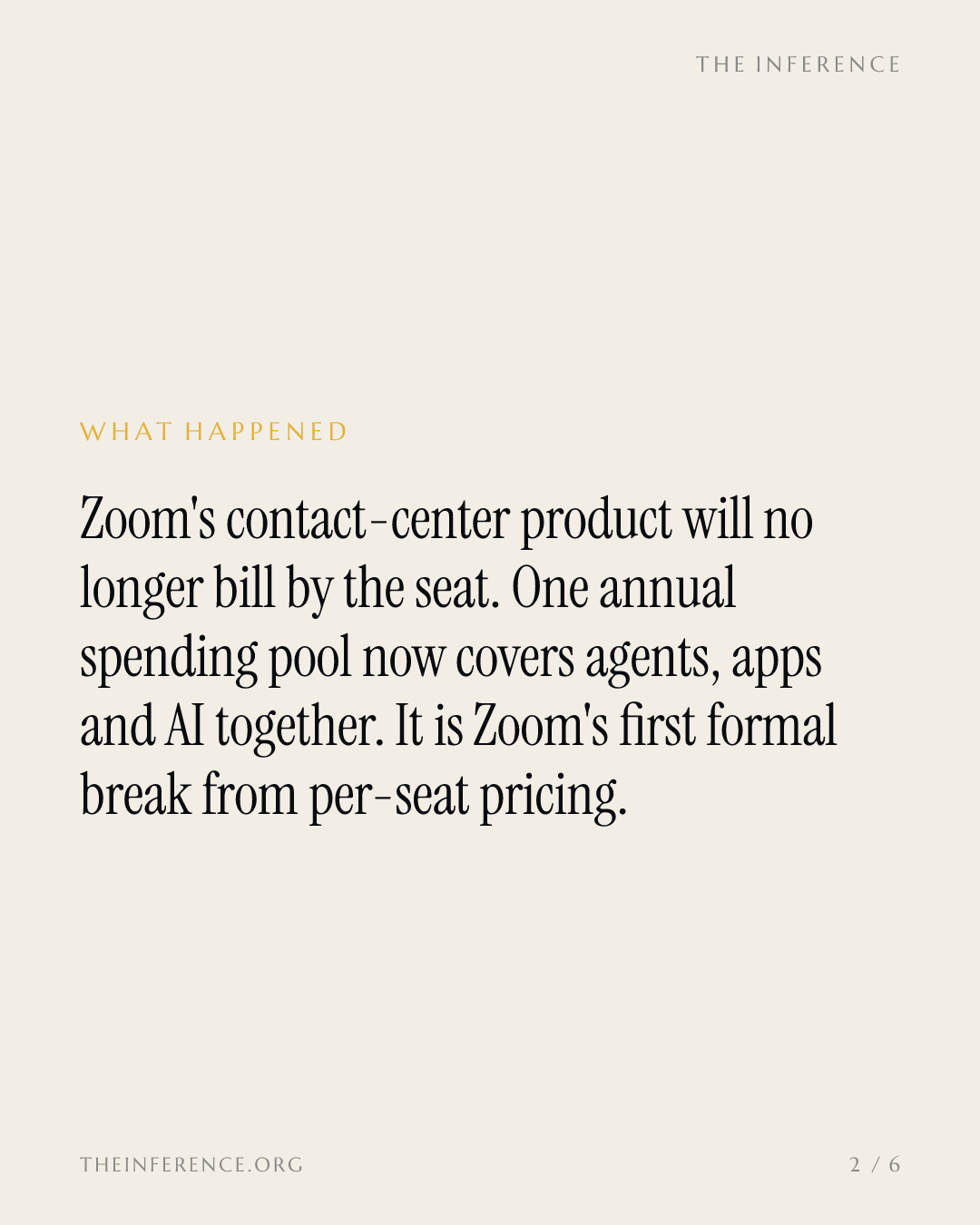
Zoom's−4.50% — Zoom, down 4.50 percent today product blitz on October 20 got the headlines, but the money change sat in the contact-center fine print: Zoom CX is replacing separate product commitments with one annual spending pool that covers agents, seats, applications and AI capabilities, letting customers "add and scale AI without product-specific purchases" 1. That is Zoom's first formal move away from the per-seat billing Eric Yuan built the company on.
It lands in the only part of Zoom that is growing fast, and it starts the test of whether Zoom can charge for work instead of chairs. We have been on this question before: Monday's piece argued Zoom's bill still counts only seats while its AI does meeting work, and a fortnight ago we noted the stock traded at 8.4 times earnings 3. Since then the multiple has ticked up to about 9 times 3, and the spend pool is the first structural answer to that argument.
The valuation assumes the seat is dying; the spend pool bills the work
Zoom trades at about $28 billion, roughly 9 times trailing earnings, with about $7.2 billion of net cash, because the market prices in a core meetings business growing only low single digits 3. A spend pool recuts the unit of billing from chairs to activity: pooled spend grows when agents handle more conversations, which is the usage Zoom is actually seeing.
The adoption numbers back the bet. Licensed AI-feature monthly active users grew 125% year over year, Zoom Virtual Agent customer count jumped 256%, and enterprise revenue grew 7.8%, its best rate in three years, with Zoom expecting to pass $5 billion in annual revenue this year 2.
Zoom's AI units are growing many times faster than its meetings base
Data
| Value | |
|---|---|
| Zoom Virtual Agent customers | +256% YoY |
| AI-feature monthly active users | +125% YoY |
| Enterprise revenue | +7.8% YoY |
The open flank: rivals now query the record
Zoom also opened its new Unified Context Layer, the running record of what was said in meetings, calls and chats, to Claude, ChatGPT, Codex, Gemini, Copilot and Slackbot through public APIs, with Zoom workflows launchable directly from Claude and Codex from November 12. Being the layer every agent draws from is the right ambition. Handing rival assistants the conversation record also invites the follow-on work, where the wallet sits, to leave Zoom. Microsoft−0.74% — Microsoft, down 0.74 percent today and Google already bundle AI into their own suites.
A pooled bill cuts the other way too: it is harder to audit than a seat count and can hide flat renewals for a quarter or two.
Wall Street leaned bullish. Oppenheimer upgraded Zoom to Outperform with a $130 target on October 21, citing AI uptake and rising revenue per user, and shares gained nearly 3% premarket 4. The next earnings print, and any pooled-pricing answer from Microsoft or Google−3.94% — Google, down 3.94 percent today, will show whether the spend pool compounds Zoom's value or quietly caps it.
Get Applications by email, free
How AI is changing the software people and companies use. In our daily email, every weekday.





Reader comments
0 comments