Michael Burry says Fiserv is worth $100 to $120 a share; the stock rose 13% to $58.83
The Big Short investor's November 2 buyout math puts Fiserv at $100 to $120 a share. A next-day beat, a doubled cost-cut target and fresh upgrades lifted the stock 13%, to $58.83.
 Vincent Jiang · 3 min read
A $100 call on a stock trading near $50
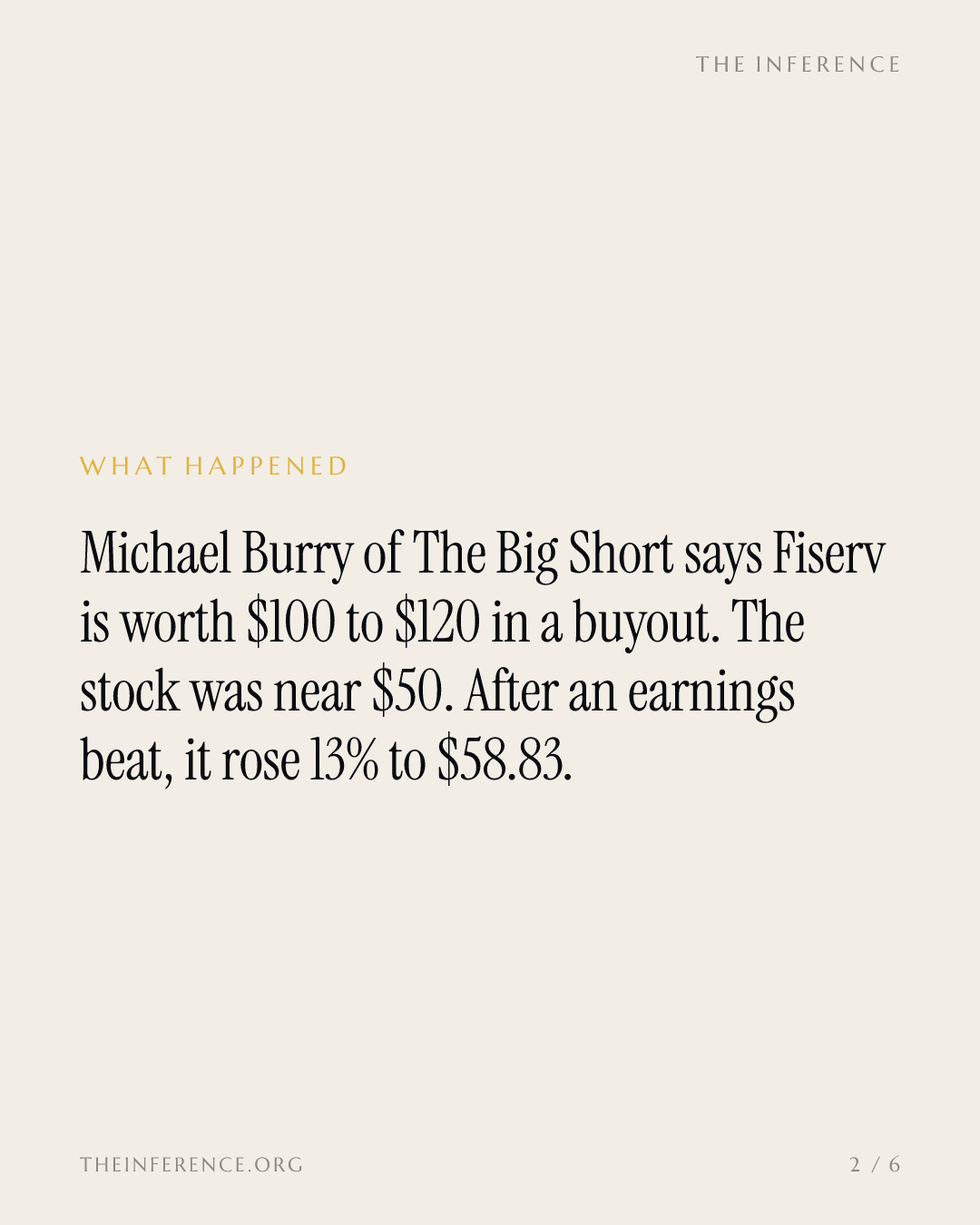
Michael Burry, whose bet against the 2000s housing bubble was chronicled in The Big Short, used a November 2 Substack post to value Fiserv−1.94% — Fiserv, down 1.94 percent today, the processor behind about a third of U.S. merchant payment volume, at $100 to $120 a share in a buyout 13. The stock traded near $50 when he wrote it, down 76.2% over two years 13.
His yardstick is the reported early-stage bid by the buyout firm Clayton Dubilier & Rice and GTCR, Global Payments'−0.59% — Global Payments, down 0.59 percent as of its last quote largest shareholder, for that rival 3. Fiserv "is still Castle," his label for top holdings, and PayPal−1.07% — PayPal, down 1.07 percent as of its last quote remains a "fat pitch" in the $50s 3, a view BofA does not share.
A beat, an impairment, and a 13% pop
On November 3, Fiserv reported third-quarter adjusted EPS of $1.75, four cents above consensus, on flat organic revenue: Merchant Solutions fell 2%, Financial Solutions grew 2% 48. Management reaffirmed 2026 guidance, doubled its Project Elevate savings target to $1 billion and promised $500 million of buybacks this quarter 4.
The savings come from embedding AI across workflows, and an agentic-AI product for banks counts 200 institutions in its pipeline 7. A $6.45 billion goodwill impairment, triggered by the share-price collapse, still drove a GAAP loss of $11.17 a share 4. The stock rose 13% to $58.83 5.
A shrinking cash engine under the pop
The pop lands on a business that has stopped growing. Free cash flow fell to $2.04 billion in the first nine months from $2.88 billion, and adjusted operating margin slipped to 31.2% from 37.0% 4.
Free cash flow has shrunk year on year in three of the last four quarters
Free cash flow fell year on year in Q3 and Q4 2025 and again in Q2 2026
Data
| Free cash flow | |
|---|---|
| Q3 '23 | $1.2B |
| Q4 '23 | $1.24B |
| Q1 '24 | $0.41B |
| Q2 '24 | $0.99B |
| Q3 '24 | $1.84B |
| Q4 '24 | $1.82B |
| Q1 '25 | $0.31B |
| Q2 '25 | $1.19B |
| Q3 '25 | $1.3B |
| Q4 '25 | $1.5B |
| Q1 '26 | $0.33B |
| Q2 '26 | $0.99B |
Fiserv's revenue growth went from 8% to minus 4% in three years
The processor's growth stalled through 2025 and turned negative in 2026
Data
| Revenue growth, year on year | |
|---|---|
| Q3 '23 | 7.9% |
| Q4 '23 | 6.2% |
| Q1 '24 | 7.4% |
| Q2 '24 | 7.4% |
| Q3 '24 | 7% |
| Q4 '24 | 6.8% |
| Q1 '25 | 5.1% |
| Q2 '25 | 8% |
| Q3 '25 | 0.9% |
| Q4 '25 | 0.6% |
| Q1 '26 | -2% |
| Q2 '26 | -4.1% |
The ladder stops at $72. Burry starts at $100
This week's upgrades climbed the ladder's middle: Argus to Buy at $72, RBC to $70, TD Cowen to $59 2. BofA+0.14% — BofA, up 0.14 percent today holds Underperform at $48, the consensus average sits at $57.55, and analysts cut 2026 EPS estimates 27 times in 90 days without one raise 1.
At Burry's range the equity alone is worth $53 billion to $64 billion, 14 to 17 times 2026 consensus EPS of $7.24, before the $25.8 billion of long-term debt an acquirer inherits, itself down from $27.8 billion at end-2025 14. His own benchmark cuts both ways: he values Global Payments' control at $45 to $60, below its $96.84 price, and notes financial buyers pay less than strategics 3.
Every target but BofA's sits above the post-earnings price; Burry's floor is near double
The upgrade ladder tops out at $72; Burry's takeout floor starts at $100
- Estimate
Data
| Value | Range | |
|---|---|---|
| BofA (Underperform) | $48 | — |
| Consensus average | $57.55 | — |
| TD Cowen (Hold) | $59 | — |
| RBC (Outperform) | $70 | — |
| Argus (Buy) | $72 | — |
| Burry takeout ($100-120) (estimate) | $110 | $100–120 |
Three tests between $58.83 and Burry's $100
Three dated tests: whether the Global Payments bid becomes a signed price, turning the measuring stick into a market multiple; fourth-quarter results, where CFO Paul Todd expects revenue acceleration and Clover's return to double-digit growth 47; and banking attrition, already down more than 25% this year 4. Keefe Bruyette called it a better-than-expected quarter against tempered hopes, with sustainability the open question 7. The cash is real; the bidder is still a rumor.
Get Economy by email, free
How AI moves rates, banks, payments and the wider economy. In our daily email, every weekday.