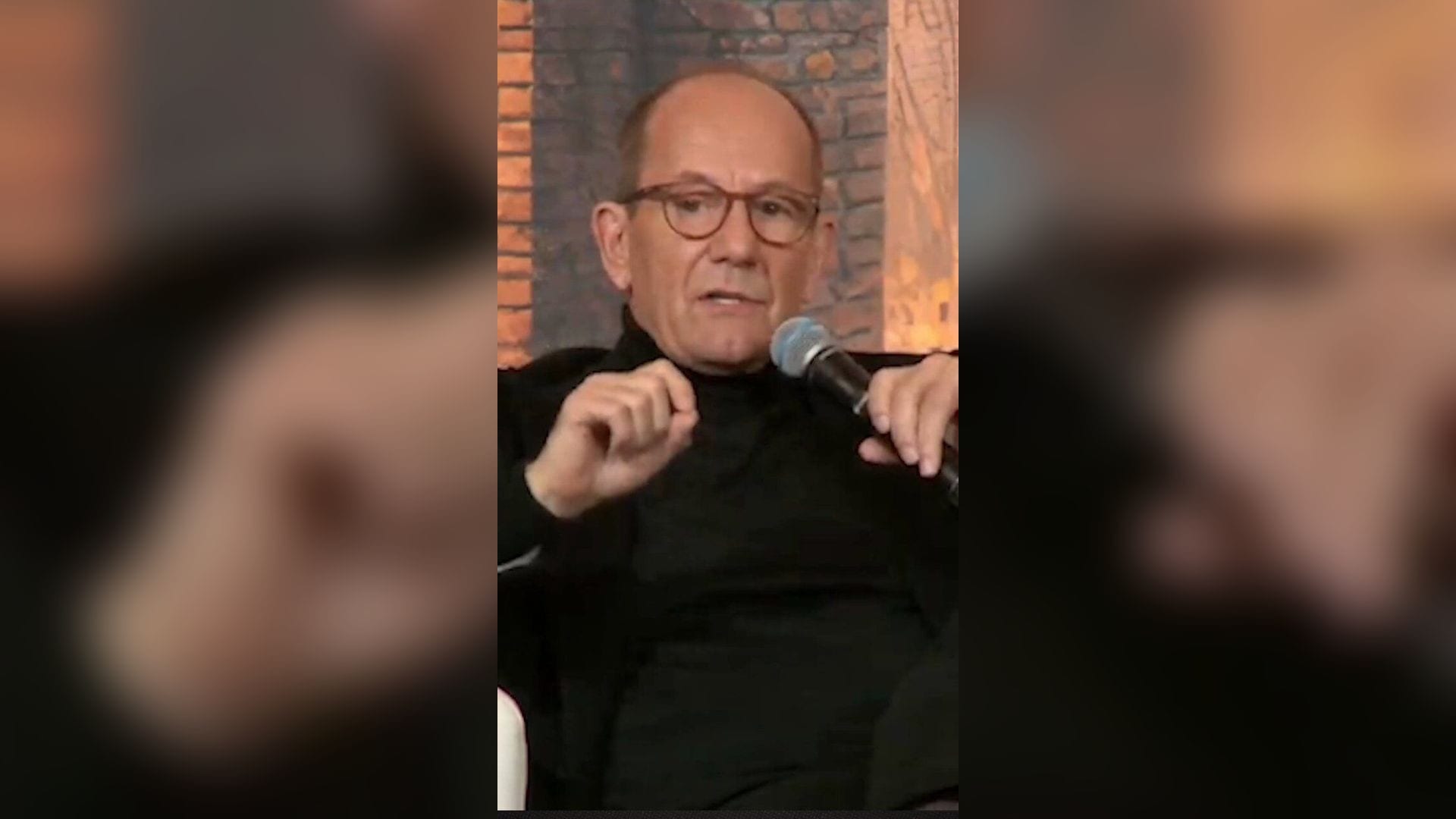
Microsoft borrows $25 billion to own the AI capacity it used to rent
Microsoft canceled its Nscale data-center deal over grid delays and returned to the bond market for the first time since 2017 in the same fortnight. The company that says demand exceeds supply is funding the build itself, and the neoclouds that leased it capacity borrow against its credit.
 Richard Tangfour-minute read
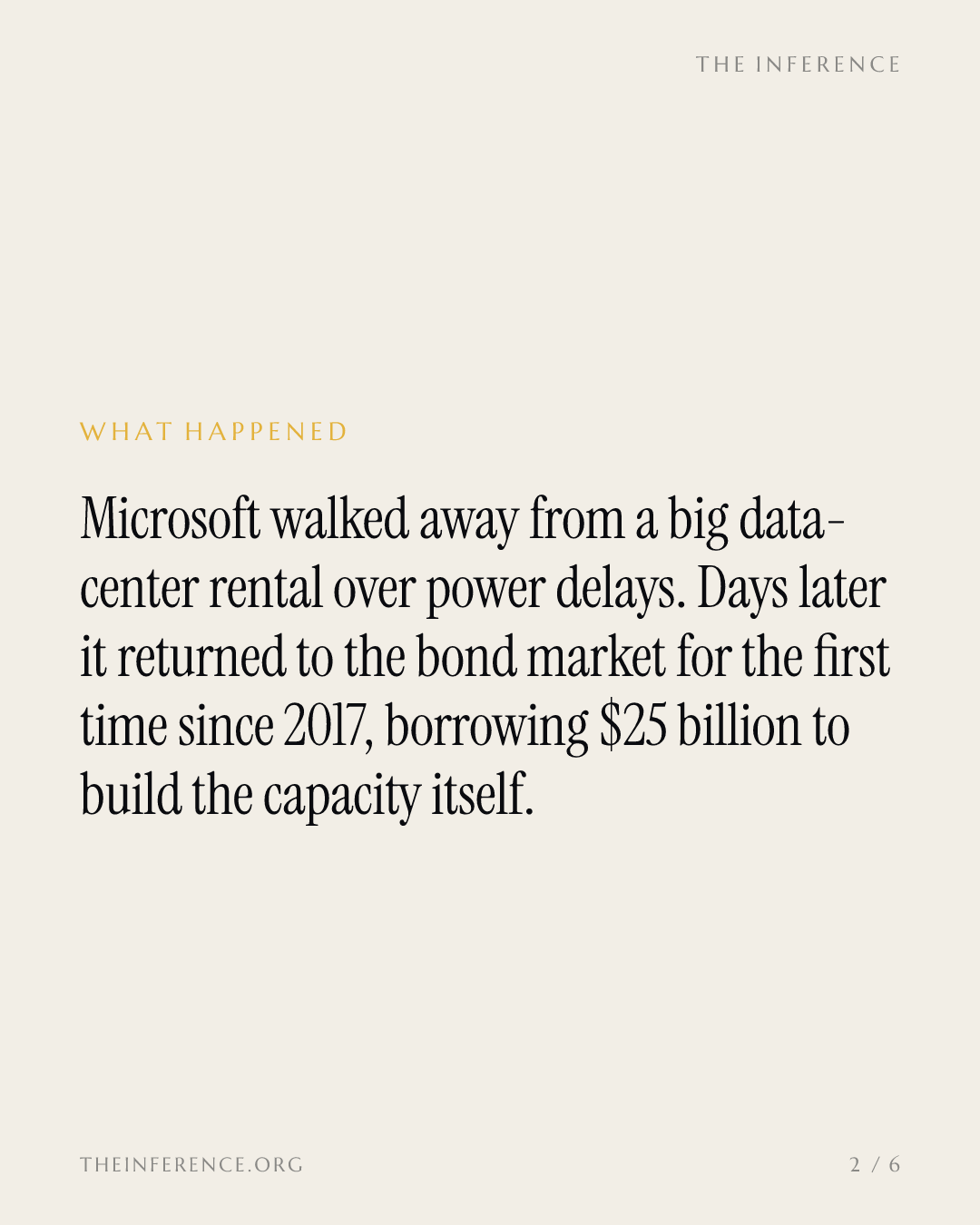
Microsoft+0.05% — Microsoft, up 0.05 percent today has stopped waiting for rented AI capacity and started borrowing to own the build. This month it walked away from its flagship Nscale data-center deal over power delays 2. Days later it returned to the US investment-grade bond market for the first time in more than nine years 1.
The company that tells investors demand exceeds available supply 3 has decided to build the supply itself, on its own balance sheet. The neoclouds it used to rent from, whose debt leans partly on Microsoft's credit, are left with a thinner story to sell lenders.
The build no longer fits inside operating cash flow
The September quarter made the case for borrowing. Microsoft spent $45.2 billion on capital, leases included 1. About three quarters of it buys short-lived assets, the processors and memory that age fastest in a data center 1. Amy Hood, the chief financial officer, guided to more than $50 billion for the December quarter 1. Free cash flow came in at $18.6 billion 1.
That is down more than a quarter year on year 3. Operating cash flow still reached $58 billion 3, so the squeeze is the spending, not the business. Microsoft is the exception among the biggest spenders: four of the five largest AI capex budgets generated less cash than they spent last quarter 4.
The company still expects positive free cash flow through June 2027, Reuters reported 5. The gap between the cash Microsoft generates and the capacity it wants is what a planned $25 billion bond sale is meant to fund 1. It is the first US investment-grade issue since 2017 1, and the ten tranches run out to 2066 1, decades past the working life of the chips they finance.
Cash capex has almost tripled since mid-2024; free cash flow has not followed
- Capital expenditure (cash)
- Free cash flow
Data
| Capital expenditure (cash) | Free cash flow | |
|---|---|---|
| Q2 '24 | $13.9B | $23.3B |
| Q3 '24 | $14.9B | $19.3B |
| Q4 '24 | $15.8B | $6.5B |
| Q1 '25 | $16.7B | $20.3B |
| Q2 '25 | $17.1B | $25.6B |
| Q3 '25 | $19.4B | $25.7B |
| Q4 '25 | $29.9B | $5.9B |
| Q1 '26 | $30.9B | $15.8B |
| Q2 '26 | $35.8B | $19.6B |
| Q3 '26 | $39.4B | $18.6B |
What broke first was power, not demand
Reuters traced the cancellation to Loughton in Essex 2. The site was due to open early next year, running 23,040 of Nvidia's+3.45% — Nvidia, up 3.45 percent today GB300 accelerators 2. Grid officials told Nscale not to expect power there until the 2030s, and Microsoft left 2. Microsoft calls it a single-site decision and says the partnership stands 2.
It had signed Nscale leases worth up to $43.8 billion, which we covered in September 7; the news this month is the walk-away. Microsoft's own guidance says the same thing from the inside: the calendar-2026 plan came down to about $170 billion 1, and the stated reason was delayed third-party computing capacity, not cooling demand 1.
Britain's grid queues can hold a project for as long as 13 years 2. That queue, not money, is the bottleneck this build runs into. Owning the site does not remove the wait; it moves it into Microsoft's own capital plan, where the strongest balance sheet in the market can carry it.
The neoclouds borrow against Microsoft's credit, and Microsoft is pulling it home
Neoclouds are data-center operators that rent computing to AI labs such as OpenAI$1.18T — OpenAI, private, latest valuation $1.18T and Anthropic$350B — Anthropic, private, latest valuation $350B 8. CoreWeave+14.43% — CoreWeave, up 14.43 percent today, the sector leader, accumulated $35.1 billion in debt by borrowing against long-term leases and the chips behind them, with lenders weighing the creditworthiness of customers like Microsoft more than CoreWeave's own 8. When the anchor tenant builds instead of renting, the top of that collateral thins.
CoreWeave's debt has nearly quintupled since the end of 2024
Data
| Total debt | |
|---|---|
| Q4 '24 | $10.62B |
| Q1 '25 | $11.9B |
| Q2 '25 | $14.56B |
| Q3 '25 | $18.81B |
| Q4 '25 | $29.82B |
| Q1 '26 | $35.15B |
| Q2 '26 | $51.61B |
The market has started to price it: shares in CoreWeave, Nebius+11.46% — Nebius, up 11.46 percent today and peers lost about a quarter of their value in a month 8, and Gartner−1.10% — Gartner, down 1.10 percent as of its last quote expects 80% of neocloud firms to cease independent operations by 2030 8. Nscale shows how fast the model scales: its contracted book grew from $100 million two and a half years ago to more than $103 billion today 2, and it filed to go public in the US last month 2.
The bonds are the easy part; the chips are the test
None of this reads as distress in the demand line. Azure grew 48% 3. Hood said demand still exceeds available capacity 3. OpenAI-related commercial revenue reached $10 billion 3. That is close to a tenth of Microsoft's revenue, and it is the concentration the build rests on 3. The commercial backlog stands at $677 billion, roughly flat quarter on quarter 3.
That backlog is the real test: Microsoft is buying chips with a working life of a few years and has to re-earn the spend inside it, from contracts that must renew 1. The debt itself is the easy part for a company rated at the very top of both Moody's−0.07% — Moody's, down 0.07 percent as of its last quote and S&P's scales 1.
If someone was always going to own this capacity, better the tenant with the strongest credit than the landlord with the shortest runway. This quarter's Azure growth and backlog say the demand to fill the build is real, so Microsoft carrying the delivery risk directly, at the cheapest capital cost in the system, is the honest way to fund it.
Get Data Center by email, free
Who is building AI's data centers, and who is paying for them. In our daily email, every weekday.