Morgan Stanley and Goldman Sachs count $9 billion a week of default insurance on AI debt
Morgan Stanley and Goldman Sachs each published research this week showing investors buying insurance against the failure of the AI buildout. The Fed meets in three days, and its rate path decides who refinances the debt that funds the chips.
 Richard Tang · 4 min read
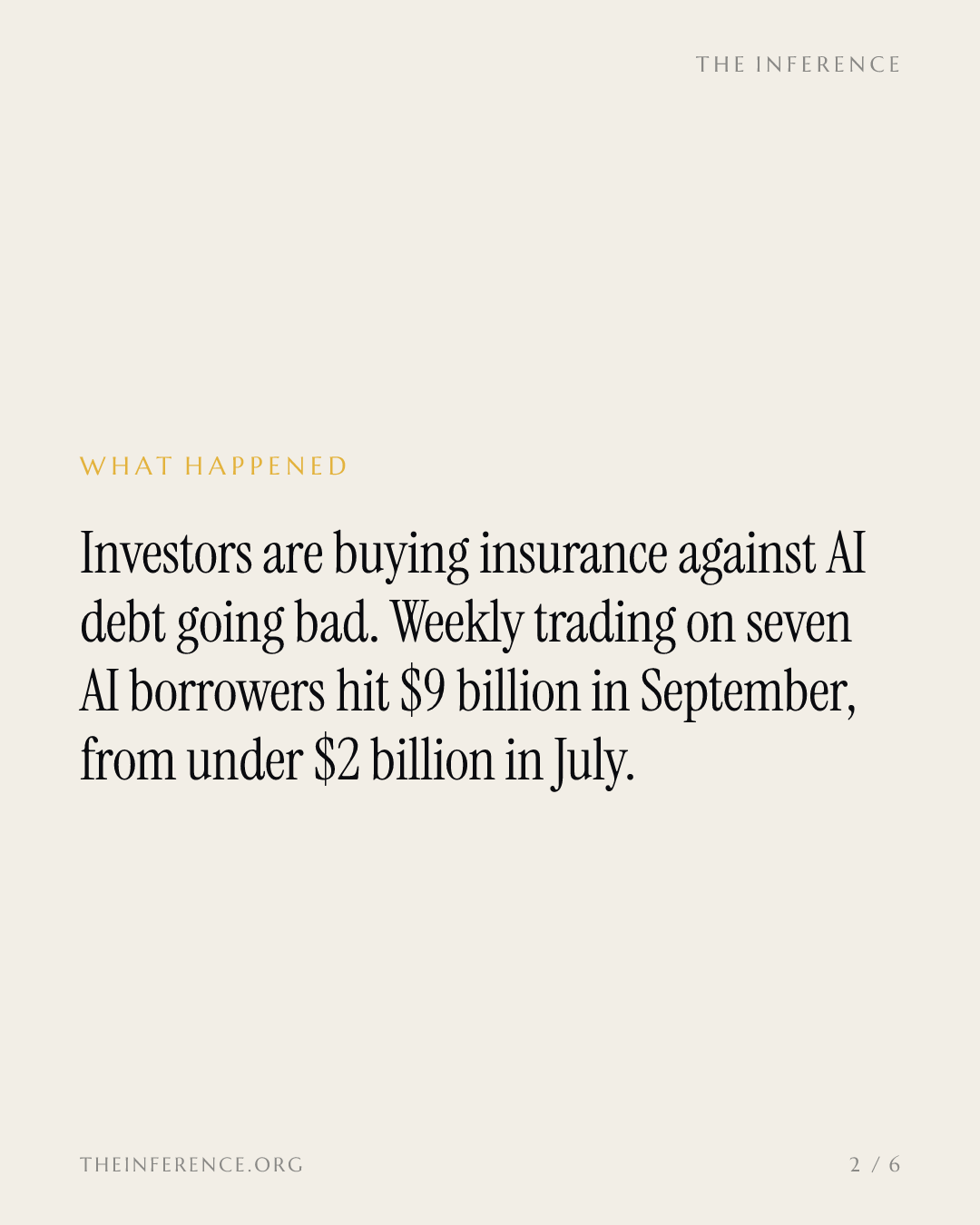
Two banks did most to finance the AI buildout, and within 48 hours this week each published research showing investors insuring against its failure 1. Weekly trading in credit default swaps, insurance against a bond issuer defaulting, on seven AI-linked issuers from Oracle+0.29% — Oracle, up 0.29 percent today to Nvidia−0.54% — Nvidia, down 0.54 percent today averaged more than $9 billion in September, Morgan Stanley−2.32% — Morgan Stanley, down 2.32 percent today counts, up from under $2 billion in July 1. Goldman Sachs−1.40% — Goldman Sachs, down 1.40 percent today cut its target for South Korea's memory-heavy Kospi index by a quarter this morning, after a fall of more than 35% from its June peak 2.
The marginal buyer of AI chips borrows to buy them 4. That is why the cost of insuring AI borrowers, alongside chip orders, now sets the sector's price.
Compute became a financeable asset class
Morgan Stanley puts global data center capex at $2.9 trillion through 2028, and reckons the big cloud operators, Amazon−0.72% — Amazon, down 0.72 percent today, Microsoft+0.64% — Microsoft, up 0.64 percent today, Alphabet−0.98% — Alphabet, down 0.98 percent today, Meta−1.36% — Meta, down 1.36 percent today and Oracle, can self-fund only about half 3. Private credit is expected to supply about $800 billion of the resulting gap, in loans tied to specific facilities 3.
Morgan Stanley counts $466 billion of AI-linked debt issued this year through September, against $101 billion in the same months of 2025 1. Goldman's own tally is $489 billion as of July 22, already above the $322 billion raised in all of 2025 4. IO Fund, the research firm behind the analysis, says it plainly: "AI compute is becoming a financeable infrastructure asset class" 4.
Morgan Stanley still sees the buildout climbing, to $1.5 trillion in 2028
- Morgan Stanley data center capex
- Estimate
Data
| Morgan Stanley data center capex | |
|---|---|
| 2026 (estimate) | $850B |
| 2027 (estimate) | $1,300B |
| 2028 (estimate) | $1,500B |
Protection costs follow the money down the chain
The insurance market arrived in weeks. Trading in US corporate CDS indices has already passed its total for all of 2025, and five-year spreads sit at records for Meta, Nvidia and SpaceX+1.86% — SpaceX, up 1.86 percent today 1. The pricing follows the structure: Nvidia and the other chip suppliers are paid when chips are delivered, while the borrowers carry the multi-year contracts and the interest 4.
The ladder shows it. CoreWeave−2.97% — CoreWeave, down 2.97 percent today, an AI cloud operator that rents out Nvidia's chips, spends more than a quarter of its revenue on debt service 4. Insuring CoreWeave's debt costs roughly ten times what insuring Nvidia's does 1. Oracle's protection has more than doubled since the start of the year 1.
CoreWeave's debt has almost quintupled in six quarters
Data
| CoreWeave total debt | |
|---|---|
| Q4 '24 | $10.6B |
| Q1 '25 | $11.9B |
| Q2 '25 | $14.6B |
| Q3 '25 | $18.8B |
| Q4 '25 | $29.8B |
| Q1 '26 | $35.1B |
| Q2 '26 | $51.6B |
Default insurance prices the AI chain, from Nvidia at 101 to CoreWeave at 1,090 bps
Data
| Value | |
|---|---|
| CoreWeave | 1,090 bps |
| Oracle | 322 bps |
| SpaceX | 226 bps |
| Meta | 108 bps |
| Nvidia | 101 bps |
Memory equity is where the credit fear surfaces
The Kospi is the equity version of the same repricing. Samsung Electronics+0.47% — Samsung Electronics, up 0.47 percent today and SK Hynix+3.73% — SK Hynix, up 3.73 percent today sell the memory that goes into the same debt-funded data centers, and memory earnings swing with chip prices; when refinancing turns expensive and builders pull back, their earnings fall first 2. Goldman's math shows what the market now discounts: a 65% decline in semiconductor earnings in 2027, a scenario its strategists call too pessimistic 2. The index trades at about four times forward earnings, a level no major market has touched since 2006 2.
Hedge funds cut tech at the fastest pace in at least a decade in the five sessions through October 15, on Goldman's own prime-brokerage data, the exit we reported on October 20 6. Goldman's strategists think the repricing has overshot: the cut target still implies more than 60% upside 2.
October 28 comes first, December settles it
Every dollar of the financing gap refinances at whatever the Fed does next. As of mid-October, after September inflation of 3.7%, futures put a hike at the October 28 meeting, three days away, at slightly better than even odds, with at least one more by year-end priced as nearly certain 7. Goldman's economists, writing on September 30, before that inflation print, expect one hike, in December, and see "a strong chance" it is the last 8.
The banks that measured the hedge still finance the buildout
If futures are right, the refinancing meets record protection costs, and whoever holds the paper takes the losses. No source names those holders; the protection buyers named are portfolio managers 1. The intermediaries sit on both sides of the fork: Goldman is among the partners behind more than $500 billion of third-party capital that Nvidia has lined up 4, and Morgan Stanley, which measured the hedge, still carries the Street's highest 2027 capex forecast, $1.3 trillion 5. October 28 delivers or defers the first hike; December settles whether it is the last 45.
Get Economy by email, free
How AI moves rates, banks, payments and the wider economy. In our daily email, every weekday.