NASA Held the Price on Its Moon Lander. It Lost the Calendar.

The contract SpaceX signed has grown 6% in cost and at least two years in schedule. The refuelling campaign behind it needs a tanker launch every six days.

Vincent JiangVincent Jiang · 3 min read
Share
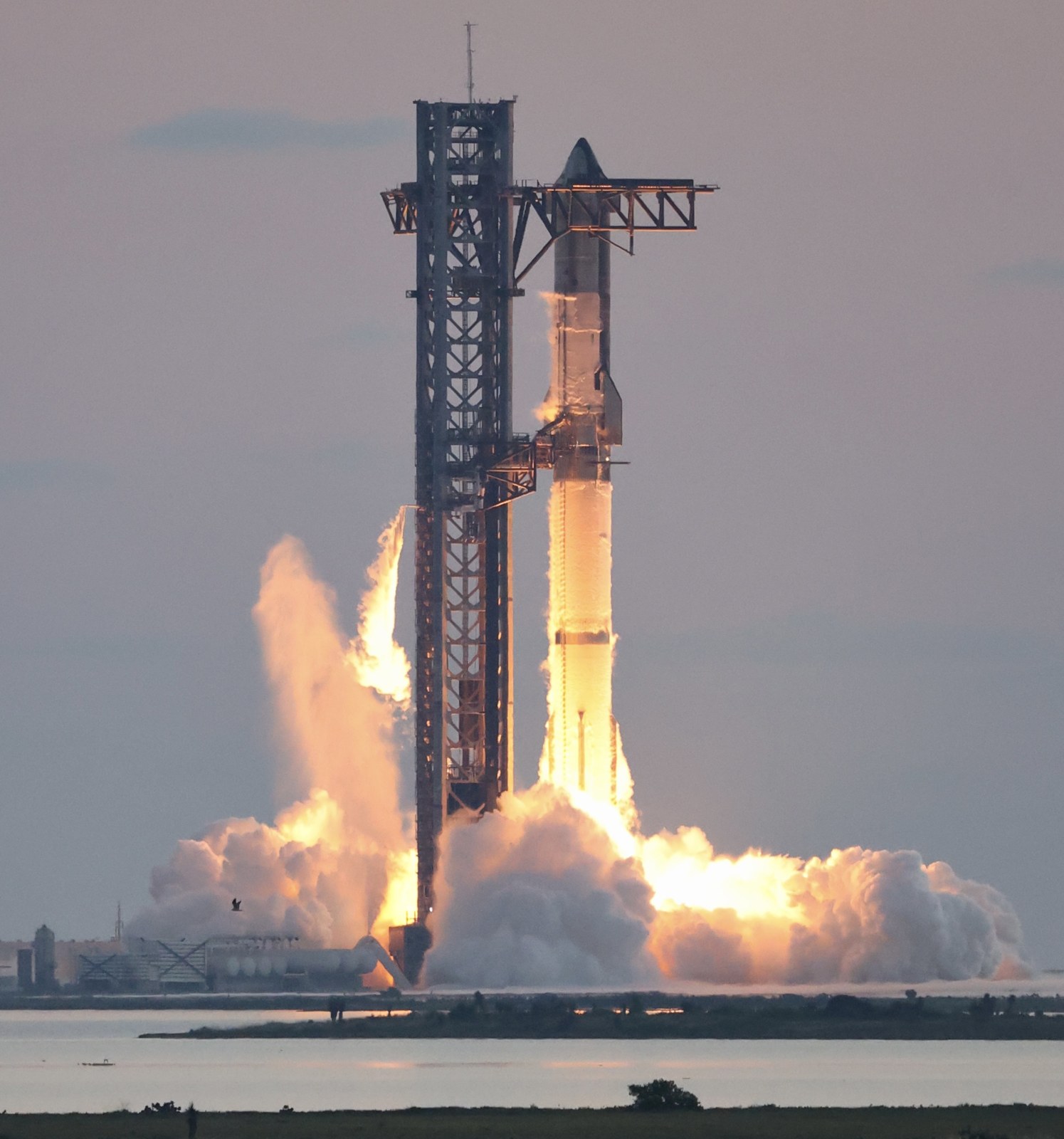
SpaceX Starship and Super Heavy igniting on the launch pad at Starbase
Starship lights its engines on Flight 5, photographed in October 2024. (Credit: Steve Jurvetson, CC BY 2.0, via Wikimedia Commons)

The mission that stopped being a landing

Artemis III was the flight that was going to put boots back on the Moon. In February NASA redesignated it a crewed demonstration in low Earth orbit, and moved the landing to Artemis IV in 2028.1 The astronauts still fly. They just do not land.

What the government actually bought

NASA awarded SpaceX−5.26% — SpaceX, down 5.26 percent today a firm-fixed-price contract worth about $3 billion in July 2021 to develop and demonstrate the lander.2 Fixed price was the point: the provider carries the overrun, and payment comes only when milestones land. That provider is now a public company, listed in June at $135 a share.9

The discipline worked on money and nothing else

By the agency's own audit, that contract has grown 6% in cost. It has also slipped at least two years, and the inspector general expects more.2 The taxpayer was protected from the invoice and not from the calendar.

A fixed-price contract transfers the money risk. It does not transfer the physics.

The arithmetic behind the landing

Starship cannot reach the Moon on one tank. NASA's report describes a depot in low Earth orbit filled by more than 10 tankers, with propellant gathering starting more than 200 days before the crew launches, and SpaceX targeting one tanker flight every six days until the depot is full.2
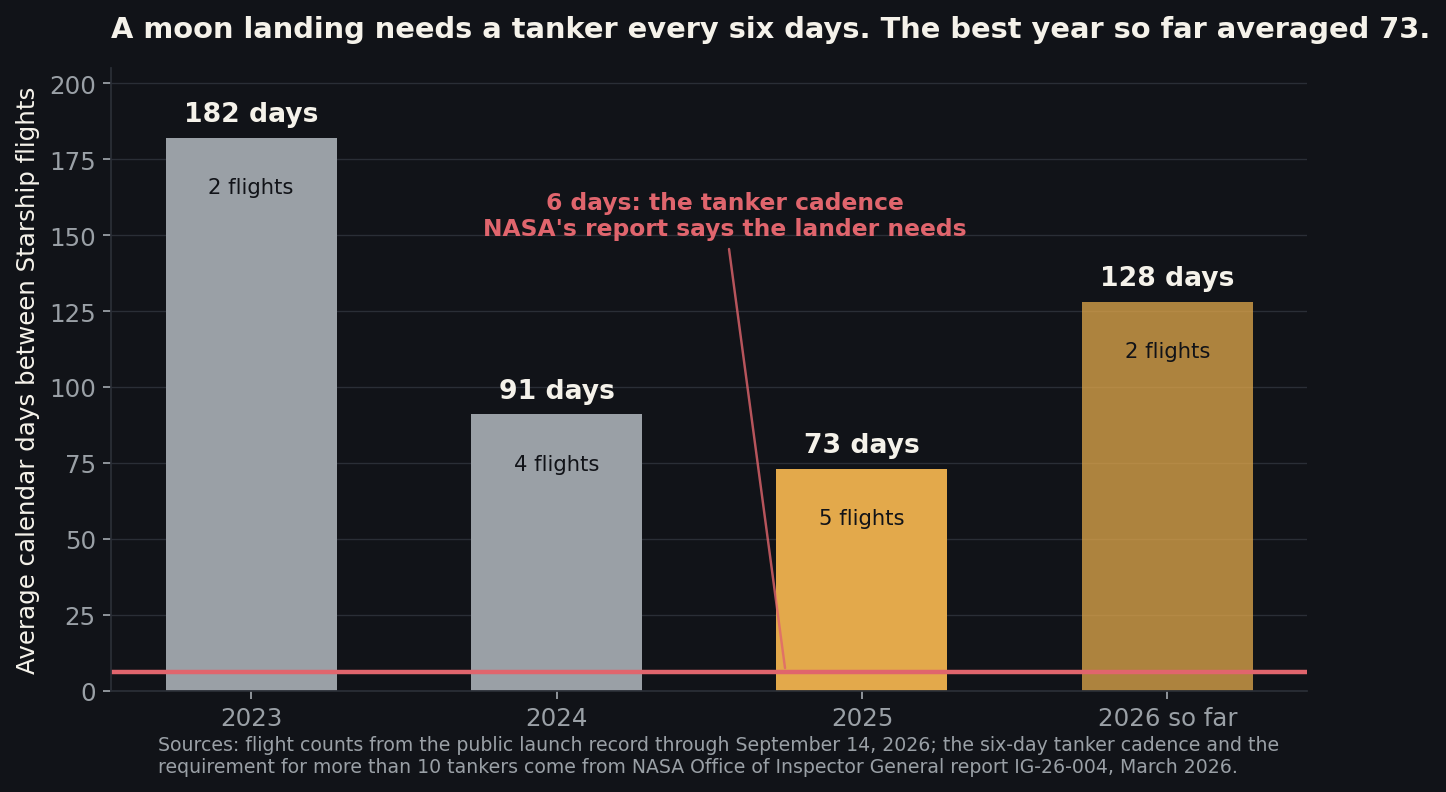
Column chart of average calendar days between Starship flights: 182 days in 2023, 91 in 2024, 73 in 2025 and 128 so far in 2026, against a line at the six-day tanker cadence the lunar lander requires.
Thirteen flights in three and a half years, against a plan that needs one every six days for months. Sources: public launch record to September 14, 2026; NASA Office of Inspector General, March 2026.

The milestone that unlocks any of it is a transfer of cryogenic propellant between two vehicles, which the program calls one of the hardest problems its provider faces. It was due in March 2025, was rescheduled to March 2026, and had still not been attempted after the thirteenth flight in July7, the first since the listing.2,3,8,10

The case that this is normal

Hard vehicles run late, and the same audit that records the slip credits the contracting approach with holding costs nearly flat across both providers.2 The alternative is not obviously faster: NASA reopened the competition, and the rocket meant to carry the rival lander exploded in May.4 Elon Musk has argued the refuelling estimates are too pessimistic, since a partly filled lander can still make the trip.5

That defence answers the cost question and leaves the cadence question where it was.

What to watch

Flight 14 is scheduled for September 22, carrying Starlink satellites to orbit.6 The number that matters is not whether it flies. It is whether two Starships ever dock and move propellant, and how many days pass before the next one leaves the pad.

The Moon is a cadence problem now, not a rocket problem.

Get Robotics & Defense by email, free

Robots, self-driving vehicles, drones and AI in defense. In our daily email, every weekday.
Loading SPCX

Reader comments

0 comments

    More in Robotics & Defense

    All in this topic →

    Robotics & Defense

    Richtech Robotics now trades below its cash, and the filings explain why

    The Las Vegas robot maker closed October at $0.95, valuing the whole company below the cash on its June balance sheet. Restated accounts and an administrative cost base that outruns the business are what the market is charging for.

    Robotics & Defense

    Tesla stops paying for referrals that sell cars, pays for referrals that sell software

    Tesla quietly stripped vehicle rewards from its US referral program and now pays owners in FSD months, a customer-acquisition budget re-pointed at the 10 million subscription milestone in Elon Musk's pay package.

    Robotics & Defense

    Musk says no to a December Optimus waitlist after a Tesla conference partner said yes

    A robotics investor whose conference Tesla sponsors says Optimus reservations open in early December. Musk answered with one word on X, and Tesla's own waitlist record is ten years of money in with no product out.

    Robotics & Defense

    SpaceX closes below its $135 IPO price while Musk promises 10,000 Starship launches a year from one site

    Shares closed 6.37% lower on Friday, under the $135 IPO price, as tech earnings punctured the AI trade. The same week, SpaceX cast the FAA's airspace rules as the bottleneck while its own flight plan runs at about 1% of the launch rate Musk now claims for one site.

    Robotics & Defense

    Ouster's 1,426 Ukraine missions are supplier-reported, and its $2.32 billion market cap faces Q3 on Nov. 3

    Forterra's uncrewed Lancers ran 1,426 Ukraine missions on Ouster lidar, and the same release tees up Rev8 as the next sensor. The counts are supplier-reported, the stock trades at 9.6 times trailing sales, and Q3 results land Monday, November 3.

    Robotics & Defense

    Red Cat splits Wall Street: a $6 price target against $25, with results due November 16

    Piper Sandler cut its target on Red Cat Holdings to $6 on October 23, the same week Red Cat opened orders for two uncrewed boats through its Blue Ops division and signed a takeover agreement for Austria's Steyr Motors. Six of seven analysts still say Buy at a $16.14 average, and the November 16 third-quarter report against $150 million to $180 million of guidance is the test.

    Get the newsletter

    The day's AI and market news, in your inbox every weekday.