Nutanix's AI costs jumped 350% when pricing went per-token; now it sells the cap as Agent Gateway
Nutanix's own 2,500 engineers saw AI costs jump more than 350% when pricing went per-token; the fix it shipped this week caps the bill by routing work between owned open-weight models and frontier APIs, and turns subscribers to frontier models into buyers of NVIDIA and AMD hardware.
 Richard Tangtwo-minute read

Nutanix−0.34% — Nutanix, down 0.34 percent as of its last quote, the cloud software company, just turned its own AI cost crisis into a product. It launched Agent Gateway this week: routing software that sets a budget cap per team, cuts token usage when a team runs hot, and sends each task either to an open-weight model on GPUs the enterprise owns or to a frontier model over an API. It exists because Nutanix had to build it for itself.
A 350% bill forced Nutanix to build the fix
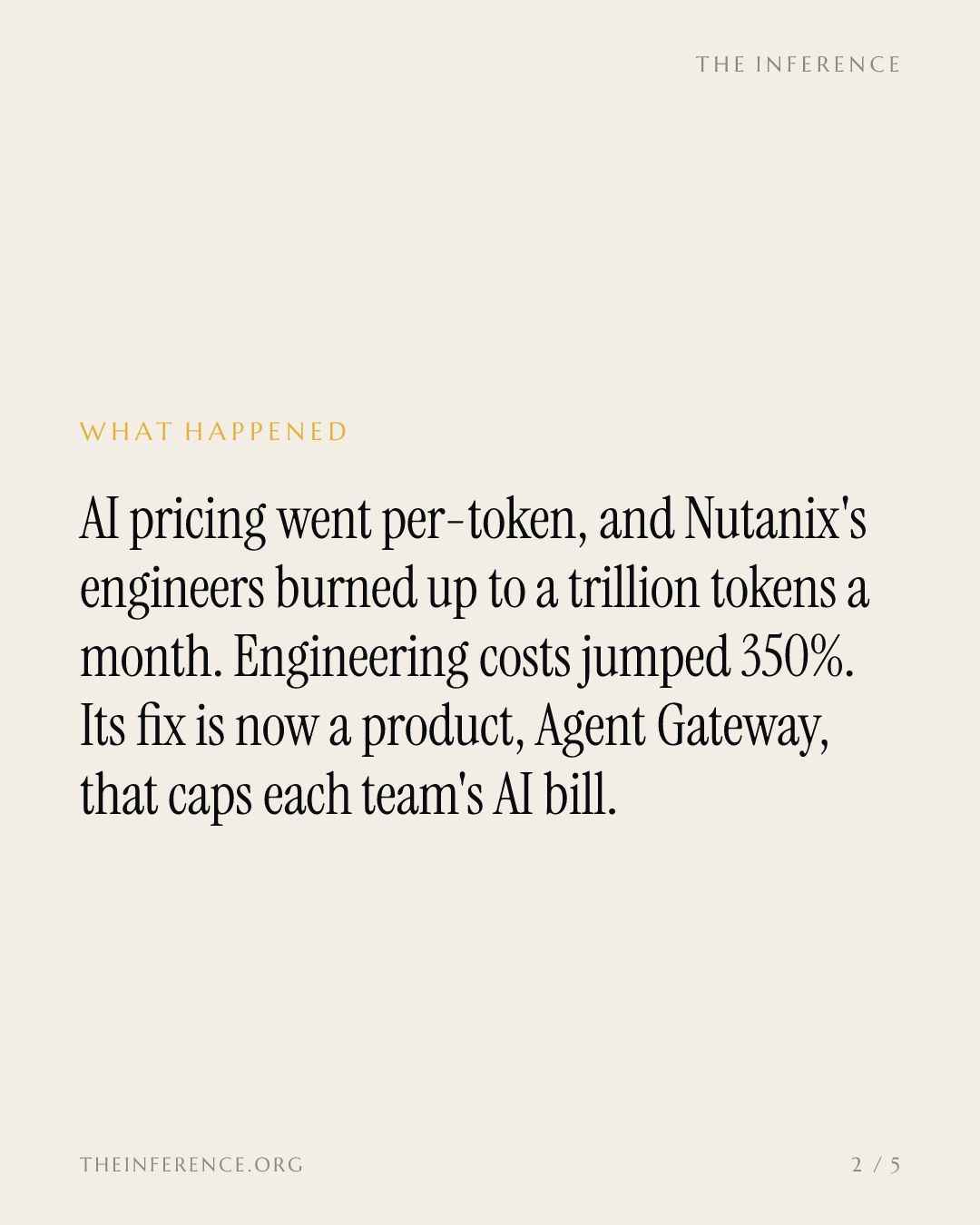
The story behind it went on the record with fiscal 2026 results on November 7 1. When AI pricing shifted from per-user to per-token, Nutanix's 2,500 engineers burned up to a trillion tokens a month and engineering costs skyrocketed more than 350% in a very short period 1. The fix was not a cheaper contract.
Nutanix put $20 million into its own GPU infrastructure, servers from NVIDIA−4.64% — NVIDIA, down 4.64 percent today and AMD+2.11% — AMD, up 2.11 percent today in colocation data centers, moved 80% of software development onto open-weight models there, and kept frontier APIs for the hardest 20% of tasks 1. Internal AI costs fell by more than half, with payback inside a year 1. Nutanix's own framing on X: 80% of AI coding tasks on self-hosted models, no per-token bill 5.
The router turns an AI bill into a GPU purchase
Here is the mechanism that matters for the money. Routing software that can send work to open-weight models the enterprise owns is what converts frontier-API spending into a hardware decision: every enterprise that copies Nutanix's playbook buys NVIDIA and AMD GPUs instead of renting frontier tokens.
Nutanix is already distributing around that logic. The revamped Elevate partner program pays qualifying Premier partners 1% of a client's total contract value through a new Business Development Fund, and partners are told to cross-sell Agent Gateway, Enterprise AI and Unified Storage 3. The router that shrinks frontier revenue is the product Nutanix pays its channel to sell.
Two camps, one company selling the border
Nutanix is selling into the camp that wants a capped bill, while the frontier labs are paid by the camp that does not. A tie-up with Netris, announced on October 21 at NVIDIA GTC, sells the same multitenant stack to neoclouds, GPU infrastructure providers renting capacity, for GPU-as-a-service, with a technology preview planned for early 2027 2. Fiscal 2026 added about 3,000 customers, taking Nutanix to 32,000 1.
The launch alone is not a buy. No Agent Gateway revenue is disclosed, and Nutanix still counts AI traction as customer logos rather than a revenue line. The test is whether cost governance converts into bookings: December's pre-orders and customer adds will say.
Get Platforms by email, free
The cloud, data and developer software AI is built on. In our daily email, every weekday.