onsemi will make and sell the in-car camera chip it is building with Valens, on undisclosed terms
Valens owns the A-PHY standard and nearly doubled automotive revenue last quarter, but the volume chip will carry onsemi's label on terms nobody has described. onsemi's $5.7 billion all-cash Synaptics deal faces the Synaptics shareholder vote on Tuesday, November 17.
 Vincent Jiangfour-minute read
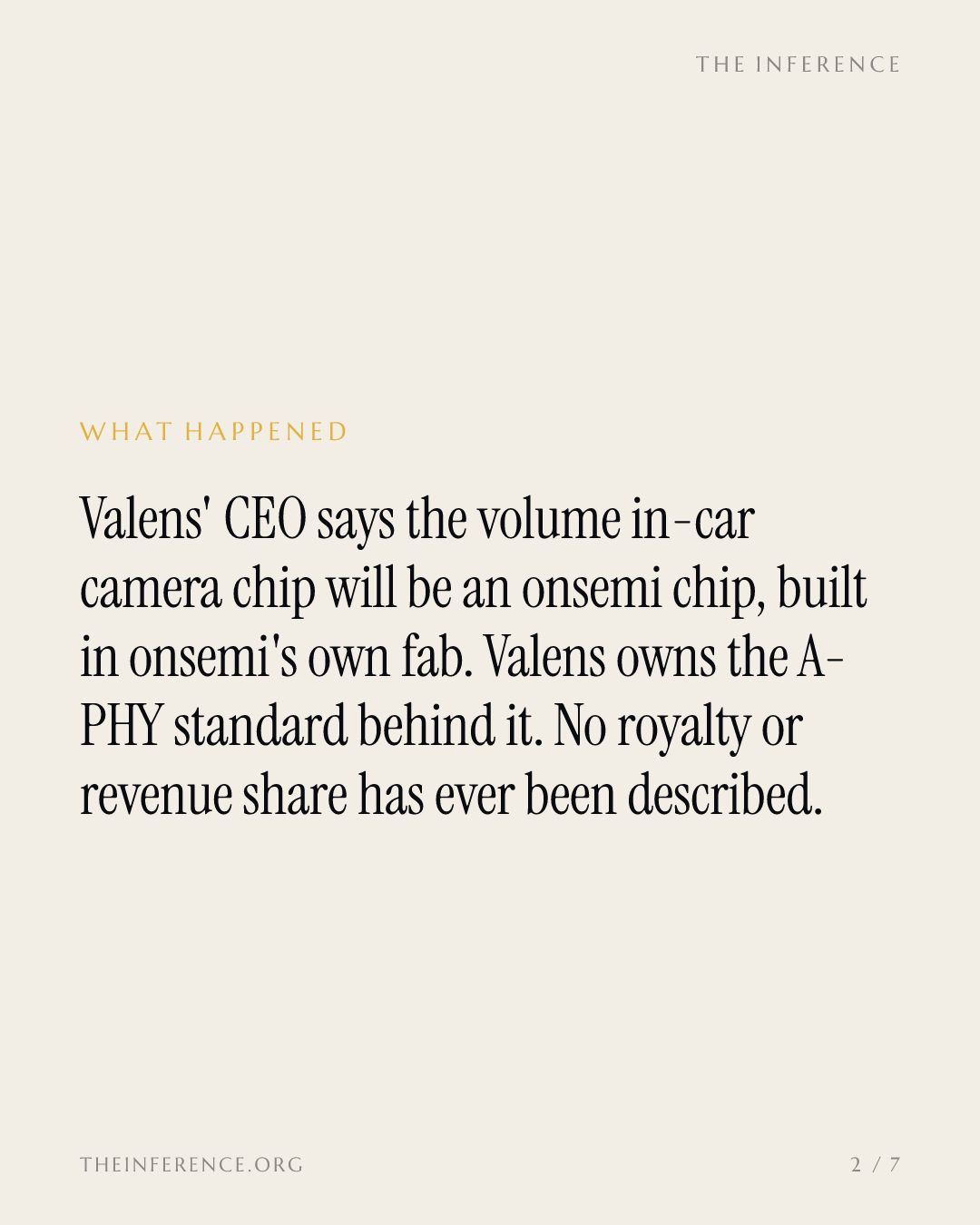
An onsemi chip, in an onsemi fab
Needham analyst Quinn Bolton asked the question directly on Valens Semiconductor's0.00% — Valens Semiconductor, unchanged today November 11 earnings call: would Valens (NYSE: VLN), the Israeli connectivity-chip company behind the A-PHY automotive link standard, design the low-cost part itself, or license its technology to onsemi−4.86% — onsemi, down 4.86 percent today, the US image-sensor and power-chip maker? 1
Chief executive Yoram Salinger's answer was the first public description of who owns the volume part: engineering has run for months, onsemi will build the chip in its own fab, both companies will market it, and "the chip is going to be an onsemi chip... it's going to be an onsemi product" 1. No royalty, license fee or revenue share was described, on the call or in the September 22 announcement 12.
The volume camera loses its serializer
The part sits where the volume is. A typical automotive camera carries two chips, an image sensor plus a separate serializer; the collaboration folds A-PHY into a 3-megapixel onsemi sensor and deletes the serializer from every surround-view, side- and rear-camera and electronic-mirror design 12. Separately, Valens has booked four design wins for its own A-PHY chipsets, the premium line that serves 8-megapixel front cameras, with production expected to begin in 2027; none of those are orders for the onsemi part 1.
Better numbers, a thinner cushion
Valens' quarter was its strongest in years: revenue of $21.9 million beat guidance, automotive revenue reached $7.9 million from $4.1 million a year earlier, and automotive gross margin jumped to 53.9% from 41.5% in the second quarter 1. Chief financial officer Karine Pinto-Flomenboim tied the margin jump to lower testing-facility expenses and a shift in product mix, and said separately that she expects the revenue level to continue based on Mercedes-Benz demand, since Valens chips sit in every Mercedes passenger model 1.
Automotive revenue nearly doubled in a year to $7.9 million
- Automotive
- Cross-industry (audio-video)
Data
| Automotive | Cross-industry (audio-video) | |
|---|---|---|
| Q3 2025 | $4.1M | $13.2M |
| Q2 2026 | $5M | $13.1M |
| Q3 2026 | $7.9M | $14M |
Cash thinned even as revenue rose
The cushion thinned anyway: cash closed September 30 at $74.7 million, debt-free, against $92.6 million at end-2025, guidance still carries a full-year adjusted EBITDA loss of $12.9 million to $14.9 million, and she said the company cannot foresee testing or supply-management expenses 1. Margins on the onsemi deal, Salinger said, are "a completely different story" 1.
Four billion in cash, a $5.7 billion bill, a vote tomorrow
onsemi closed its October quarter with $4.16 billion of cash 8. Tomorrow, November 17, Synaptics−0.52% — Synaptics, down 0.52 percent as of its last quote stockholders vote on selling to onsemi for $123.00 a share in cash, about $5.7 billion, a deal rewritten down from roughly $7 billion after an unnamed rival bid on September 2 345. Synaptics brings the Wi-Fi 7 and edge-AI processors onsemi would own outright 5. The Valens arrangement hands it a connectivity standard on undisclosed terms instead 1.
onsemi's cash bottomed at $2.0B in Q1, then doubled to $4.16B, short of the $5.7B deal
Data
| Cash and equivalents | |
|---|---|
| Q4 2024 | $2.69B |
| Q1 2025 | $2.76B |
| Q2 2025 | $2.53B |
| Q3 2025 | $2.47B |
| Q4 2025 | $2.15B |
| Q1 2026 | $2B |
| Q2 2026 | $3.52B |
| Q3 2026 | $4.16B |
Shanghai gets a headquarters while Rožnov stays a plan
Even as capital spending shrinks, onsemi keeps putting design and manufacturing where its customers are. Shanghai approved its Greater China headquarters on November 11, with eight joint application labs running in China and three more planned 6. The €1.8 billion plan a Czech ecosystem report still lists for the Rožnov pod Radhoštěm fab is the outlier on that map 7: onsemi spent $19 million on capex in its October quarter 8, a squeeze The Inference charted on November 7.
The case for handing over the standard
Valens' argument is fair. A-PHY stayed concentrated in premium front cameras because the silicon was premium-priced and carmakers refuse to bet a safety-critical system on one vendor: OEMs "need confidence in their supply chains", which "means having multiple established suppliers supporting the same standard" 1. Salinger called the onsemi pairing the supplier choice automakers "expect from an industry standard" 2. A sensor sold under onsemi's label can still pay Valens per unit. The record shows who builds and sells it, not who collects what.
The undisclosed terms are the number to watch
Three readings price it: tomorrow's Synaptics vote 3, the 2027 production start 1, and Valens' Form 20-F, filed last February and due again in the new year, where a number for the arrangement could first appear 1. onsemi is spending $5.7 billion to own connectivity outright in one deal and borrowing it in the other, and only one of those prices is public 4. Watch whether automotive gross margin holds 53.9% once the onsemi sensor ships 1.
Get Chips by email, free
How AI demand is reshaping chipmakers, memory and the fabs behind them. In our daily email, every weekday.



Reader comments
0 comments