Quanta Computer revenue rose 125% to NT$1.12 trillion as it seeks to shift inventory to AI customers
Taiwan's biggest AI-server maker just doubled sales while keeping less of each one, and its fix is to ask hyperscale customers to hold the inventory. Whether they accept decides whose balance sheet carries the boom.
 Vincent Jiangthree-minute read
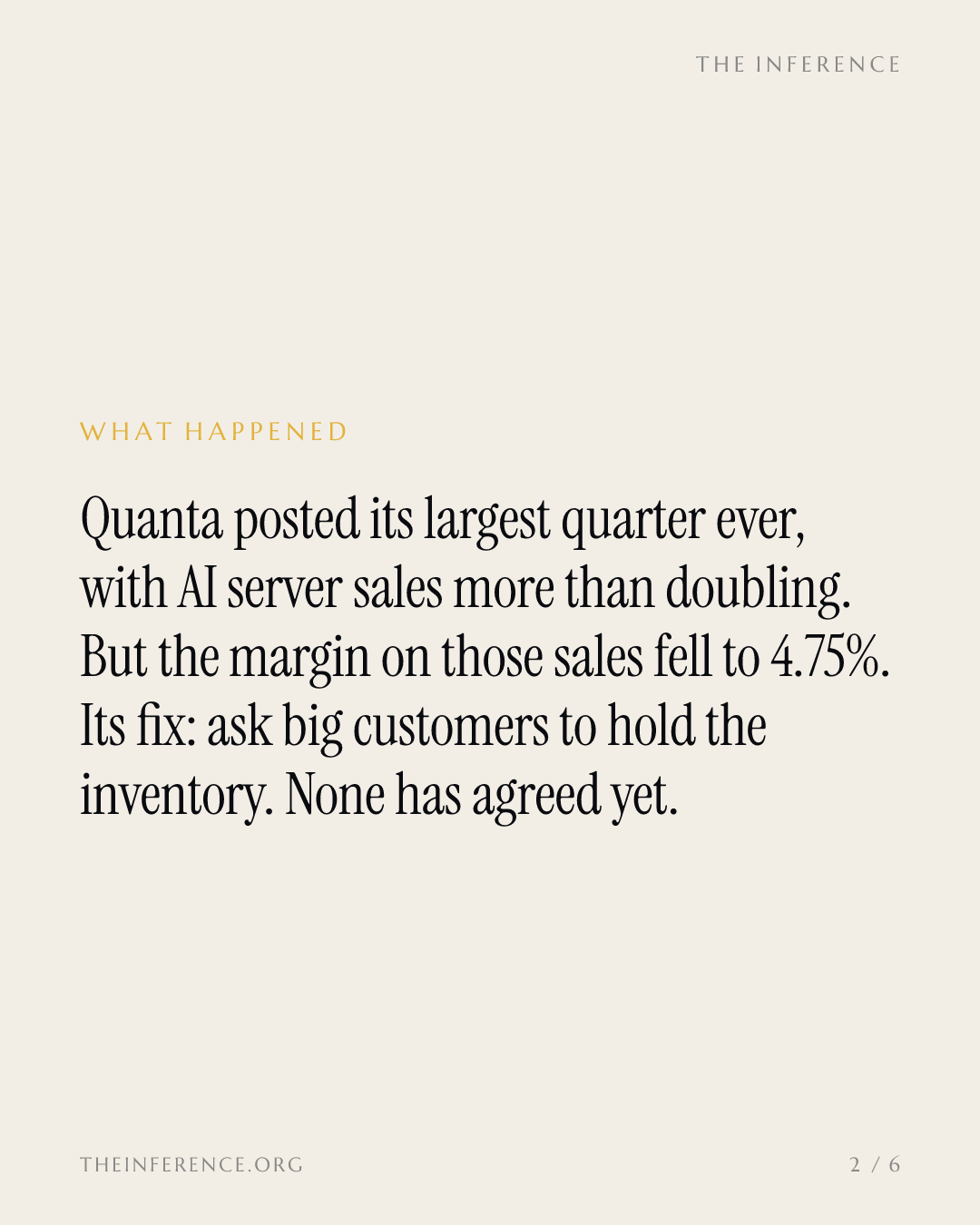
Quanta Computer−6.54% — Quanta Computer, down 6.54 percent today (2382.TW) posted the largest quarter in its history and immediately asked its biggest customers for a favor 1. Third-quarter revenue hit NT$1.1155 trillion, about US$34.1 billion, up 125.2 percent year over year 1. The gross margin on those sales fell to 4.75 percent, down from 6.84 percent a year earlier and 5.02 percent in the second quarter 12.
Net profit still climbed 73 percent from the prior quarter to NT$28.42 billion, with earnings per share of NT$7.08 against NT$4.26 a year ago 12. Management, speaking at the November 11 investor conference, is negotiating consignment terms for next-generation racks that would move inventory of high-value components onto customers' own books 2. The arrangement would lift Quanta's return on invested capital by shifting working-capital risk to the hyperscalers, who have not agreed to accept it at scale 2.
Gross margin slid from 6.84% to 4.75% in four quarters
Quanta kept 210 bps less per sale than a year ago, yet net profit rose 73%
Data
| Value | |
|---|---|
| Q3 2025 | 6.84% gross margin |
| Q2 2026 | 5.02% gross margin |
| Q3 2026 | 4.75% gross margin |
Cheaper racks, thinner slices
The margin story is arithmetic, not accident. Complete AI server systems carry enormous component costs that Quanta passes through as revenue, so each rack inflates the top line while diluting the percentage the company keeps 2. Servers contributed over 80 percent of third-quarter revenue, with AI-optimized hardware at 75 to 80 percent of that server business, per chief financial officer Elton Yang 2.
Management expects the mix to intensify: servers should reach 85 to 90 percent of total revenue in 2027, with AI servers at 80 to 85 percent of server revenue 12. The legacy notebook business, meanwhile, is shrinking; shipments are projected down 15 to 20 percent for the full year 2. What looked like diversification a decade ago is consolidating into dependence on a single theme, priced thinner each quarter.
Capacity doubles while capex climbs
Quanta allocated NT$34.6 billion of capital expenditure in the first nine months of 2026, roughly 80 percent directed at AI production facilities in the United States and Thailand, on course to double AI-related capacity versus 2025 levels 2. Management forecasts capex of NT$40 billion to NT$45 billion in 2027, focused on power distribution and cooling, the physical bottlenecks of next-generation racks 2.
Absolute profit has so far outrun the margin decay: operating profit rose 75.3 percent year over year to NT$32.2 billion, and nine-month EPS of NT$20.03 set another record 1. But the counterparty risk is now explicit. Wistron, Inventec and Foxconn−0.83% — Foxconn, down 0.83 percent today compete for the same design wins, and the consignment pivot works only if customers with alternative Southeast Asian suppliers accept terms that transfer inventory risk from the manufacturer to themselves 2. No source yet shows whether any hyperscaler has agreed.
Consignment is the test now
Vera Rubin-based rack shipments begin before year-end and ramp meaningfully in the first quarter of 2027; the transition from Nvidia's−4.41% — Nvidia, down 4.41 percent today GB300 architecture extends through the current quarter, and quarterly AI server revenue is still guided up despite a slight dip in Q3 unit shipments 2.
Watch whether gross margin stabilizes above or falls below 4.75 percent once Rubin volume lands, and watch for the first named customer accepting consignment terms 12. The opening position is clear: Quanta is betting record volume, doubled capacity and customer-held inventory can outrun a shrinking slice of each sale 12.
Get Data Center by email, free
Who is building AI's data centers, and who is paying for them. In our daily email, every weekday.