RWE wants data centers to pay for Europe's grid, and RWE owns what gets built
The RWE chief says the companies driving Europe's power demand should pay for the grid that serves them. He also owns the sites, the PPAs and 55% of a grid operator that would collect.
 Vincent Jiang · 3 min read
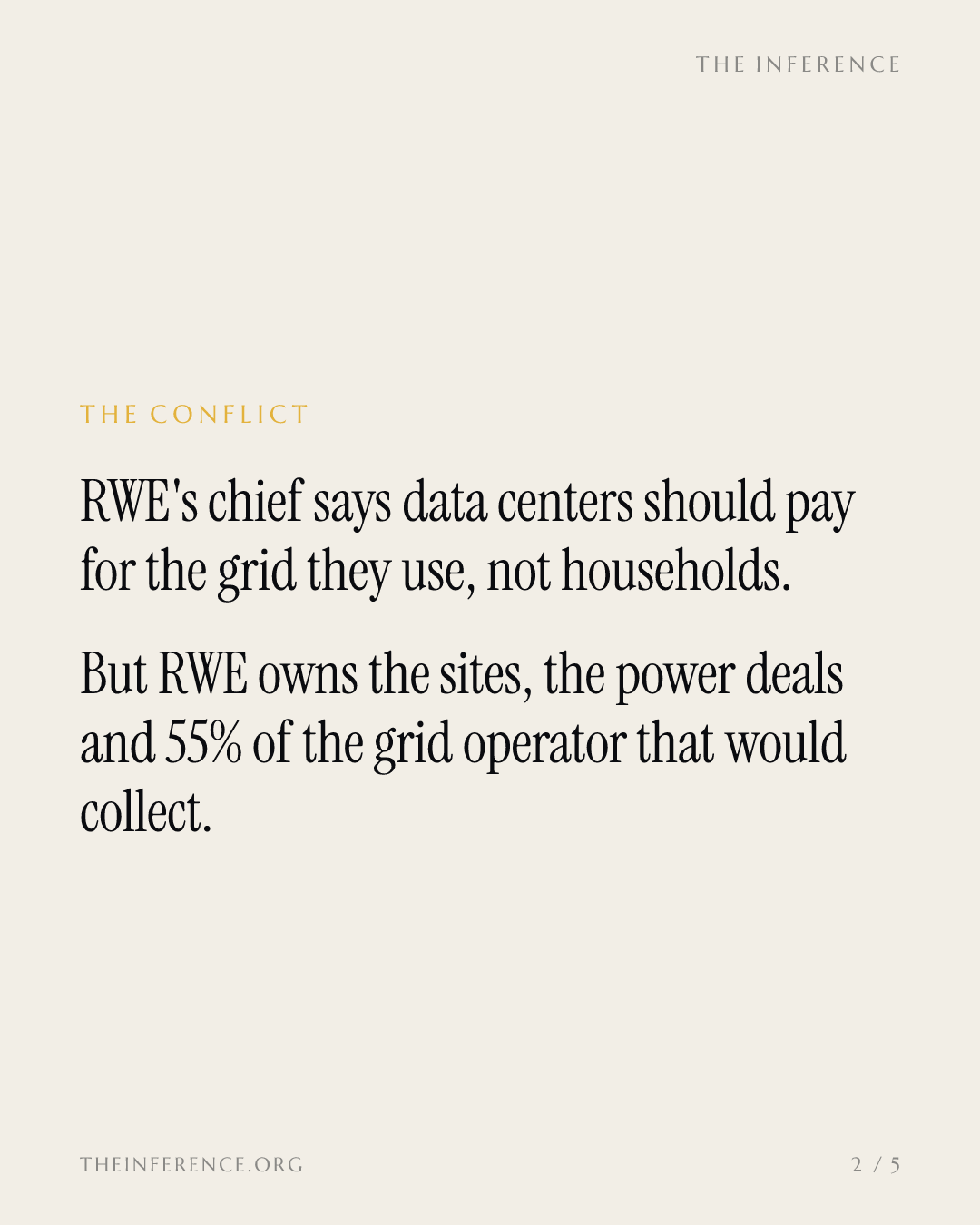
Europe's AI power fight is being written now, and the man holding the pen also owns the paper. RWE−0.59% — RWE, down 0.59 percent today chief executive Markus Krebber told Bloomberg on October 7 that data centers demanding more grid and more firm capacity are not paying for it, and that policymakers should bill the new demand instead of spreading the cost across households 17. Moody's puts the American bill for new AI power plants at about $110 billion, and Krebber warns that data centers willing to pay a premium will tighten competition for supply and pressure European consumers and energy-heavy industry 1.
The advocate owns the assets he wants repriced
Krebber is not a neutral voice. RWE owns roughly 30 industrial sites suited to data centers, has 10 in development and about 3 GW of grid capacity applied for and secured 2. It handed a decommissioned UK coal site to Amazon−1.98% — Amazon, down 1.98 percent today and sells power to data-center operators through PPAs 12. It holds 55% of grid operator Amprion, financed partly by a €3.2 billion deal in 2025 2. If Europe adopts demand-pays rules, hyperscalers' connection bills rise and RWE's ready sites, firm capacity and grid stake all reprice, which makes the campaign read like a sales strategy.
The premium is already on the tape
Pricing shows what demand-pays could look like: Inderes estimates Google's data-center power deal with Fortum at about €80 per megawatt-hour, roughly 57% above 2030 futures at €51 1. RWE plans to grow US capacity from about 13 GW to 22 GW by 2031 with about €17 billion committed, funded in part by the $1.22 billion it took from Interior in August to quit offshore wind 26.
He disclaimed the bid he is making
Meanwhile the CEO sits at the Uniper table without claiming a seat. Five non-binding bids are in for the 99.12% state-owned utility, up to 74.12% for sale at a possible €10 billion: KKR with RWE, Apollo, Equinor, EPH, and Brookfield with CPPIB 34. Krebber calls RWE's role "very, very limited and small" and says a takeover is "not possible" and "not what we strive for", after RWE leadership had previously dismissed interest in the company 3. Bidding while disclaiming is option value: RWE pays nothing to hold a place in the field while Berlin decides how to sell.
| Bidder | Consortium |
|---|---|
| KKR | with RWE |
| Apollo | solo non-binding bid |
| Equinor | solo non-binding bid |
| EPH | solo non-binding bid |
| Brookfield | with CPPIB |
The market has not paid for the campaign
The counterpoint: Europe has so far avoided the US price shock, so regulators may see no urgency, and a public utility campaign can die in Brussels. RWE raised 2026 adjusted EBITDA guidance to €5.57–6.35 billion and plans €42 billion of net investment through 2031, yet the stock stood at €57.54 on October 7, 7.2% below its 52-week high, with Berenberg's €72 target about 25% above it 5.
How to watch it
Three tells land soon: the Uniper shortlist, expected in the coming weeks 4; whether EU policymakers pick up Krebber's cost-allocation argument 1; and Q3 results on November 11, the first checkpoint on the raised guidance 5. If demand-pays rules arrive, the reprice shows up first in RWE's site portfolio and its Amprion stake.
RWE needs nearly twice its first-half EBITDA to hit raised guidance
- Estimate
Data
| Value | Range | |
|---|---|---|
| H1 2026 actual | €3B | — |
| 2026 guidance low (estimate) | €5.57B | €5.57–6.35B |
| 2026 guidance high (estimate) | €6.35B | — |
*Related: RWE took $1.22 billion to quit US wind, then sold $1.5 billion of green bonds.*
Deepdive
AI-generated from this story and its cited sources. Not investment advice.