S&P sees 2027 bond issuance growth at 2.7% and puts Meta on a downgrade clock over $132 billion of deficits
The rater's 2027 outlook puts global issuance growth at 2.7% while AI stays the market's main source of new supply, and it put Meta on a downgrade clock over a three-year cash deficit Wall Street models at less than half the size. AI's funding plans were written for a market that no longer exists.
 Richard Tang · 4 min read

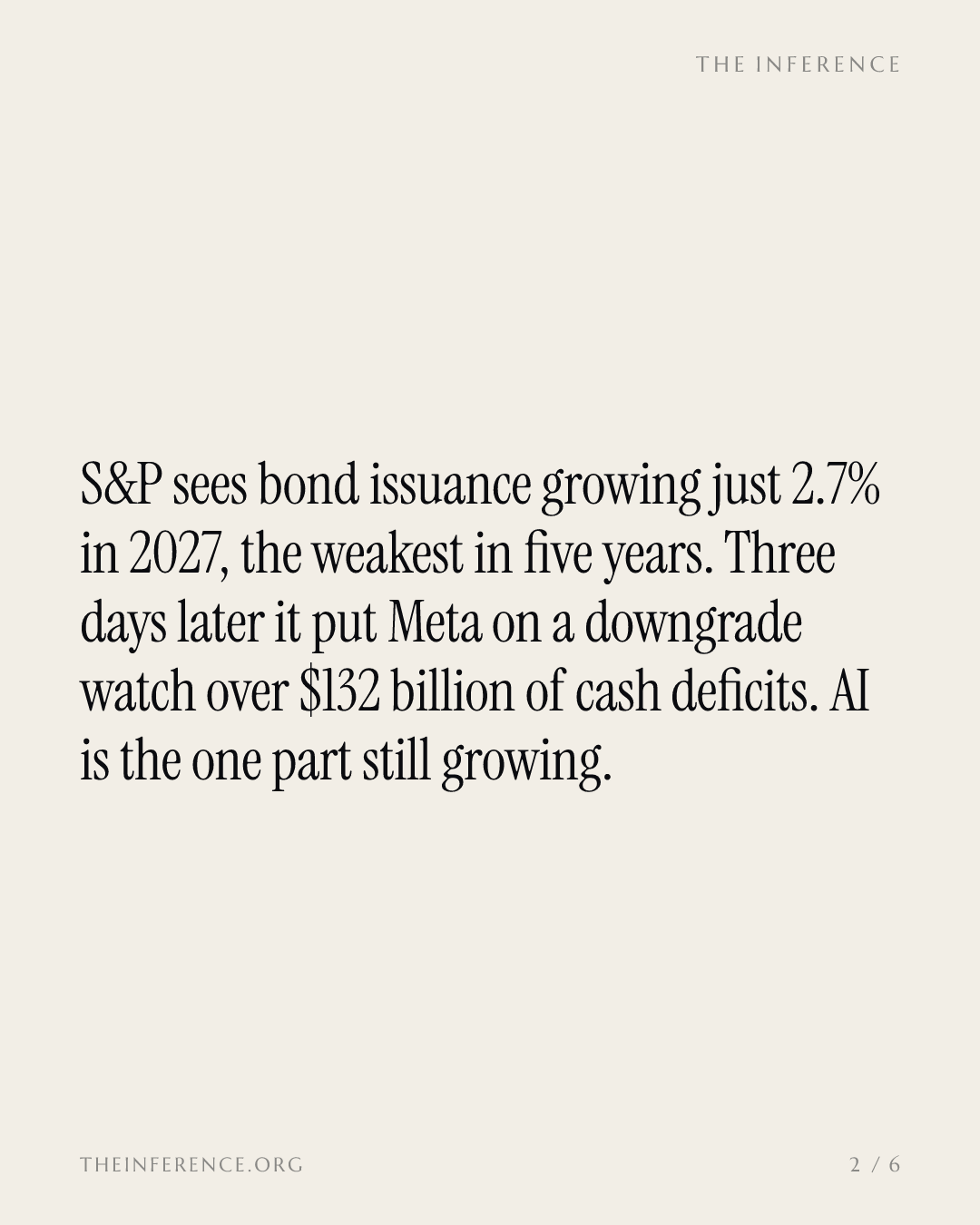
S&P Global Ratings$123B — S&P Global Ratings, private, latest valuation $123B spoke twice last week, and both times it said the same thing: the market that funds AI is not going to grow into the borrowing AI has planned. On October 27 the agency published its 2027 outlook and put global bond issuance growth at 2.7%, the weakest pace in five years 1.
Three days later it cut Meta's credit outlook to negative on the AA- rating, over cash deficits the rater sizes at $132 billion across three years 23. The referee is telling AI's borrowers that the deep, cheap market their plans assume is about to stop deepening.
The market that funds AI is no longer growing
The slowdown comes off the heaviest year on record, roughly $11.7 trillion of global issuance in 2026, after growth of 12.2% 1. Elevated rates and Middle East war risk curb new borrowing, and maturing corporate debt forces issuers out regardless.
The exception is AI. Hyperscaler issuance, the giant cloud and data-center operators financing AI infrastructure, is approaching $300 billion this year, and S&P expects it to keep rising in 2027 even as the whole market crawls 1. That supply faces AI capex forecast above $1.3 trillion, and S&P's own words are that it "will keep testing investor appetite for technology credit" 1. AI borrowers are becoming a rising share of a market that has stopped growing, and they will pay for the privilege.
S&P sees a cash hole twice the Street's, and the rating hinges on 2028
The Meta−0.39% — Meta, down 0.39 percent today warning is that forecast applied to one balance sheet. S&P expects free operating cash flow deficits of $22 billion, $71 billion and $39 billion over 2026 through 2028, and will consider a downgrade if adjusted leverage, debt measured against earnings, stays above 1.0x with cash flow still negative beyond 2028 23.
Meta answered with a stock sale of up to $95 billion, which is itself an admission that operations will not cover the build 2. Wall Street sees a smaller hole: its 59-analyst tally puts the three-year deficit at $61.32 billion, less than half S&P's figure, and has Meta near breakeven by 2028 2. The widest gap is 2028, the year the rating decision hinges on 2.
S&P sees more than twice Wall Street's cash hole at Meta
- S&P forecast
- Wall Street consensus
- Estimate
Data
| S&P forecast | Wall Street consensus | |
|---|---|---|
| 2026 (estimate) | $22B | $9.55B |
| 2027 (estimate) | $71B | $43.32B |
| 2028 (estimate) | $39B | $8.45B |
Capex at $34 billion a quarter has already flipped Meta's cash flow negative
Meta's own numbers this year back the rater. Free cash flow swung from $13.2 billion in the first quarter to negative in the third, as quarterly capex reached $34 billion, up 80% year over year 24.
Meta's free cash flow flipped negative as capex climbed
Data
| Free cash flow | |
|---|---|
| Q1 '24 | 12.85B |
| Q2 '24 | 11.2B |
| Q3 '24 | 16.47B |
| Q4 '24 | 13.56B |
| Q1 '25 | 11.09B |
| Q2 '25 | 9.02B |
| Q3 '25 | 11.17B |
| Q4 '25 | 14.83B |
| Q1 '26 | 13.23B |
| Q2 '26 | 1.75B |
| Q3 '26 | -1.16B |
The funding plans were written for a market that no longer exists
The 2027 funding plans now on the table were drafted against a market growing at 12% 5. Microsoft−0.68% — Microsoft, down 0.68 percent today priced $25 billion of bonds on October 29, its first US dollar sale since 2017 5. The deal drew $115 billion of orders, at AAA rates only the strongest AI borrower gets 5.
The same boom is priced very differently down the credit scale: five-year default insurance costs about 54 basis points for Microsoft, 116 for Meta and 275 for Oracle−6.99% — Oracle, down 6.99 percent today 5. That gap is lenders already charging more to fund the weaker AI borrowers, and the price climbs as the balance sheet thins, before any market-wide slowdown is even priced.
Default insurance already charges Oracle five times Microsoft's price
Data
| Value | |
|---|---|
| Microsoft | 54 bps |
| Meta | 116 bps |
| Oracle | 275 bps |
The debt reaches far past the big names too: private equity alone owns or finances roughly a quarter of active US data-center capacity, so any repricing of AI credit lands on banks and private credit as well 6.
The referee's own pay runs on the issuance it just forecast to stall
S&P Global+2.06% — S&P Global, up 2.06 percent today earns transaction fees that scale with issuance, and its third-quarter report already shows the linkage. Ratings revenue grew 2% while total revenue grew 7%, and guidance assumes high single-digit billed issuance growth with $250 billion to $300 billion of hyperscaler issuance baked in 7. Morgan Stanley+0.94% — Morgan Stanley, up 0.94 percent today had already flagged weak Q3 debt issuance hitting S&P Global and Moody's+2.89% — Moody's, up 2.89 percent today 8. Asked on its own earnings call about slower market issuance in 2027, management called it too early to comment 7.
The 2027 forecast its own credit desk published says that assumption stops next year. Read the two documents together: if issuance growth really collapses to a crawl, the Ratings division's growth goes with it.
S&P Global's revenue growth cooled the quarter issuance slowed
Data
| Revenue growth, year over year | |
|---|---|
| Q1 '25 | 8.2% |
| Q2 '25 | 5.8% |
| Q3 '25 | -3.7% |
| Q4 '25 | 9% |
| Q1 '26 | 10.4% |
| Q2 '26 | 10.4% |
| Q3 '26 | 6.8% |
The test is Meta's fourth-quarter call
Meta typically gives next year's capex guidance on the fourth-quarter call, and the number settles the argument 2. Above the Street's roughly $210 billion for 2027 makes S&P's darker math the likelier one; the Street's math was built to fit inside Meta's cash pile, and S&P's $132 billion was not 2.
If the rater is right, 2027 funding plans have to change, the equity sales get bigger, and the cost of AI debt rises. None of that changes the case for learning AI or building with it. It changes how the build gets paid for. The funding plans drawn for a 12%-growth market now have to be redrawn for one growing 2.7%.
Get Economy by email, free
How AI moves rates, banks, payments and the wider economy. In our daily email, every weekday.