Snap suits allege sex trafficking by design; Meta agreed to pay states up to $17.1 billion over teen harms
A Seattle plaintiffs' firm filed suits Thursday for six children who were 8 to 14, alleging Snapchat's features connected them to predators and destroyed the evidence. Snap's quarter is priced; its product-defect risk is not.
 Richard Tang · 3 min read

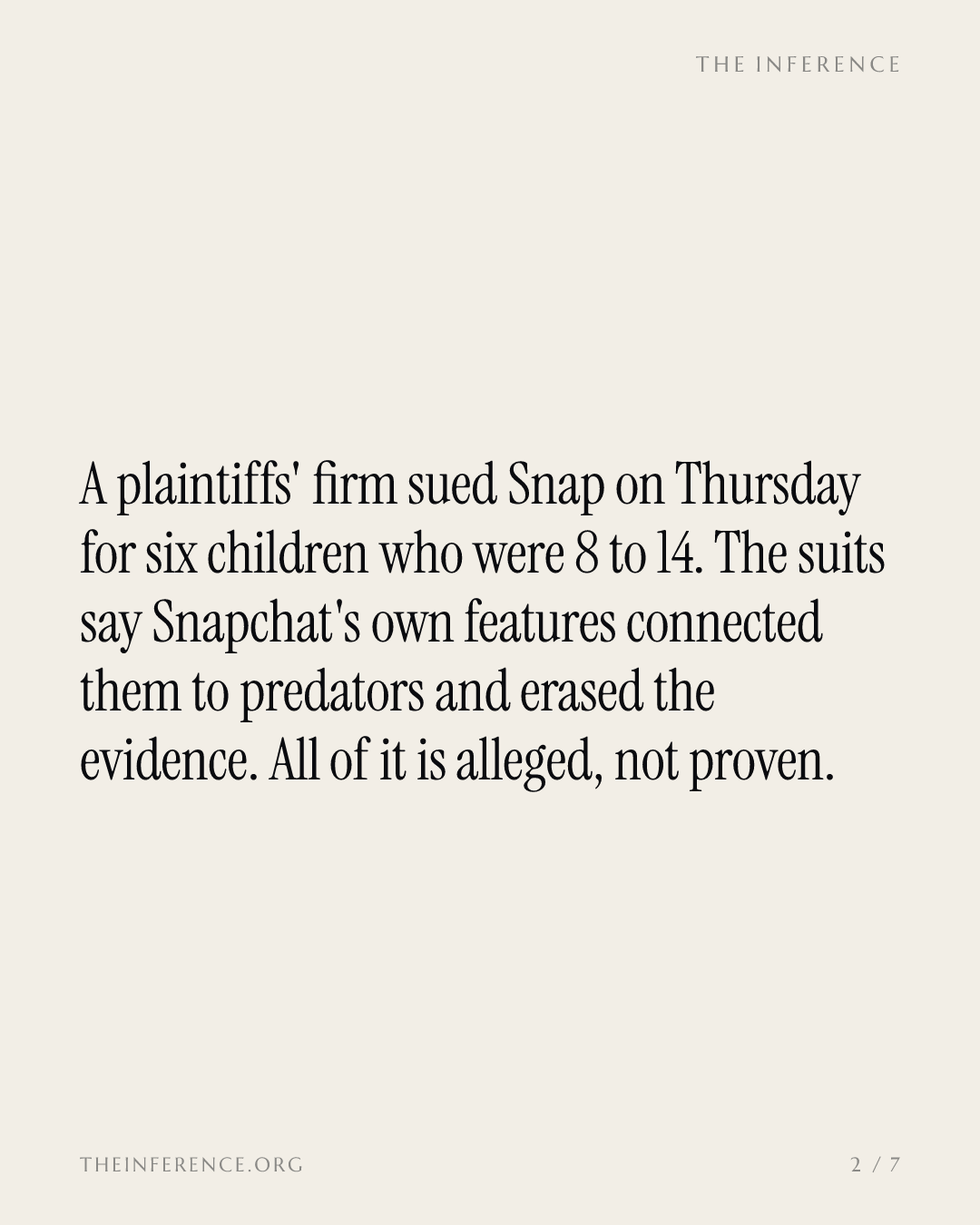
The Social Media Victims Law Center sued Snap+0.41% — Snap, up 0.41 percent today on Thursday for six children who were between 8 and 14 when the harm allegedly occurred, filing in a Seattle federal court and a Philadelphia state court 1. The complaints argue that Snapchat's own features connected the children to adult predators and then destroyed the evidence 1.
The filings landed the day after Snap's third-quarter report, in which advertising revenue growth slowed to 4%, and the shares fell about 14% 23. Investors sold the quarter. The complaints are the half of Thursday's news that is still unpriced.
The complaints treat the design as the delivery mechanism
The alleged chain runs through shipped features, in order 1. Quick Add recommends strangers and presents them as "Friends", starting the contact. Snap Map, the complaints say, handed one man in Louisiana a 12-year-old's home address; disappearing messages then erased the trail; My Eyes Only, a hidden vault, kept material beyond parents and investigators 1.
Snap's executives allegedly received a 133-page sextortion handbook
The escalation is the knowledge claim. Snap executives allegedly received a 133-page "Sextortion Handbook" in early 2024 1. Its anonymous author claimed more than 3,000 blackmailed girls and wrote instructions for exploiting those exact features 1. The named adults now face criminal charges, one federally indicted in April for using Snapchat against several minors 1. All of this is pleaded, not proven. Snap disputed the earlier claims against it and points to its Family Center supervision tool, safety tutorials and location sharing that stays off unless switched on 4.
The theory moved from addiction to product defect
The Los Angeles case Snap settled on November 2, days before opening statements, alleged addictive design: streaks, scores and notifications built to keep teenagers engaged 45. Terms were not disclosed 4. Thursday's filings argue the product is defective, with founding attorney Matthew Bergman, a career product-liability lawyer, calling Snapchat "a sex trafficker" 16.
His firm's stated method is to apply product-liability law to force safety into a platform's economics 6. The difference matters: an addiction claim prices a payout, while a defect claim would reach the recommendation engine itself, the friend suggestions and map that make Snapchat work.
Shareholders hold the risk the quarter left unpriced
The quarter's mechanics were not the danger: revenue set a record, Snap turned a profit after a year-ago loss, and subscriptions carried growth while brand advertising declined 3.
Snap's quarterly revenue kept climbing to a record even as its ad engine slowed
Revenue hit $1.72B last quarter even as ad growth slowed to 4%
Data
| Revenue | |
|---|---|
| Q4 '23 | $1.36B |
| Q1 '24 | $1.2B |
| Q2 '24 | $1.24B |
| Q3 '24 | $1.37B |
| Q4 '24 | $1.56B |
| Q1 '25 | $1.36B |
| Q2 '25 | $1.35B |
| Q3 '25 | $1.51B |
| Q4 '25 | $1.72B |
| Q1 '26 | $1.53B |
| Q2 '26 | $1.6B |
| Q3 '26 | $1.72B |
This class of claim has already been priced against a peer: Meta+0.98% — Meta, up 0.98 percent today agreed in August to pay states up to $17.1 billion over teen harms 5. Product liability applied to Snapchat would land as settlements and as redesigns of the recommendation and location systems, and shareholders own both.
The fix is engineering, and the first movers keep the teen audience
I am pro-AI and stay that way. What these complaints describe, if proven, is a design problem, and the fix is engineering: age-aware recommendations, location off by default, retention that keeps evidence for minors. The platforms that build that first keep the teenage audience and the advertisers who want it.
The market repriced Snap's ad engine on Thursday. It has not repriced the docket.
Get Applications by email, free
How AI is changing the software people and companies use. In our daily email, every weekday.