SpaceX is negotiating access to 80,000 US cell sites; Crown Castle rose 9% as AT&T, Verizon and T-Mobile fell
Bloomberg reports SpaceX is negotiating access to at least 80,000 US cell sites, the ground half of a fourth nationwide carrier. The towers close the gap between satellite coverage and urban capacity, and Thursday night's tape named the landlords the winners and the Big Three the targets.
 Richard Tang · 4 min read
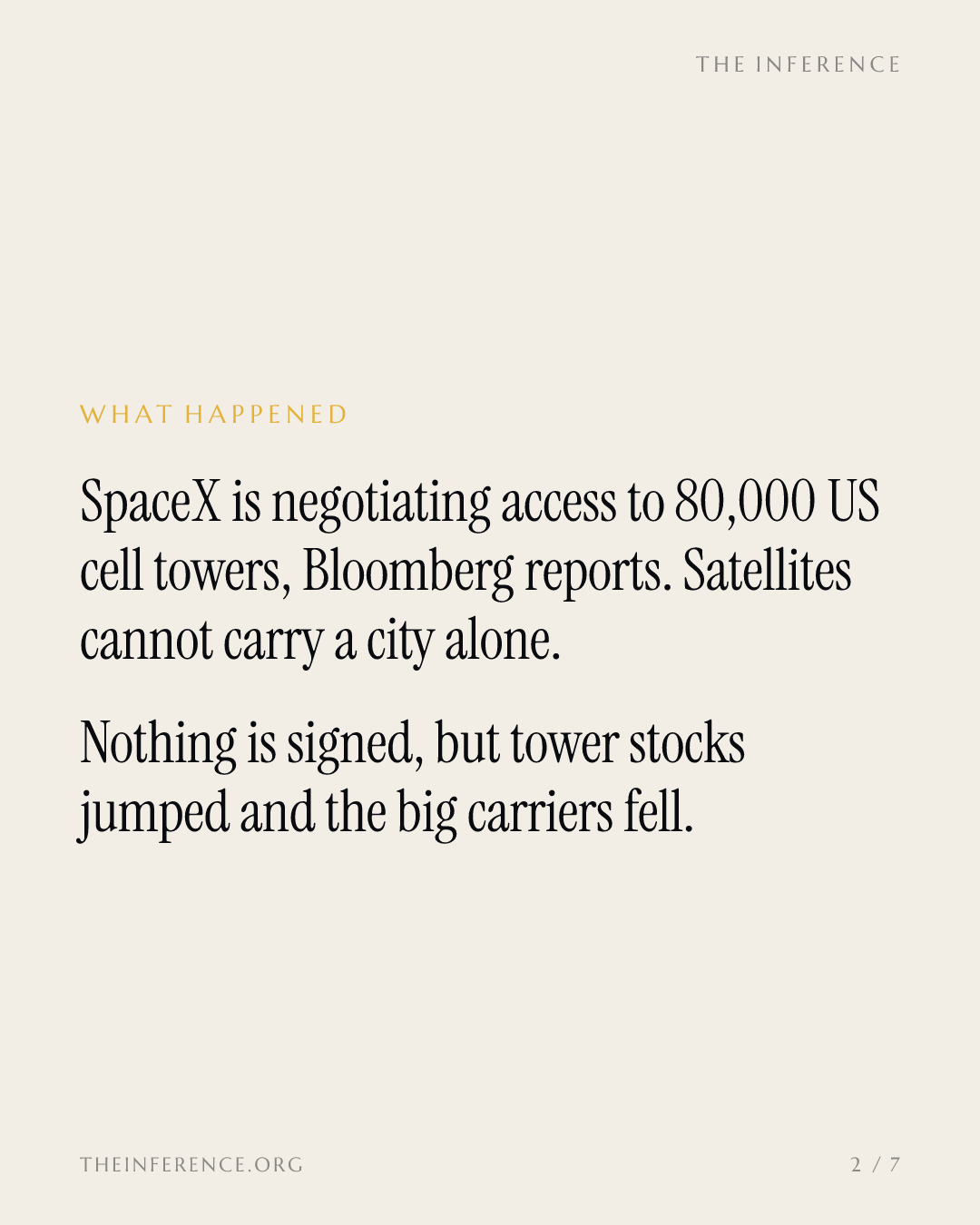
SpaceX−8.40% — SpaceX, down 8.40 percent today is negotiating access to at least 80,000 cell sites across the United States, Bloomberg reported Thursday evening, in talks that include Crown Castle+9.97% — Crown Castle, up 9.97 percent today, one of the country's biggest tower owners 1. That is about half of the 158,500 purpose-built towers operational in the US 2.
The satellites alone were never going to be a carrier: the ground network was the missing link, and SpaceX is negotiating to rent it from the incumbents' own landlords 1. Nothing is signed. The after-hours tape repriced the order anyway: AT&T+0.36% — AT&T, up 0.36 percent today, Verizon0.00% — Verizon, unchanged today and T-Mobile fell between 4.2% and 5% 2, while Crown Castle jumped 9% and American Tower+6.95% — American Tower, up 6.95 percent today, another of the largest US tower owners, added 5% 3. SpaceX itself spent Thursday in a broader tech selloff, closing down about 9% near $145 4. The report added only 1.4% after hours 3.
Towers do what satellites cannot
The satellite phone service sold today through T-Mobile−1.14% — T-Mobile, down 1.14 percent today, T-Satellite, runs on about 650 satellites at around 4 Mbps: a coverage layer for texts and dead zones, not a network that can carry a city 5. SpaceX's own FCC filing concedes the physics, saying deployment "will rely on radios feeding sectorized antennas on towers, rooftops, and other structures" 5. Satellite industry analyst Tim Farrar said the same from outside: reliable building penetration in urban areas would take an extensive and expensive ground network of towers 5.
The spectrum is arriving ahead of the towers
The airwaves are further along than the ground steel. SpaceX is buying 800 MHz low-band spectrum from Grain Management, the private investment firm that bought the band from T-Mobile, a purchase we covered earlier this week, though the FCC still has to clear the transfer to SpaceX 5. The band penetrates walls, and the FCC has already approved 15,000 next-generation satellites and cleared a path for SpaceX to compete as a retail wireless provider 5.
A separate, roughly $20 billion purchase of spectrum from EchoStar−6.35% — EchoStar, down 6.35 percent today, the parent of prepaid carrier Boost Mobile, does not close until November 2027, and SpaceX cannot use it before then 5. Research firm TD Cowen prices a nationwide terrestrial build from scratch at more than $80 billion 2.
Renting the gap is faster than rebuilding it
The fastest route through that gap is already standing. DISH built a national 5G network and then abandoned it, leaving its equipment on tower sites 6. Crown Castle chief executive Chris Hillabrant called that standing build "the industry cheat code," and his chief financial officer, Sunit Patel, noted DISH needed about four years to put it up 6. Bank of America+0.63% — Bank of America, up 0.63 percent today analyst Michael Funk ballparked 2029 for working service on Wednesday's earnings call 6.
Hillabrant declined to name tenants but said Crown Castle is talking to "all parties," and he named a second upside: incumbents spending harder to defend against a new entrant 6. Either path raises the rent on the same towers.
SpaceX pays the bills
Lease values could reach into the billions, Bloomberg's sources said 1. The bills land on a balance sheet that ended the third quarter carrying $36.1 billion of debt, and on a capital plan whose fourth-quarter guidance of $35–40 billion nearly doubles the third quarter's spending, much of it for the AI compute build we called half the company 4.
MoffettNathanson analyst Julie Zhu wrote that the call amplified "the enormous calls on capital that loom over the next few years" 4. Musk's commitment was explicit: the terrestrial buildout and the spectrum "will pave the way for Starlink Mobile to become a major mobile carrier in the US" 3.
Capex is guided to nearly double in Q4, before a single tower lease is signed
- Capital expenditure
- Estimate
Data
| Capital expenditure | |
|---|---|
| Q1 2026 | $10.1 |
| Q2 2026 | $18.4 |
| Q3 2026 | $19.6 |
| Q4 2026 (guide) (estimate) | $37.5 ($35–40) |
Three gates decide whether this becomes a carrier
Watch documents, not the tape. First, the FCC's clearance of the SpaceX-Grain transfer, which would put the low-band airwaves in hand 5. Second, a signed tower lease or a Crown Castle tenant disclosure, which would turn talks into a build 6. Third, the EchoStar close in November 2027, which gates the mid-band capacity a retail launch needs 5. Until one of those opens, any service date is a late-decade guess, and the first signed lease, not the next after-hours move, is what converts a satellite company into a fourth carrier.
What happens next
TWhether SpaceX gains the mid-band capacity a retail launch needs
The case for
A fourth national tenant plus harder defensive spending by incumbents both raise rent on the same Crown Castle and American Tower towers.
The case against
Nothing is signed, and the EchoStar mid-band spectrum a retail launch needs cannot be used before November 2027.
- November 2027EchoStar spectrum purchase closes.
Get our follow-up when these land
Free. We'll email you when we publish on AT&T, and send our free weekday newsletter. Unfollow in one click.