SSE defends the charge on British bills the morning its interim earnings nearly double
On 1 October SSE handed shareholders a trading update, with half-year EPS of 64 to 68p against 36.1p a year earlier, and handed bill payers an op-ed conceding the network element of bills will rise "for a period". Its 225 to 250p target for 2029/30 is built on the same grid buildout those bill payers fund.
 Vincent Jiang · 3 min read
SSE splits its morning between shareholders and bill payers
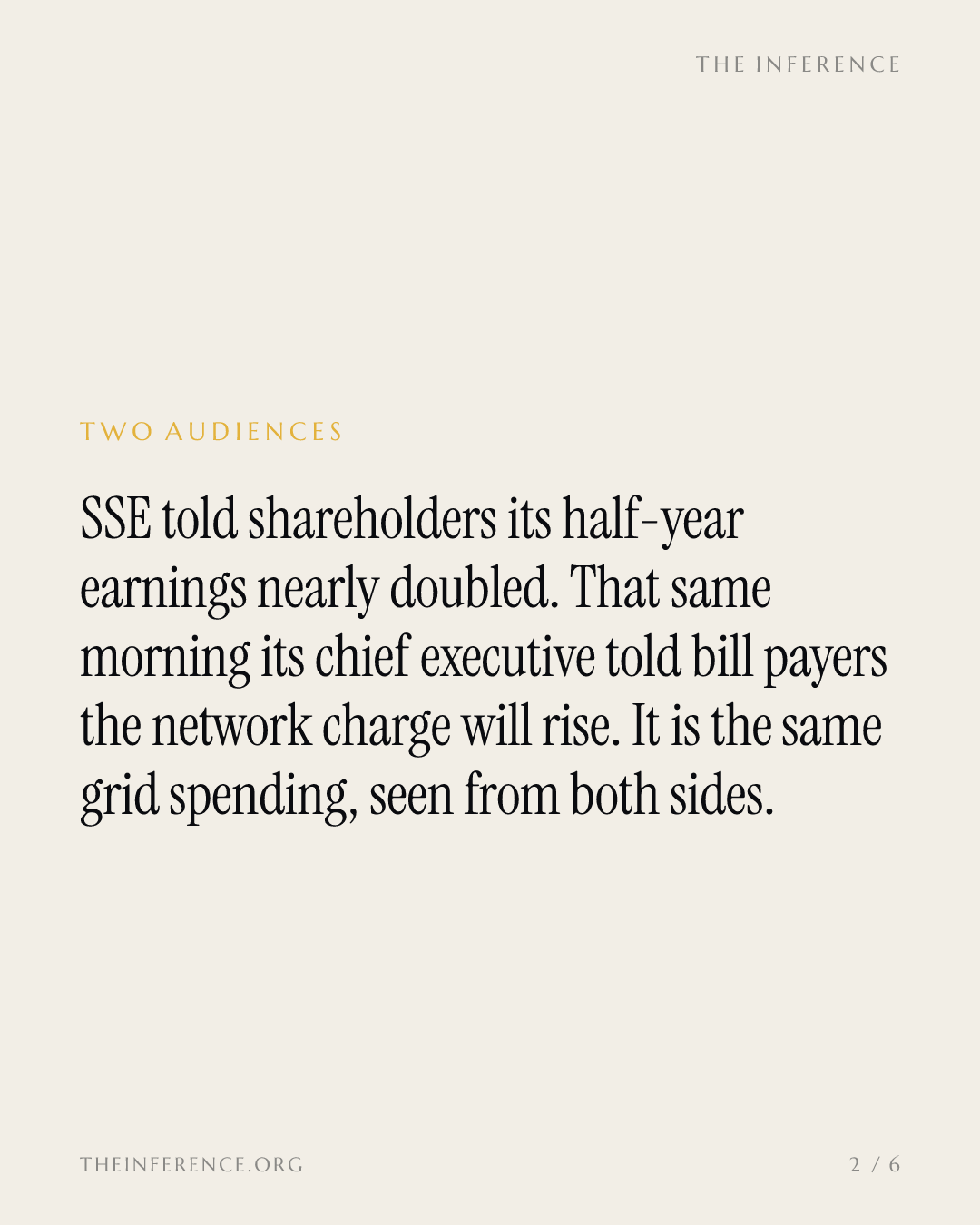
SSE published two documents on 1 October 12. The trading update told shareholders half-year adjusted earnings per share will land at 64 to 68p, against 36.1p in the same half a year earlier 13. The op-ed, signed by chief executive Martin Pibworth, told bill payers that renewables and grid investment are "the only viable recipe for stable, lower prices" 2. One company, one morning, two audiences.
Regulated networks are flattening the half-year seasons
Adjusted investment across regulated networks ran about 70% higher year on year, the majority in Transmission, where work is accelerating across 11 major projects 14. Renewable output rose about 20% on more favourable weather and new capacity 14.
Half-year capital investment lands around £2.5bn, with adjusted net debt and hybrid capital around £11.5bn 1. Full-year guidance holds: 168 to 193p for 2026/27, and 225 to 250p for 2029/30 18. Seasonality is fading, SSE says, because regulated networks now supply a growing share of earnings 1.
Behind it sits a £33bn, five-year plan to expand renewables and upgrade an ageing grid for rising demand 4. Guidance for the year to March 2026 was 147 to 152p, down from 160.9p the year before, as the buildout ran 5. Half-year results land on 18 November 1.
Earnings dip through the grid buildout, then SSE targets up to 250p by 2029/30
- Adjusted EPS
- Estimate
Data
| Adjusted EPS | |
|---|---|
| FY24/25 (reported) | 160.9p |
| FY25/26 (guide) (estimate) | 149.5p (147–152p) |
| FY26/27 (guide) (estimate) | 180.5p (168–193p) |
| FY29/30 (target) (estimate) | 237.5p (225–250p) |
The bill paper concedes the charge rises
Pibworth's case runs on three numbers: 70% of the past decade's bill increases came from inflation and commodity costs, not renewables or network costs 2. Gas prices have doubled since the Middle East crisis, and wholesale electricity is 30% cheaper than it would be without renewables 2.
Then the concession, in plain words: the grid must also absorb electric vehicles, AI data centres and air conditioning, so "the network element of energy bills will increase for a period" 2.
That is the same spending line producing the 70% investment jump 12. The AI buildout now runs through British network charges and into SSE's regulated asset base. Pibworth's answer is that the spending ends "wasted wind" and electrifies transport and heating 2.
The reform camp has a face and a deadline
Reform is not hypothetical. Bills reach a three-year high this winter as the price cap adds £60, taking the typical bill to £1,723 6. Ofgem's accounting of the £90bn grid programme puts the net cost at around £30 a year by 2031 6.
Andy Burnham's "buy British" grid guidance, laid before Parliament this month and effective 17 November unless either House votes it down, concedes a "short-term cost trade-off" 6. It also creates GB Grid, the first state-owned player in electricity networks since privatisation 6.
In August, a think-tank paper urging £137bn of network cuts took about 2% off SSE in days 7. The argument is unresolved, and SSE's guided earnings hold only if Pibworth's side wins it.
Two dates in November will price the argument
The 225 to 250p target is a bet on the bill settlement surviving, not on the weather 1. Two dates frame it: 17 November, when the guidance takes effect, and 18 November, when SSE reports 16. Winter weather and the Strait of Hormuz set the rest 12. The network charge on a British bill and the return on SSE's asset base are the same pounds, seen from two sides.
Deepdive
AI-generated from this story and its cited sources. Not investment advice.