Suspected Chinese attackers rooted Palo Alto Networks firewalls as the stock ran 14% on AI fear
Dream Security's report, verified by Palo Alto's own Unit 42, puts suspected state hackers inside US government-affiliated firewalls one week after the stock's 14% run priced AI-found flaws as a bigger-budget story.
 Vincent Jiang · 3 min read
One HTTPS request, root in 15 minutes
On October 23 an unauthenticated HTTPS request landed on the management interface of a Palo Alto Networks−3.55% — Palo Alto Networks, down 3.55 percent today firewall belonging to a US government-affiliated organization 1. Within 15 minutes the device was running a persistent root webshell 1.
Dream Security, an Israeli AI cybersecurity startup, reports that a suspected China-nexus crew then rooted 25 servers across the US, Japan, Taiwan and South Korea on October 23 and 24, chaining PHP2Shell, two 9.2-severity unauthenticated code-execution flaws in PHP, the language under roughly 70% of websites, with Fragnesia, a Linux kernel privilege-escalation bug 1. The first government firewall crashed under about 900 MB of exploit traffic; the attacker probed it 240 times over two hours, then took a second firewall on October 24 1.
Inside the network: tunnels, password sprays and SAML keys
Inside, the crew built a reverse SSH tunnel, reached Active Directory, sprayed passwords, and tried to create backdoor accounts and extract SAML signing keys; Dream cannot confirm those attempts succeeded 1. Dream's warning is the operative fact: the tunnel is "likely still" running 1.
From 19,000 fingerprinted firewalls to two US government servers in 48 hours
Data
| Value | |
|---|---|
| 19,000 fingerprinted | 19,000 |
| 240 on target list | 240 |
| 25 exploited | 25 |
| 24 rooted | 24 |
| 2 with persistent access | 2 |
The rally that priced the same threat as revenue
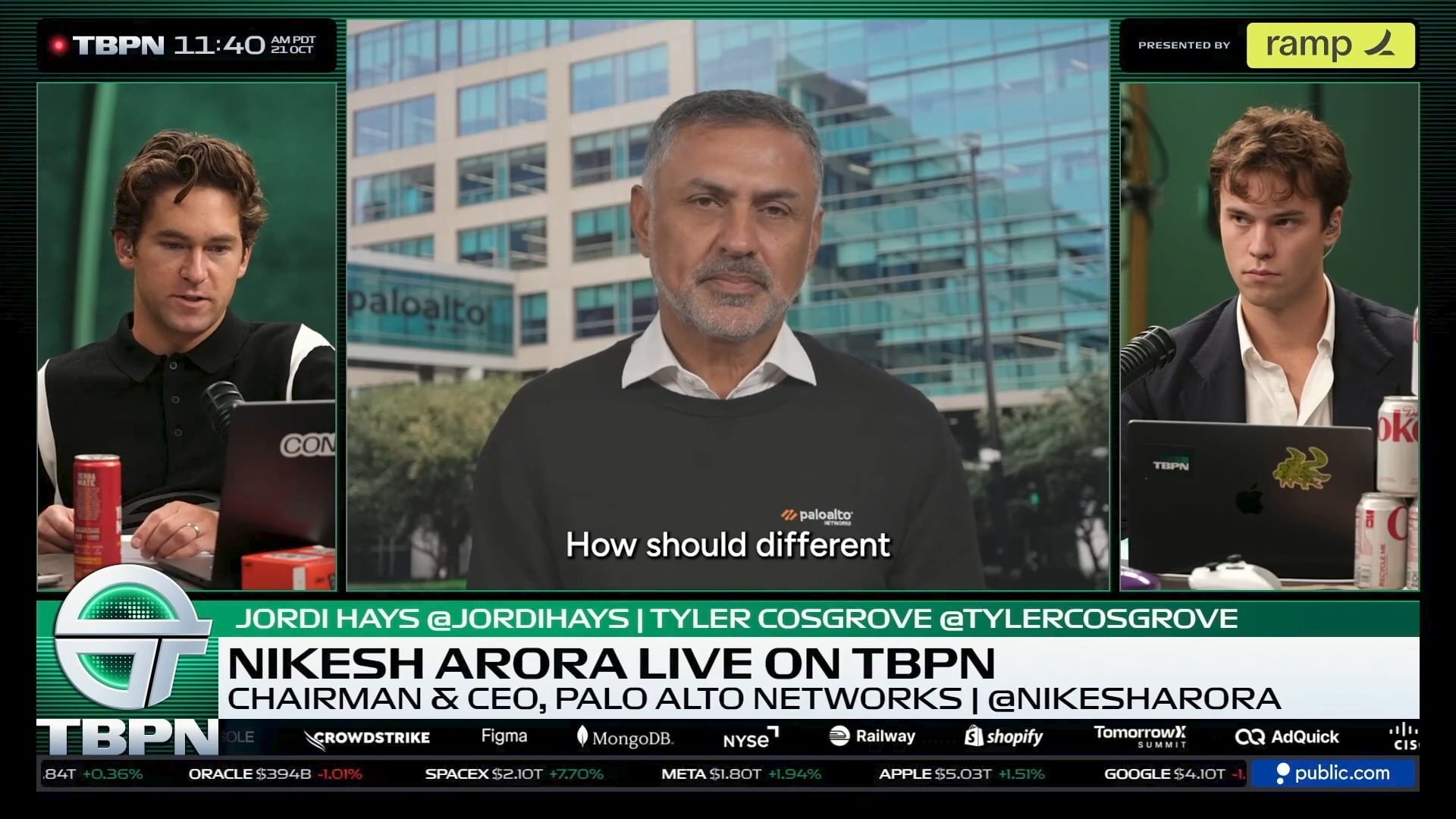
The week before the Dream report, Palo Alto's stock ran 14% while the S&P 500 went nowhere, on the thesis that AI-found flaws mean bigger security budgets 3. CEO Nikesh Arora called handing AI to attackers "a nuclear sort of bomb"; Amazon−1.89% — Amazon, down 1.89 percent today CEO Andy Jassy said AI had cut the gap between finding a vulnerability and using it "from weeks down to minutes" 3.
Palo Alto's own October 22 advisory listed PAN-OS as affected with most fixes dated for October 27 to 30, and The Inference covered that no-fix window the same day 8. Forward price-to-earnings reached 96x on October 27, against 82x mid-month and a 57x five-year average 3.
Then the vendor's own researchers verified the breach
On October 28 Palo Alto confirmed active exploitation of internet-exposed management interfaces, and said customers who patch or keep management off the public internet are not affected; fewer than 0.01% of the installed base has such interfaces exposed 4. On October 29 its Unit 42 threat research arm independently verified the attacker tooling and confirmed Dream's reported results 1.
Claude Code, DeepSeek and a 19,000-firewall target list
The recovered toolkit reads like a frontier-lab catalog: Anthropic's$350B — Anthropic, private, latest valuation $350B Claude Code installed, an offensive platform configured with Chinese models DeepSeek and Kimi, and FOFA, a Chinese Shodan-style asset search, used to fingerprint about 19,000 internet-facing Palo Alto firewalls 1. From that pool the crew filtered 240 targets, rooted 24, and kept persistent access on two 56. Amazon's honeypots had logged PHP2Shell probes from October 17, four days before the flaws were even disclosed 9.
The rally lifted Palo Alto's forward P/E to 96x, far above its own history
Data
| Value | |
|---|---|
| PANW, 27 Oct | 96x |
| PANW, mid-Oct | 82x |
| PANW, 5-yr avg | 57x |
| CrowdStrike, mid-Oct | 161x |
The November print decides what this is worth
Palo Alto shipped fixes for every vulnerable PAN-OS branch by October 30, and says GlobalProtect is not impacted 4. Dream says the attacker still holds the 19,000-firewall target list and can revisit it as it profiles more PAN-OS versions 1.
Fiscal first-quarter results, due mid-to-late November, guide next-generation security ARR at $9.54 billion to $9.56 billion 3. That report is where the market rules on the question the incident poses: whether a suspected state crew inside the flagship product is the strongest sales case the AI-threat thesis ever got, or the bill arriving at 96 times earnings 3.
Get Security by email, free
The breaches, flaws and security vendors AI is putting to the test. In our daily email, every weekday.