The Army signed $919 million of low-code ceilings; Appian's $500 million half carries no drawn dollar
Pega's $419 million sole-source IDIQ arrived on a filing; Appian's $500 million ceiling, signed in January, is the quiet half. The software the Army now fields runs agents, and both contracts price seats.
 Vincent Jiang · 3 min read

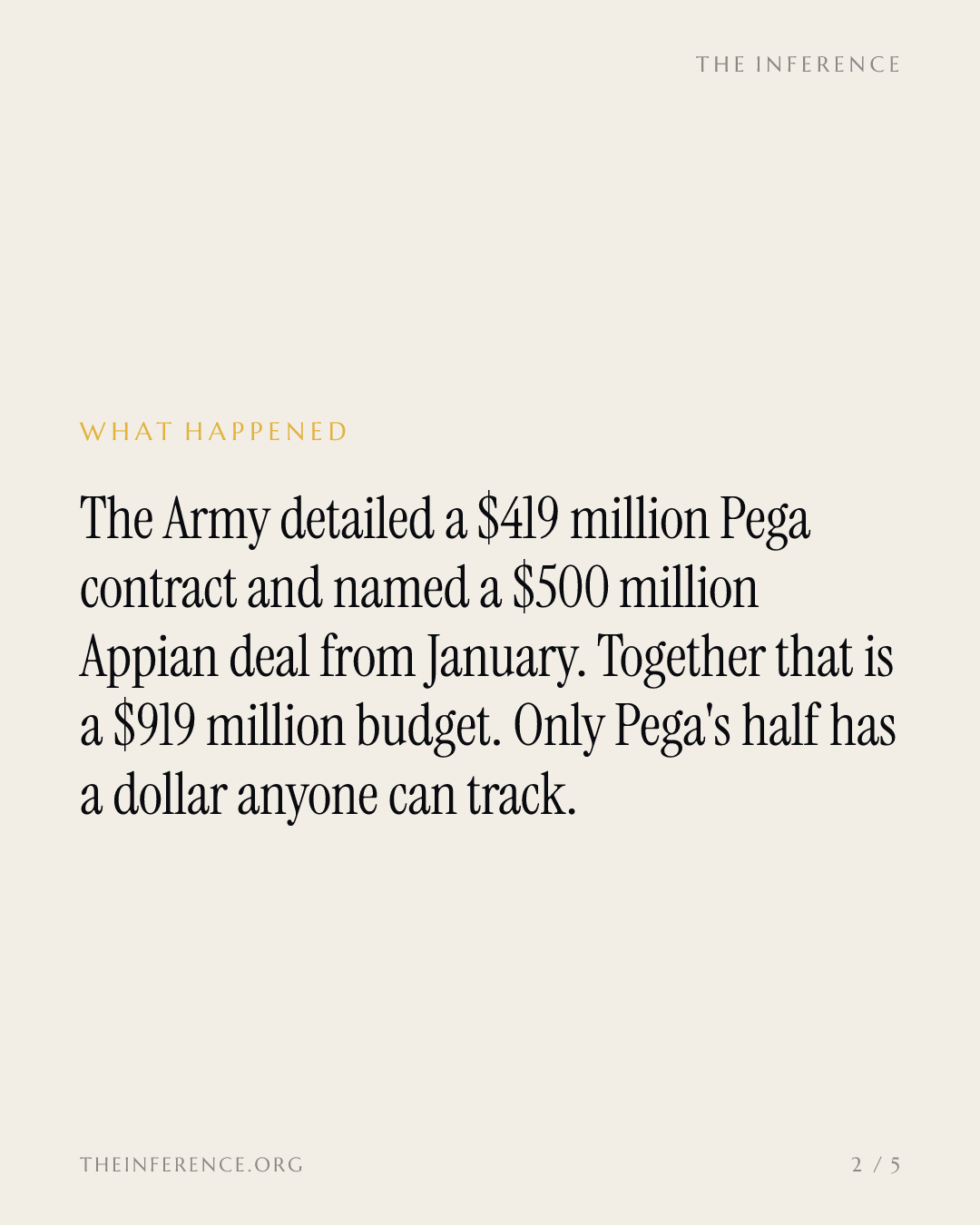
Pega's+3.95% — Pega's, up 3.95 percent today filing and Appian's+2.51% — Appian, up 2.51 percent today milestone landed three days apart, and together they price the Army's low-code budget at $919 million. Only one half of that carries a dollar anyone can track.
Two ceilings, one budget
The Army detailed a sole-source award to Pegasystems on November 2: a firm-fixed-price, indefinite-delivery/indefinite-quantity contract worth up to $419 million over ten years, covering subscriptions to the Pega Government Platform, Tier-3 premium support and outcome-priced services, with work running to October 28, 2036 1. IDIQ means a ceiling, not a check; orders fill it over time.
The same notice names the vehicle's other half: an enterprise agreement signed in January under which the Army may buy up to $500 million of Appian (Nasdaq: APPN) platform licenses, support and cloud services over the same ten years 1.
Both fit Army Secretary Dan Driscoll's August memo directing the service to prefer commercial software over custom code, and Capability Program Executive Enterprise Software and Services, the office behind the Pega deal, lists no-code and low-code tools among its fiscal 2026 priorities 1.
The half that carries no dollar
Appian spent October 29 showing its half is in production 2. The Appian Defense Cloud won Impact Level 5 authorization, the level that clears the Department of War's highest-sensitivity unclassified workloads 2.
On that cloud the Army fielded the initial release of TACTMIS, the Total Army Combat and Training Munitions Information System, the Army's authoritative system for munitions requirements, forecasting and expenditure reporting, built in 110 days from contract award for more than 10,000 users worldwide 3.
Appian counts over 2 million Defense Department and intelligence-community users, more than 100 mission platforms and 12 Army programs in production, with deployment volume up almost 4x in twelve months 2. Partners report the same direction: benefits processing times cut by 61% and 62% at one federal department, 70,000 hours saved at a major defense agency 4.
What no release carries is a price. Neither the IL5 announcement nor the TACTMIS announcement names a dollar figure, and Appian's latest quarterly results disclose no federal line 235. The January ceiling averages $50 million a year if drawn evenly 5. Appian's whole business ran at $203 million in the June quarter 5.
Appian's whole quarterly business grew from $150M to $203M; no federal line is disclosed
Data
| Total revenue | |
|---|---|
| Q1 '24 | $149.84M |
| Q2 '24 | $146.45M |
| Q3 '24 | $154.05M |
| Q4 '24 | $166.69M |
| Q1 '25 | $166.43M |
| Q2 '25 | $170.64M |
| Q3 '25 | $187M |
| Q4 '25 | $202.87M |
| Q1 '26 | $202.18M |
| Q2 '26 | $203.26M |
The Army bought seats; the software runs agents
The complication sits inside TACTMIS. Agent use there grew more than 25-fold in the first three months, as soldiers leaned on assistants for record searches across 14 operational grids, forecast summaries and weekly briefings 3. The enterprise agreement prices licenses, support and cloud services 1. Agents are usage inside the platform, not a line item in either vendor's federal pricing. A customer that renews on seats while its staff work through assistants holds renegotiation leverage at every renewal, and both vendors' revenue sits in exactly that seat-based math.
For a Pegasystems holder, the read that the Army is Pega's runs the award backwards: its half arrived on a sole-source filing after Appian's cloud already held the fielded work 12.
What November 5 answers
A ceiling is not revenue, and Driscoll's plan to fold hundreds more software deals into enterprise agreements is a lever for lower prices as much as higher volume 1. Appian reports third-quarter results on November 5 6, against full-year 2026 guidance of $845 million to $853 million in total revenue 5.
The number that would move the stock is not guidance. It is a federal dollar figure for the $500 million ceiling signed in January. Until management gives one, the fastest-growing thing Appian sells the Army is the one thing it does not price.
Get Deals by email, free
The acquisitions, rounds and contracts that move AI money. In our daily email, every weekday.