Workday agreed to buy identity startup ConductorOne without naming a price; Sana cost $1.1 billion last year
Workday agreed to buy identity startup ConductorOne, selling as C1.ai, without naming a price, put its Sana agents inside Claude and Copilot, and dated most of its new Autopilot agents for 2027. Shareholders must judge the agent story on a roadmap.
 Vincent Jiang · 3 min read
Three bets on governing agents, none priced
Workday's−1.03% — Workday, down 1.03 percent today new Talent Acquisition Agent watches a recruiter's queue of 25 open jobs before anyone logs in, and it reached early adopters on October 13 at Rising, the company's annual user conference in Las Vegas. 12 That autopilot was one of three announcements resting on the same bet: that companies will pay to keep AI agents inside company rules.
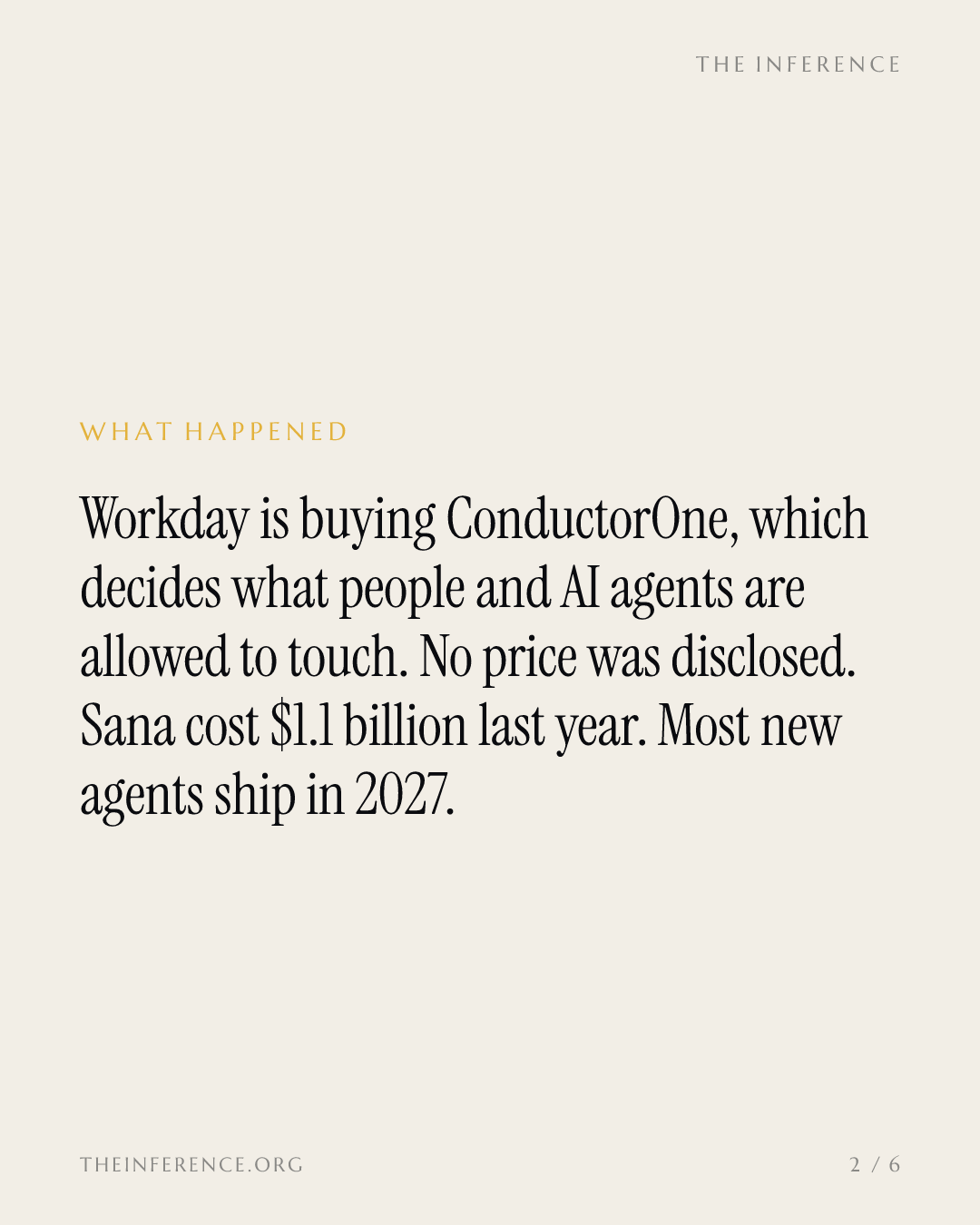
The other two arrived the same morning. Workday signed a definitive agreement on October 12 to buy ConductorOne, Inc., the startup selling as C1.ai, whose software decides which person or agent may touch which system, and disclosed it in a Form 8-K, the SEC filing required for material events. 34 Sana, the software that coordinates Workday's agents, will run inside Claude, Google Cloud's Gemini Enterprise, Microsoft+0.98% — Microsoft, up 0.98 percent today Copilot, Teams, and Slack. 5
Nothing in the filing or the announcement names a price. 34 Both give only a closing window, Workday's fiscal fourth quarter, which ends January 31, 2027. 34 A year ago the agent shopping carried numbers: $1.1 billion for Sana, after Paradox and Flowise. 6
The gap the acquisition sells into
The case for the purchase is a survey gap. C1.ai's Future of Identity Report, a March 2026 poll of 508 IT and security leaders at U.S. organizations with more than 1,000 employees, found 95% already run autonomous agents and only 22% report full visibility into their machine identities. 7 Deloitte, cited in Workday's release, puts mature governance at 21%. 4
Nearly every large U.S. company runs autonomous agents; about a fifth govern them
Data
| Value | |
|---|---|
| Run autonomous agents | 95% |
| Raised identity spending | 91% |
| More machine than human identities | 47% |
| Full visibility into machine identities | 22% |
| Mature agent governance (Deloitte) | 21% |
The front end belongs to rivals now
The announcements hand the interface to Anthropic$350B — Anthropic, private, latest valuation $350B, Microsoft, and Google while keeping the rules in Workday. No third-party tool reaches Workday data directly; every request goes through Sana, which applies the customer's permissions and records each action. 5
The tie with Anthropic runs both ways. Anthropic runs its own finance and people systems on Workday, and Workday's engineers build their products with Claude Code. 8
The installed base gives the bet somewhere to land. Nearly 5,000 of Workday's 11,500-plus customers have activated the Deployment Agent, and the payroll, accounting, and deployment autopilots are planned for early adopters only in early 2027. 1
Workday's revenue growth has slid from about 17% to about 13%
Data
| Revenue growth, % year over year | |
|---|---|
| Q3 '23 | 16.7% |
| Q4 '23 | 16.7% |
| Q1 '24 | 18.2% |
| Q2 '24 | 16.7% |
| Q3 '24 | 15.8% |
| Q4 '24 | 15% |
| Q1 '25 | 12.6% |
| Q2 '25 | 12.6% |
| Q3 '25 | 12.6% |
| Q4 '25 | 14.5% |
| Q1 '26 | 13.5% |
| Q2 '26 | 12.8% |
Buyers cannot budget what is not priced
The silence lands on the people who sign the purchase orders. Workday's release says customers can set how often agents run, to manage activity and cost as use grows; with no published prices, a buyer sizing a rollout has nothing to put in a budget. 1 Salesforce's+2.19% — Salesforce, up 2.19 percent today Agentforce has seen slow uptake over data readiness and IT budget gaps, TechTarget reported. 9
Josh Bersin, an independent HR analyst, told TechTarget that users are ready for the upgrade but "going to push back on the price," and that governance and orchestration are what vendors must solve first. 9
On October 6, six days before the signing, the trust of co-founder David Duffield sold 99,228 Workday shares for about $18.6 million, at weighted averages of $184.80 to $189.39, under a trading plan adopted in December 2025. 1011 The trust still holds 35.6 million Class B shares, so the sale is a sliver of the stake. 10
The readings that decide it
Revenue growth has cooled from 16.7% in late 2023 to 12.8% in the quarter ended July 2026, so the agent roadmap now carries the investment case. 12 Three readings decide it: the C1.ai close by January 31, 2027 3, Sana's general availability in Claude in late 2026 8, and the first disclosed price, in the closing papers or the next 10-Q. Workday has said when its agents ship; it has not said what any of them cost.
Deepdive
AI-generated from this story and its cited sources. Not investment advice.