Workday nearly doubles its cost of debt and leaves $1.5 billion of the raise unnamed
Workday closed a $2.5 billion four-tranche note sale on October 23 and named a use for $1 billion of it: retiring 3.500% notes from 2022. The swap lifts interest on the affected debt from $35 million to about $152.5 million a year, and more than half the raise sits unallocated on a balance sheet already drained by buybacks.
 Richard Tang · 3 min read
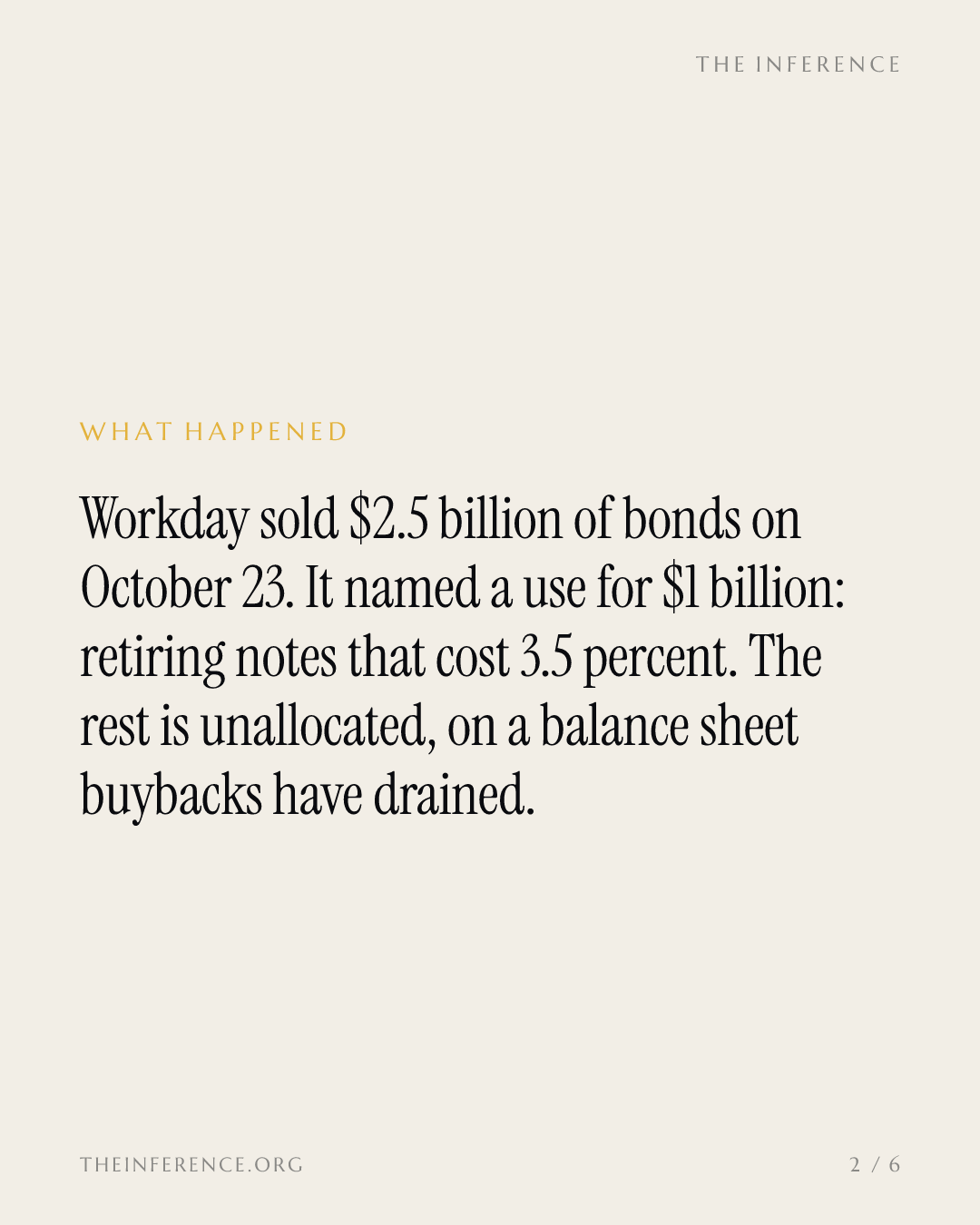
Workday+0.01% — Workday, up 0.01 percent today, which sells HR and finance software to more than 11,500 organizations, closed a $2.5 billion bond sale on October 23, and its own filing accounts for $1 billion of the money 12. That billion retires the 3.500% notes due next April 12.
The remainder, about $1.5 billion, goes to general corporate purposes, which the prospectus says may include working capital, capital spending, acquisitions and share repurchases, without committing to any of them 12. Workday's agent strategy is now showing up on its balance sheet: capital that costs roughly 6 percent a year, pointed at work the company has not yet specified 12.
The new debt costs nearly double what it replaces
The notes being retired come from Workday's April 2022 sale, $3.0 billion across three tranches at coupons of 3.500 to 3.800 percent, and the two longer 2022 tranches are still outstanding 3. Once the notes due 2027 are retired, Workday carries about $4.5 billion of total debt, the as-adjusted figure in its own prospectus 2. Interest on the swapped debt rises from $35 million a year to about $152.5 million 1.
Three of the four book-runners on this deal, the banks that organize and sell a bond offering, also ran the 2022 sale: Morgan Stanley−2.32% — Morgan Stanley, down 2.32 percent today, Bank of America's−0.88% — Bank of America, down 0.88 percent today BofA Securities and Wells Fargo−0.66% — Wells Fargo, down 0.66 percent today 23. Barclays−1.45% — Barclays, down 1.45 percent today, a passive book-runner in 2022, a named but lesser role, is a joint book-runner now 23.
The new notes cost 5.7 to 6.5 percent; the 2022 stack they join costs 3.5 to 3.8
Data
| Coupon | |
|---|---|
| 3.50% 2027 (retiring) | 3.5% |
| 3.70% 2029 | 3.7% |
| 3.80% 2032 | 3.8% |
| 5.70% 2029 | 5.7% |
| 6.00% 2031 | 6% |
| 6.30% 2033 | 6.3% |
| 6.50% 2036 | 6.5% |
The unallocated money lands on a balance sheet already draining
Cash and marketable securities have more than halved since January 2025, to $3.4 billion at the end of July 2. In the July quarter Workday spent $1.3 billion repurchasing 9.8 million shares, and its board authorized a fresh open-ended $4 billion buyback, while free cash flow came in below the year-ago quarter 4. It also agreed this month to buy the identity startup ConductorOne without naming a price 6. The pattern suggests the bond raise is what an open-ended buyback and unpriced acquisitions look like from the debt side.
Workday's liquid assets have more than halved since January 2025
Data
| Cash and marketable securities | |
|---|---|
| Jan 2025 | $8B |
| Jan 2026 | $5.4B |
| Jul 2026 | $3.4B |
A six percent coupon sets the bar for the agent business
Workday sells itself as the trusted agentic platform for HR, finance and IT, with agents that drive measurable outcomes 5. The coupon is the cleanest test of whether they do: agents, acquisitions and repurchases all have to clear roughly 6 percent, and cash sitting in treasury does not 5.
Workday's fiscal third quarter closes October 31, and the report on that quarter will be the first to carry the new debt 12. The question it has to answer is plain: what does the rest of the raise earn? A named acquisition, an agent product with revenue attached, or a buyback owned as a return of cash. Lenders collect their coupon whatever happens; shareholders only win if the answer clears roughly six percent.
Get Deals by email, free
The acquisitions, rounds and contracts that move AI money. In our daily email, every weekday.