Xiaomi Beat Apple by 48 Hours and Sold Out. Forecasts Still Hand Apple a Quarter of the Market.

Xiaomi's first wide foldable landed two days before Apple's event, thinner, cheaper, on its own 3nm silicon, and pre-orders emptied on day one. Then the arithmetic: it stops at China's border.

Vincent JiangVincent Jiangthree-minute read
Share
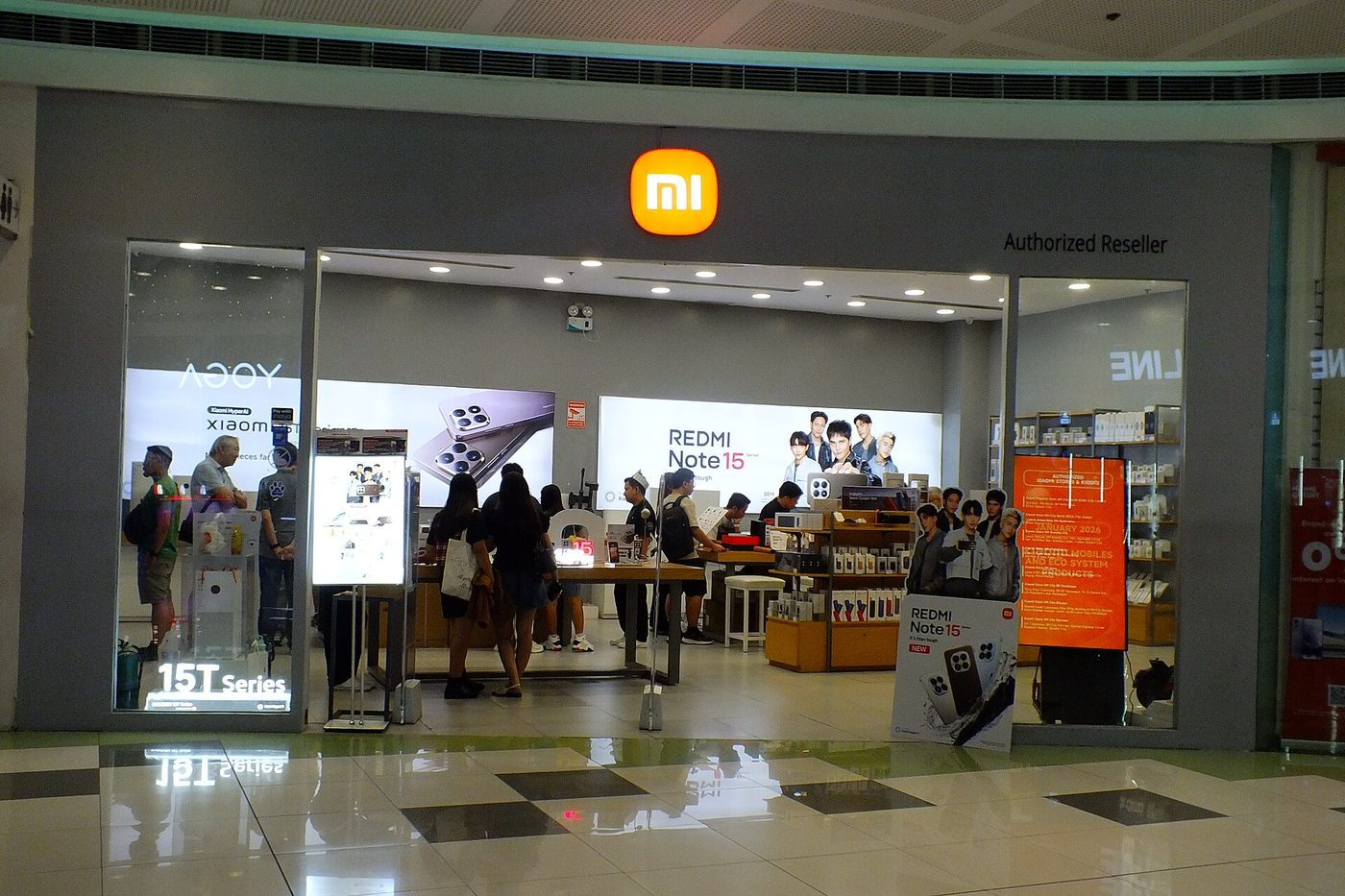
Shoppers browsing inside a brightly lit Xiaomi store in a shopping mall
Shoppers at a Xiaomi store in Pasay, Metro Manila. Xiaomi sells phones in more than 100 markets. The 18 Fold is not one of the products they can buy. Photo: Wide Awake!, January 18, 2026, CC BY 4.0.

Xiaomi+0.76% — Xiaomi, up 0.76 percent today put its first wide foldable on stage on September 7.1 Apple−0.73% — Apple, down 0.73 percent today opens its own event on September 9. Two days.

The hardware, side by side

The Xiaomi 18 Fold weighs 219 grams and measures 5.02mm open. Closed, it is 117.8 by 83.6mm. The inner screen runs 7.58 inches at 4,000 nits, the cover screen 5.38. A 6,000mAh cell takes 67W by cable and 50W without one. Leica tuned the 200-megapixel main camera and a 50-megapixel periscope.2,3

Apple's foldable is expected near $1,999, with two rear cameras, no telephoto, and 25W wireless charging.4

The price, and the sellout

Xiaomi's starts at 10,999 yuan, about $1,540.2 Pre-orders emptied on day one, with first-sale demand running 310% above the previous generation.5

On X, Ice Universe flagged it as the first phone anywhere to carry the O3 chip.6 Ben Geskin, holding one at IFA in Berlin, described a mini tablet that shuts to passport size.7

The chip is the real story

The engine is Xiaomi's own. The Xring O3 is a 3nm TSMC−5.95% — TSMC, down 5.95 percent today part carrying 24 billion transistors and a 200 TOPS neural engine. Xiaomi has committed 50 billion yuan, roughly $7 billion, to chip design over a decade.8
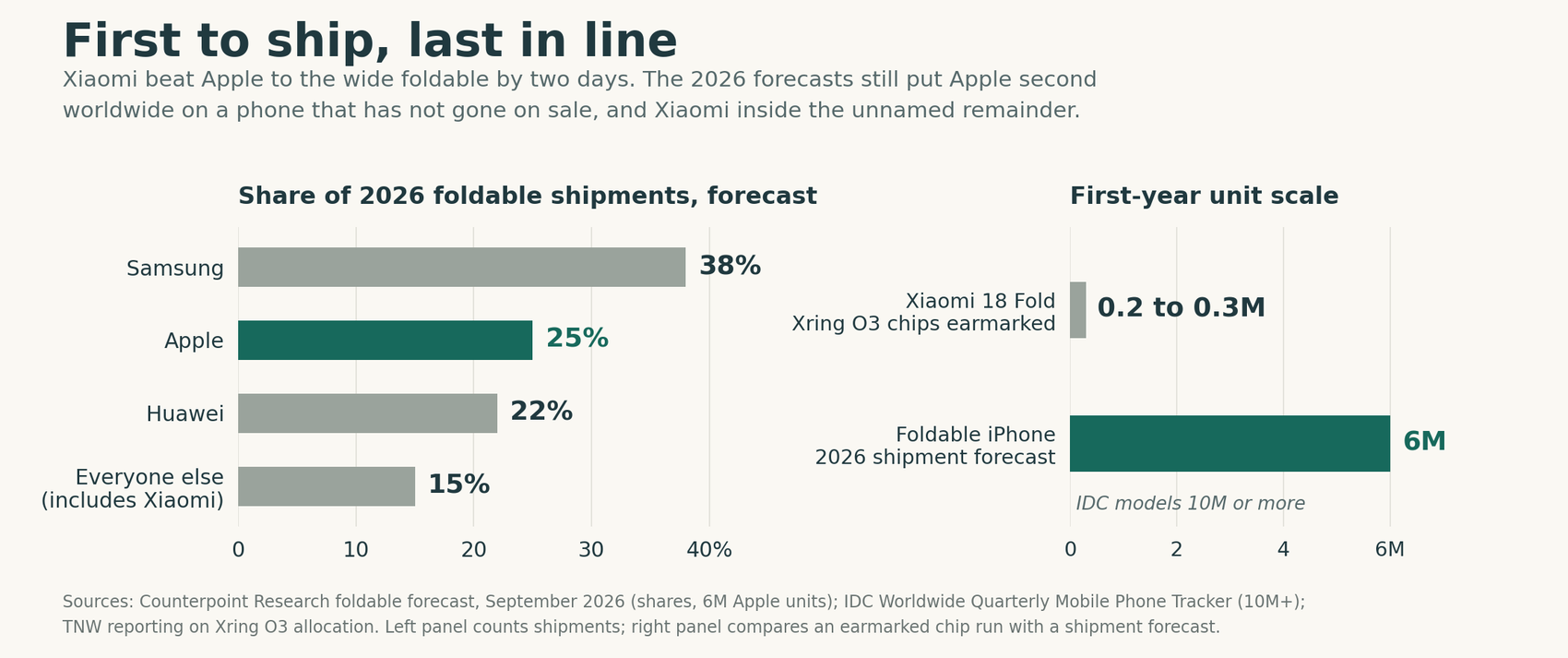
Two-panel chart. Left: forecast share of 2026 foldable shipments: Samsung 38%, Apple 25%, Huawei 22%, everyone else including Xiaomi 15%. Right: first-year unit scale: Xiaomi 18 Fold chips earmarked 0.2 to 0.3 million against a 6 million foldable iPhone forecast.
First to ship, last in line. Xiaomi arrived two days early and sold out, yet the forecasts seat Apple second worldwide on a phone nobody has bought, and file Xiaomi inside the unnamed remainder. Sources: Counterpoint Research, September 2026; IDC; TNW on Xring O3 allocation.

Then the arithmetic

Then the arithmetic. That silicon run is earmarked for 200,000 to 300,000 handsets9, and the 18 Fold stays inside China. Counterpoint puts Apple at 25% of 2026 foldable shipments, second to Samsung Electronics'−4.47% — Samsung Electronics, down 4.47 percent today 38%, on as many as six million units.10 IDC models more than ten million.11

“Supply, not demand, is expected to cap the early ramp.”
— Liz Lee, Counterpoint Research, on Apple

The sentence fits Xiaomi too, for a different reason.

Still a rounding error

Foldables are still near 2% of all smartphones. Xiaomi booked 108.9 billion yuan in second-quarter revenue on a record handset selling price of 1,351 yuan.12 Huawei answered the same Monday with the Mate XT2 trifold at 19,999 yuan.1

Xiaomi got there first, thinner, and cheaper. It stops at the border.

Get Applications by email, free

How AI is changing the software people and companies use. In our daily email, every weekday.
Loading AAPL

Reader comments

0 comments

    More in Applications

    All in this topic →

    Applications

    Four days after reaching ChatGPT's 1.2 billion users, Synthesia capped its free video tier at one a month

    OpenAI killed Sora in March, and a Synthesia plugin now fills the video slot inside ChatGPT, in front of the chatbot's 1.2 billion weekly users. Four days after launch, the $4 billion London company capped its free tier at one AI video a month.

    Applications

    Omnicom's creative networks lose leaders as $1 billion of its Interpublic merger savings come out of labor

    Omnicom's third quarter showed 7.2% organic growth and merger savings arriving on schedule, yet about $1 billion of the $1.5 billion program comes out of labor, and the labor works in the creative shops now shedding executives. December's quarter is the first test of both claims at once, and the answer reads through to Publicis and WPP.

    Applications

    Adobe will let rival AI agents into Photoshop only on terms that keep Adobe paid

    Adobe will host outside agents inside its apps while rival usage is billed on someone else's account, and its own research says 58% of the companies it talks to are stuck in an AI pilot or unable to deploy at scale. The December 9 report, the first under new CEO Anil Chakravarthy, tests which of the two explanations for Adobe's falling net-new ARR holds.

    Applications

    Chegg lost 40 percent of its revenue and stopped reporting subscribers

    AI wiped out the homework-help business and now builds its replacement cheaply. But the pivot is measured in site visits, the subscriber count has vanished, and a stock at $0.61 now faces two listing clocks.

    Applications

    October's record container imports flow straight into Descartes' December 2 quarter

    Descartes Systems Group bills per transaction on multiyear contracts, so the record October container volume its own report measured lands directly in the quarter it reports on December 2. The same surge is the risk if tariff front-loading unwinds.

    Applications

    Coursera trades just $113 million above its cash pile while its own buyback sits $71 million underwater

    The market pays about $113 million, under one times forward EBITDA, for a business guiding to $1.23 billion of revenue, because the merger math fails and management's own $215 million buyback sits $71 million underwater. A 14.7% holder and a poison pill set the collision date.

    Subscribe to TheInference for free